

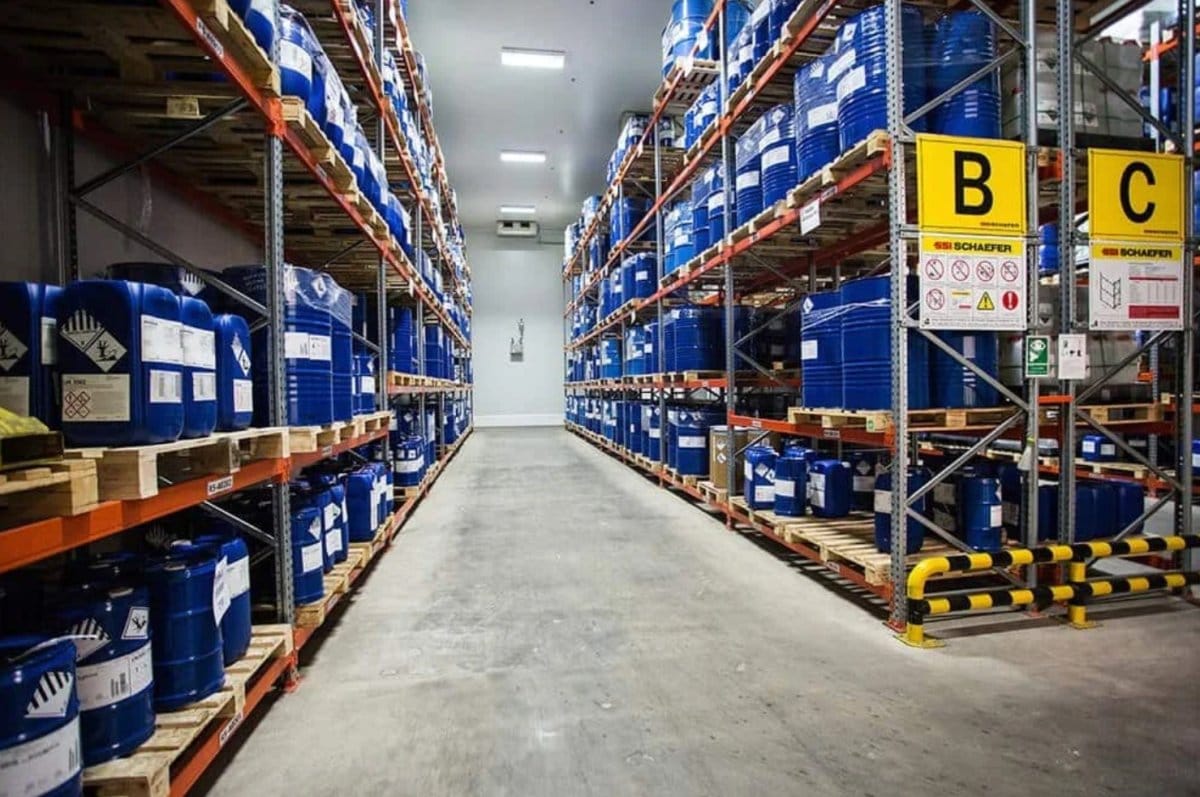
Did you know that a single litre of leaked lubricant has the potential to contaminate up to one million litres of water? While many industrial operators view warehouse management as a secondary concern, correct oil drum storage is the first stage of a proactive maintenance strategy that dictates the ISO cleanliness of your entire system. With the benchmark price for Group II base oil reaching approximately US$1,790 per tonne in 2026, protecting your fluid assets from environmental degradation is no longer just a compliance task; it’s a financial necessity.
We understand the frustration of seeing high-spec lubricants compromised by water ingress or oxidation before they even reach the machine. This professional guide provides a technical framework to help you master Australian storage requirements, including the critical bunding standards set by AS 1940:2017. You’ll learn how to establish a robust standard operating procedure that reduces oil analysis failures, avoids heavy environmental fines, and ensures your lubricants remain chemically stable from delivery to application. BioKem Oil Services is your partner in maintaining these standards and solving complex contamination challenges before they impact your operational uptime.
Key Takeaways
- Understand why “new” oil often fails ISO 4406 cleanliness standards and how storage directly impacts long-term asset reliability.
- Master the technical requirements for correct oil drum storage, including the “3 and 9 o’clock” rule to prevent moisture ingress caused by drum “breathing.”
- Navigate Australian compliance standards, specifically AS 1940:2017, to ensure your facility meets mandatory 110% bunding capacity for spill containment.
- Learn how to integrate oil analysis and kidney-loop filtration into your fluid handling process to guarantee integrity before system entry.
- Identify the environmental and operational risks of poor storage, from varnish formation to significant financial losses in a volatile 2026 lubricant market.
The Impact of Correct Oil Drum Storage on Asset Reliability
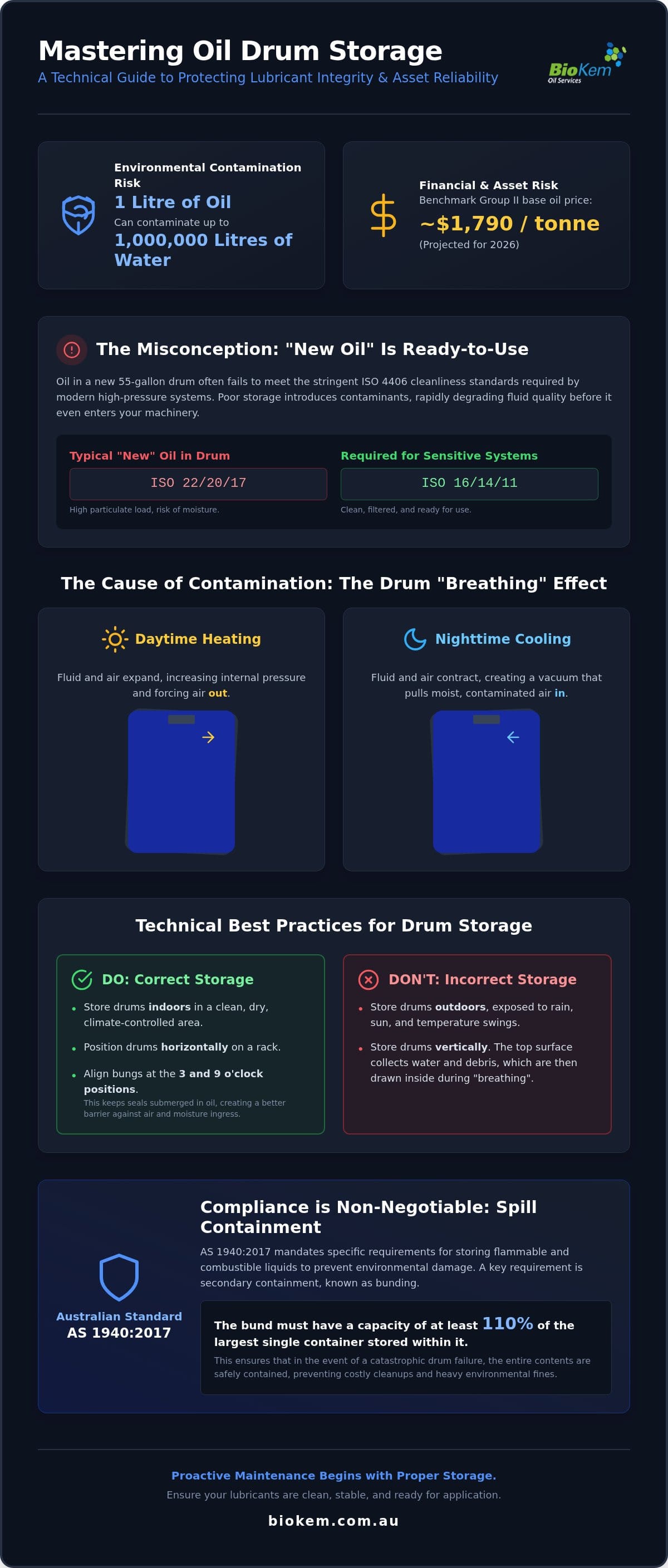
Correct oil drum storage is the systematic preservation of lubricant chemistry and ISO 4406 cleanliness levels from the moment of delivery. Many industrial operators work under the misconception that oil arriving in a standard 55-gallon drum is clean enough for immediate use. In reality, new oil often carries a particulate load that exceeds the tight tolerances of modern high-pressure hydraulic systems. When storage conditions allow for moisture ingress or dust accumulation, this baseline contamination worsens rapidly.
The financial cost of poor storage is rarely confined to the price of the oil itself. Particulates act as abrasive agents that accelerate component wear, while moisture triggers chemical reactions that shorten the fluid’s remaining useful life. Poorly managed stock directly undermines the success of high-level maintenance. If you’ve scheduled hot oil flushing for a new system, starting with contaminated drums forces the process to fight incoming particulate loads rather than simply removing construction debris. BioKem Oil Services positions correct storage as the foundation for these subsequent technical interventions, ensuring that your purification projects yield maximum results.
Lubricant Degradation and Oxidation
Improper storage environments accelerate the depletion of critical additives designed to protect your machinery. When drums are left in areas with extreme temperature fluctuations, the resulting thermal stress promotes oil oxidation. This chemical breakdown is the primary precursor to varnish formation. Effective varnish mitigation begins in the warehouse; by controlling the storage climate, you prevent the initial oxidative precursors that eventually coat internal valves and heat exchangers. BioKem Oil Services provides the technical expertise to identify these degradation markers through precise oil analysis.
The ISO 4406 Cleanliness Standard
The ISO 4406 code uses a three-digit format to represent particle counts per millilitre of fluid at 4, 6, and 14 microns. Reliability engineers use tools like the Particle Pal range to monitor these levels because they’re the primary indicators of system health. Maintaining these specific levels is essential because equipment manufacturers often specify cleanliness targets as a condition of their warranty. If storage-related contamination is detected during a failure analysis, a warranty claim can be denied. For a reliability engineer in 2026, ISO 4406 represents the most critical metric for quantifying fluid health and predicting the operational longevity of high-value machinery.
Managing the “Breathing” Effect: Indoor vs. Outdoor Storage
Correct oil drum storage requires an understanding of fluid dynamics that many warehouse managers overlook. A drum isn’t a static container; it’s a dynamic environment that interacts with its surroundings through a phenomenon known as “breathing.” As temperatures rise during the day, the air and lubricant inside the drum expand, increasing internal pressure. When the environment cools at night, the fluid contracts, creating a vacuum that draws in external air. Even with tight seals, moisture and microscopic particulates are pulled through the bung threads, compromising the fluid’s integrity before it ever reaches a machine.
While industry professionals often reference Used Oil Storage Regulations for environmental compliance, the same rigorous containment logic applies to fresh lubricants. Indoor, climate-controlled storage remains the gold standard for critical fluids. This environment shields drums from industrial dust, process steam, and the high-pressure washdowns common in heavy industry. If your facility’s oil analysis reveals that moisture has already compromised your stored stock, the team at BioKem Oil Services provides specialized filtration and dehydration services to restore the fluid to its required ISO 4406 cleanliness level.
Thermal Expansion and Moisture Ingress
Daily thermal cycles act as a pump for contaminants. In high-humidity environments, this process introduces water vapour that eventually condenses into liquid droplets. Because water is denser than oil, it settles at the bottom of the drum, creating a hidden reservoir of contamination. This is particularly damaging for high-performance synthetic oils, where trace moisture can trigger hydrolysis, permanently degrading the additive package and reducing the lubricant’s load-carrying capacity. BioKem Oil Services utilizes advanced testing to detect this emulsified water before it causes component failure.
Optimising Outdoor Storage Areas
If outdoor storage is unavoidable due to site constraints, you must implement a protocol to mitigate environmental exposure. Drums should never be placed directly on the ground; soil moisture accelerates base corrosion, while concrete facilitates rapid temperature transfer that worsens the breathing cycle. Utilise raised racking or pallets to maintain airflow and prevent water contact. For vertical storage, always use drum covers or “rain hats” to prevent water from pooling on the lid. If water is allowed to sit over the bungs, the cooling vacuum will suck liquid water directly into the lubricant, a much faster contamination route than simple humidity.
Technical Best Practices for Drum Positioning and Handling
Implementing a rigorous protocol for receiving and handling lubricants is as vital as the storage environment itself. Correct oil drum storage begins the moment a shipment arrives at your facility. We recommend a five step protocol for all new arrivals. First, inspect drums for transit damage or leaks. Second, verify that batch numbers and specifications match your procurement records. Third, clean the drum tops thoroughly to remove road grime and particulates. Fourth, log the arrival date to support strict inventory management. Finally, move the drum to its designated storage rack. This systematic approach aligns with global industrial safety frameworks, such as the Spill Prevention, Control, and Countermeasure (SPCC) guidelines, ensuring that potential leaks are identified before they escalate into environmental hazards.
Effective inventory management relies on the First In, First Out (FIFO) principle. Over time, heavy additives in certain high viscosity lubricants can begin to settle, a process known as additive fallout. By rotating stock, you ensure that fluids are used within their optimal shelf life. Additionally, implementing a colour coding system for different oil types prevents catastrophic cross contamination during dispensing. Using dedicated transfer pumps for each fluid class is a non negotiable requirement for maintaining the ISO 4406 cleanliness levels established during the initial filtration process.
The 3 and 9 O’Clock Bung Rule
For facilities using horizontal racking, the positioning of the drum bungs is critical for fluid preservation. When a drum is placed on its side, the bungs must be located at the 3 and 9 o’clock positions. This specific orientation ensures that the bung seals remain submerged in the lubricant. By keeping the seals covered in oil rather than air, you create a liquid barrier that significantly reduces the drum’s ability to breathe in moisture laden air during cooling cycles. Mechanically, horizontal storage also simplifies leak detection; a failing seal will immediately result in visible oil loss rather than silent air ingress. When transitioning from vertical to horizontal storage, utilize mechanical drum lifters to ensure the alignment is precise and the drum is secured against rolling.
Advanced Contamination Control Tools
Once a drum is opened for dispensing, it becomes highly vulnerable to ambient contamination. Standard bungs should be replaced with high efficiency desiccant breathers that strip moisture and particulates from the air entering the container. To verify that your handling procedures are working effectively, we recommend utilizing BioKem Oil Analysis Services before introducing any fluid to your critical machinery. Sampling the oil directly from the drum provides a technical baseline for fluid health and confirms that your correct oil drum storage protocols have successfully preserved the lubricant’s chemical integrity.
Australian Standards: AS 1940 and Spill Containment
Compliance with Australian regulations is the foundation of correct oil drum storage. AS 1940:2017, the primary standard for storing and handling flammable and combustible liquids, provides the technical framework for industrial facilities. Most lubricants are classified as combustible liquids, meaning they require specific containment strategies to mitigate fire risks and prevent environmental degradation. The EPA maintains a strict stance on hydrocarbon management because even a minor leak can have catastrophic consequences; a single litre of oil has the potential to contaminate one million litres of water. Failure to adhere to these standards doesn’t just risk the environment; it exposes your business to significant Category 1 WHS penalties, which have seen substantial increases as of 2026.
Secondary containment is a non-negotiable aspect of site safety. For a standard 205L drum, the bund must hold at least 110% of that volume, which equates to a minimum capacity of 226L. If you’re storing multiple containers, the bund must be able to hold 25% of the total volume or 110% of the largest container, whichever is greater. Managing ignition sources in lubrication rooms is equally critical. You must ensure that electrical fittings are compliant and that no “hot work” occurs near fluid storage areas. These measures ensure that your facility remains a safe, controlled environment for high-value fluid assets. Similar standards of care apply to residential waste management; for example, specialists like Lil’ Stinky Septic Service provide the necessary septic maintenance and pumping to protect local environments from hazardous leaks.
Selecting the right bunding material depends on your specific lubricant chemistry and the physical environment. Polyethylene bunds offer excellent resistance to corrosive additives, while steel bunds provide superior durability and fire resistance in heavy industrial settings. Maintenance is vital; if a bund fills with rainwater or debris, its effective capacity is compromised, leaving you vulnerable during a spill. In Australia, secondary containment is a mandatory legal requirement for all industrial sites to prevent hazardous hydrocarbons from entering the soil or local waterways.
Safety Data Sheets (SDS) and Signage
Your storage area must be clearly placarded to identify the hazards present. As we move through 2026, it’s essential that your Safety Data Sheets (SDS) are updated to reflect current Workplace Exposure Limits (WELs). These stricter limits mean that spill response training must include the use of high-specification respiratory PPE alongside standard absorbent materials. If your current storage setup lacks the necessary compliance hardware, you can explore BioKem’s range of specialist filtration and containment products to bring your facility up to standard. Regular staff training on spill kit deployment ensures that your team can act decisively to contain a breach before it reaches the environment.
From Storage to System: Ensuring Fluid Integrity
Transitioning oil from a warehouse to a high-pressure hydraulic system is the final, most critical phase of fluid management. Even when you’ve maintained correct oil drum storage, you can’t assume the lubricant is fit for service without technical verification. Contamination can occur during the final transfer process or as a result of unforeseen seal failures during the storage period. Reliability engineers in 2026 treat the drum as a potential source of risk until laboratory or onsite analysis proves otherwise. Sampling the fluid before it enters the reservoir ensures that your machine isn’t the first filter for your new oil.
Kidney-loop filtration serves as an essential “polishing” step for oil that has been stored for extended periods. This process utilizes external filtration units to circulate the oil through specialist filters, removing any particulates that settled or entered during the drum’s breathing cycles. If your oil analysis reveals that moisture has reached levels beyond the saturation point, standard filtration won’t suffice. In these instances, vacuum dehydration is required to remove dissolved and emulsified water, restoring the dielectric strength and chemical stability of the lubricant. This proactive approach ensures that the effectiveness of correct oil drum storage is verified before the fluid reaches critical components.
Pre-Use Oil Analysis
Utilizing patch test kits allows for immediate onsite visual confirmation of fluid cleanliness. This method provides a rapid snapshot of particulate levels, allowing technicians to compare drum samples against target ISO 4406 codes before application. Beyond simple cleanliness, analysis identifies signs of additive depletion or shelf-life expiration. If a lubricant has exceeded its recommended storage duration, its molecular structure may have changed, potentially voiding equipment warranties if used without remediation.
BioKem’s Remediation Solutions
When storage protocols fail or environmental conditions prove too extreme, professional intervention is necessary to salvage your fluid assets. BioKem provides national onsite oil purification services, including vacuum dehydration for moisture removal and varnish mitigation for lubricants stored in high-heat environments. These processes ensure that even compromised oil is returned to its peak operational state. To complement this, BioKem’s Hot Oil Flushing services ensure that the receiving system is chemically clean and free of construction debris or legacy contaminants. This holistic approach guarantees that your machinery starts its cycle with the highest possible fluid integrity.
Securing Your Fluid Assets for Long-Term Reliability
Implementing correct oil drum storage represents a fundamental shift from reactive warehouse management to proactive reliability engineering. By mastering technical positioning and environmental controls, you effectively prevent the ingress of moisture and particulates that lead to premature component failure. Adhering to the 110% bunding requirements of AS 1940:2017 ensures your facility remains compliant with Australian safety standards while protecting local ecosystems from hydrocarbon contamination.
When storage conditions fall short, professional remediation is the only way to safeguard your machinery. BioKem serves as the sole Australian distributor for Filters S.p.A. and provides specialist varnish mitigation and hot oil flushing services. We provide detailed laboratory reporting to ensure your fluids meet strict ISO 4406 compliance before they enter your critical systems. It’s essential to verify fluid health before any transfer occurs.
Contact BioKem Oil Services for Professional Oil Analysis and Purification to verify your fluid integrity today. Your commitment to technical excellence begins at the drum.
Frequently Asked Questions
Is engine oil classed as a dangerous good in Australia?
Most engine oils and lubricants aren’t classed as dangerous goods in Australia; they’re typically categorized as C2 combustible liquids. This means they have a flashpoint above 93°C and don’t require the same stringent placarding as flammable liquids. However, they’re still regulated under AS 1940:2017 for storage and handling. You must maintain proper secondary containment because these fluids represent a high risk to the environment if a spill occurs.
What is the “3 and 9 o’clock” position for oil drum storage?
This technical rule applies to horizontal storage where the drum’s two bungs are aligned horizontally at the 3 and 9 o’clock marks. This specific orientation ensures that the bung seals remain completely submerged in the lubricant. By keeping the seals covered in oil rather than air, you prevent the drum from drawing in moisture laden air during daily cooling cycles. This is a vital component of correct oil drum storage.
How long can oil be stored in a drum before it expires?
Most industrial lubricants have a shelf life of two to five years, but this varies based on the additive package. Highly additised fluids, such as extreme pressure oils, are more prone to additive fallout or chemical separation over time. It’s best practice to perform an oil analysis if a drum has been in storage for more than 24 months. This verifies that the fluid’s chemical integrity and performance characteristics are still within specification.
Can I store oil drums vertically if they are outside?
Vertical outdoor storage is generally discouraged because rainwater pools on the lid and is eventually drawn through the bungs during the cooling phase. If vertical storage is your only option, you must use drum covers or “rain hats” to deflect water. You can also tilt the drum slightly using a block to ensure water doesn’t sit directly over the bungs. However, correct oil drum storage usually dictates horizontal racking for any outdoor application.
What is the required bunding capacity for oil drum storage?
Australian standard AS 1940:2017 requires secondary containment to hold at least 110% of the largest container’s volume or 25% of the total volume stored, whichever is greater. For a single 205L drum, your bund must have a minimum capacity of 226L. It’s essential to keep your bunds clear of rainwater and debris. Accumulated liquid reduces the effective volume available to contain a spill, which can lead to non compliance during site inspections.
How does moisture get into a sealed oil drum?
Moisture enters through a process called thermal breathing. As ambient temperatures rise and fall, the air and oil inside the drum expand and contract, creating a pressure differential. This vacuum draws in external air through the bung threads, even if they’re tightly sealed. In humid environments, this air carries water vapour that condenses into liquid inside the drum. This water eventually settles at the bottom, leading to hidden contamination and potential additive hydrolysis.
Should I filter new oil before putting it into my machine?
You should always filter new oil because it rarely meets the ISO 4406 cleanliness standards required by modern high pressure systems. Contaminants often enter the fluid during the manufacturing process or through breathing during storage. Using a dedicated transfer pump with a high efficiency filter or a kidney loop system ensures you don’t introduce harmful particulates. Professional oil analysis is the only way to confirm the fluid meets your machinery’s target cleanliness code.
What Australian standard covers oil drum storage?
The primary standard is AS 1940:2017, which covers the storage and handling of flammable and combustible liquids. This standard outlines the technical requirements for spill containment, ventilation, and fire safety protocols in industrial environments. Compliance with this standard is a legal necessity for Australian operators in 2026. It ensures that your site minimizes environmental risks while protecting your fluid assets from degradation caused by improper handling or environmental exposure.