


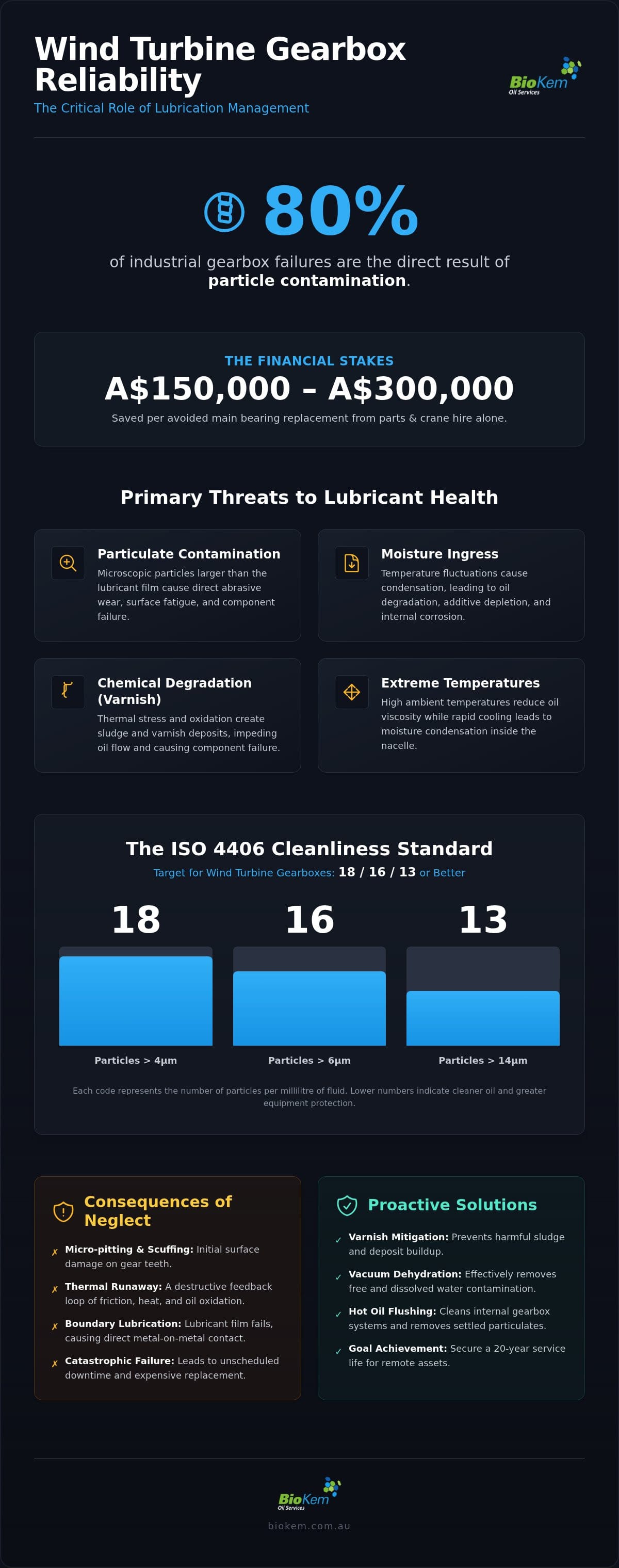
Approximately 80% of industrial gearbox failures are the direct result of particle contamination. For Australian wind farm operators, this statistic represents more than just a technical hurdle; it’s a significant financial risk. When a single avoided main bearing replacement can save between A$150,000 and A$300,000 in parts and crane hire, the stakes for precision maintenance couldn’t be higher. You likely already know that common problems with wind turbine gearbox lubrication, such as moisture ingress and particulate buildup, are the primary drivers of unscheduled downtime and premature oil degradation.
We recognise the complexities of managing remote assets where the cost of oil replacement and gearbox repairs can quickly spiral. This guide identifies the critical particulate, chemical, and environmental factors that compromise your turbine’s reliability. You’ll learn how to mitigate these risks through advanced lubrication management to maintain ISO 4406 cleanliness standards of 18/16/13 or better consistently. We will examine how proactive strategies like varnish mitigation and vacuum dehydration extend gearbox life and reduce oil consumption while supporting long term ecological health.
Key Takeaways
- Identify the technical triggers behind common problems with wind turbine gearbox lubrication, including the specific particulate and environmental factors that accelerate component fatigue.
- Master the ISO 4406 cleanliness standards required to protect high-torque assets and understand why maintaining a target of 18/16/13 is essential for reliability.
- Recognise the signs of varnish and chemical degradation in modern synthetic lubricants to implement effective mitigation strategies before irreversible damage occurs.
- Evaluate the role of advanced maintenance protocols, such as hot oil flushing and vacuum dehydration, in securing a 20-year service life for remote Australian wind farm installations.
Understanding the High-Stakes Environment of Wind Turbine Gearbox Lubrication
Wind turbine gearboxes operate under mechanical conditions that would compromise standard industrial equipment within hours. These systems must manage immense torque while rotating at relatively low speeds, a combination that places extreme pressure on internal components. In modern wind turbine gearbox design, the lubricant is the only barrier preventing catastrophic metal-to-metal contact. By 2026, high-performance synthetic lubricants have become the industry standard for these assets because they offer superior shear stability and thermal resistance compared to traditional mineral oils. These advanced formulations are engineered to withstand the rigorous duty cycles of renewable energy production, yet they remain vulnerable to degradation if environmental and mechanical stresses aren’t managed.
Addressing common problems with wind turbine gearbox lubrication requires a deep understanding of how external factors influence internal chemistry. In the Australian context, extreme temperature fluctuations present a significant challenge. When ambient temperatures spike, oil viscosity can drop below safe thresholds, while rapid cooling at night can lead to moisture condensation within the nacelle. These cycles don’t just affect the physical thickness of the oil; they accelerate the depletion of vital additive packages that protect the gear teeth from wear.
The Critical Role of the Lubrication Film
Elastohydrodynamic lubrication (EHL) is the primary mechanism protecting planetary gear sets. Under the intense pressure found at the gear mesh, the lubricant’s viscosity increases locally, creating a microscopic film that separates moving parts. However, variable wind speeds cause this film thickness to fluctuate constantly. For remote Australian assets, maintaining a high viscosity index is essential. This ensures the oil remains thick enough to provide protection during peak thermal loads while remaining fluid enough to circulate and filter effectively during cooler periods. Without this stability, the system enters boundary lubrication conditions where friction and wear increase exponentially.
Consequences of Lubrication Failure
When the lubrication film fails, the gear surfaces suffer immediate damage. Micro-pitting and scuffing are the typical early warning signs, appearing as frosted or dull areas on the gear teeth. If left unaddressed, these surface defects lead to thermal runaway, a condition where friction-induced heat accelerates oil oxidation. This creates a destructive feedback loop of increasing temperatures and rapidly degrading oil quality. The financial impact of such failures is substantial. While a proactive varnish mitigation strategy or regular hot oil flushing requires a modest investment, a single gearbox replacement can cost hundreds of thousands of dollars. Avoiding one main bearing failure can save between A$150,000 and A$300,000 in parts and crane hire, making precise lubrication management a cornerstone of operational profitability.
Particulate Contamination and the Breakdown of ISO Cleanliness Standards
Microscopic particles are often described as the silent killer of wind turbine reliability. While heavy debris is easily spotted during routine checks, it’s the particles invisible to the naked eye that inflict the most significant damage. These contaminants are often larger than the microscopic lubrication film separating gear teeth, leading to direct surface contact. According to the U.S. Department of Energy, surface-initiated fatigue and bearing issues are among the common causes of gearbox failure. Addressing common problems with wind turbine gearbox lubrication starts with recognising that particulate matter isn’t just a byproduct of wear; it’s a primary driver of it.
Decoding ISO 4406 for Wind Assets
The industry relies on the ISO 4406 standard to quantify oil cleanliness. This three-digit code represents the number of particles per millilitre at 4, 6, and 14 microns. Accurate quantification at these scales requires sophisticated instrumentation, such as the laser diffraction analyzers supported by Anka Analitik. For 2026 wind turbine gearboxes, the industry target is typically an ISO code of 18/16/13 or better. Maintaining this level of purity is challenging in remote Australian environments where dust and moisture are prevalent. When levels rise above these thresholds, the risk of component fatigue increases exponentially. Operators can use patch test kits for immediate onsite assessment, providing a visual confirmation of contamination levels between formal laboratory reports. Regular monitoring ensures that the oil’s protective qualities aren’t compromised by built-in debris from manufacturing or ingressed particles from the surrounding environment.
The Mechanism of Abrasive Wear
Abrasive wear occurs when hard particles become trapped between moving surfaces, a process known as three-body abrasion. These particles act like a grinding paste, scoring bearing races and gear teeth. This creates a destructive cycle where wear debris generates even more wear debris, rapidly degrading the lubricant’s effectiveness. High-performance filtration is the only way to break this cycle. By integrating Filters S.p.A. products, operators can capture sub-micron contaminants that standard inline filters often miss. Effective filtration must address several particle sources:
- Built-in Contamination: Residual sand, metal shavings, or dust left over from the manufacturing or commissioning process.
- Ingressed Contamination: Particles that enter the system through breathers, seals, or during oil top-ups in the field.
- Generated Wear: Microscopic metal particles shed from gears and bearings during normal operation, which then accelerate further damage.
Managing these threats requires more than just reactive filter changes. Utilising expert oil analysis ensures that these microscopic threats are identified before they lead to catastrophic component failure, ultimately protecting the A$150,000 to A$300,000 investment represented by the main bearing and gearbox assembly.
Moisture Ingress and the Chemical Degradation of Synthetic Lubricants
Humidity is a persistent adversary in the Australian wind sector. Coastal moisture and inland temperature swings create a constant cycle of condensation within the nacelle. This moisture doesn’t just sit on the surface; it migrates into the gear oil, triggering a series of chemical reactions that compromise the entire system. One of the most persistent common problems with wind turbine gearbox lubrication is this invisible moisture ingress, which can reduce the fatigue life of a bearing by up to 75% even at concentrations as low as 0.05%.
While moisture management is critical for wind turbines, it is equally important for the health of residential and commercial structures; if you are dealing with dampness or mould in your property, visit Subfloor Ventilation Sydney for professional guidance.
When water enters the lubricant, it initiates hydrolysis, a process where the water molecule reacts with the ester base or additive packages. This reaction doesn’t just deplete the protective additives; it also accelerates oxidation, leading to the formation of sludge and varnish. To ensure long-term reliability, operators must adhere to rigorous gear oil performance tests to verify that the lubricant can still handle the high-torque loads typical of 2026 wind assets. This chemical degradation is often irreversible once it reaches a certain threshold, making early detection vital.
Dissolved vs. Free Water: A Critical Distinction
Understanding the state of water within the oil is vital for effective maintenance. Water exists in three states: dissolved, emulsified, and free. Dissolved water is held within the oil’s molecular structure and is invisible to the naked eye. Once the oil reaches its saturation point, often around 500 ppm for synthetic gear oils, it becomes emulsified, giving the oil a cloudy appearance. Standard particulate filters are powerless against dissolved moisture. Removing this deep-seated contamination requires specialised equipment. Utilising vacuum dehydration is the most effective method for restoring oil dielectric strength and removing water at the molecular level before it transitions into damaging free water.
Additive Depletion and Acid Formation
The chemical fallout of moisture ingress is often measured through the Total Acid Number (TAN). As water reacts with the lubricant’s chemistry, it creates corrosive acidic byproducts that attack yellow metals and steel components alike. High acid levels are a precursor to hydrogen embrittlement, where hydrogen atoms liberated during the corrosion process migrate into the bearing steel, causing microscopic cracks and eventual spalling. Regular oil analysis allows technicians to track TAN levels and additive health, providing a safeguard against the common problems with wind turbine gearbox lubrication that stem from chemical instability. Technicians should monitor for a TAN exceeding 1.0 mg KOH/g, as this indicates the oil has reached a critical stage of degradation.
The Varnish Phenomenon: Identifying and Preventing Thermal Degradation
Varnish represents a sophisticated stage of oil degradation that often goes undetected by standard maintenance protocols. While particulate matter and moisture are frequently discussed, varnish is a sub-micron soft contaminant that evades standard mechanical filters. It begins as soluble oxidation products within the oil. As these products accumulate, they reach a saturation point where they transition into insoluble deposits. Common problems with wind turbine gearbox lubrication often escalate when these deposits adhere to internal surfaces, creating a sticky, resinous coating on critical components. Modern ‘Group III’ synthetic oils are particularly susceptible to this issue; while their high purity offers excellent stability, they have a lower solvency for polar oxidation byproducts compared to older mineral-based lubricants.
The operational impact of varnish is diverse and destructive. In gearbox coolers, varnish acts as an insulator, significantly reducing heat transfer efficiency and leading to higher operating temperatures. Within bearings, it narrows clearances and restricts oil flow, which can cause localised overheating. Perhaps most critically, varnish is a primary cause of sticking in the solenoid valves used for pitch and yaw control. When these valves fail to respond precisely, the turbine’s ability to optimise its position relative to the wind is compromised, leading to reduced power output and increased structural stress.
The Varnish Cycle in Remote Wind Farms
In the vast landscapes of Australia, extreme temperature swings accelerate the varnish cycle. During periods of high load, the oil’s capacity to hold oxidation products in solution increases. However, when the turbine slows or ambient temperatures drop overnight, the oil ‘dumps’ these contaminants onto cooler metal surfaces. To manage this, operators should move beyond simple particle counts and utilise the Membrane Patch Colorimetry (MPC) test. This specific analysis measures the varnish potential of the oil before deposits form. For assets showing elevated MPC values, implementing a varnish removal system is a vital step for maintaining long-term chemical stability and preventing unscheduled downtime.
Thermal Degradation Mechanisms
Two primary physical phenomena drive the formation of varnish in high-performance wind assets: micro-dieseling and electrostatic spark discharge. Micro-dieseling occurs when entrained air bubbles are rapidly compressed in high-pressure zones, such as the gear mesh, creating localised hotspots that reach temperatures exceeding 1,000°C. These hotspots cause immediate carbonisation of the surrounding oil. Separately, electrostatic spark discharge can occur in high-flow filtration systems where the friction of oil passing through non-conductive filter media generates static electricity. When this charge reaches a critical level, it sparks through the oil, causing molecular cracking and the formation of insoluble precursors. Recognising these triggers is essential for solving the common problems with wind turbine gearbox lubrication that lead to premature oil death. If your oil analysis indicates rising oxidation levels, consider our varnish mitigation solutions to restore your lubricant’s protective properties and protect your gear set.
Strategic Maintenance: Hot Oil Flushing and Dehydration Protocols
A simple oil change is often insufficient for solving common problems with wind turbine gearbox lubrication. When oil is drained, a significant percentage of contaminants remain trapped in the housing, on gear teeth, and within bearing races. These residuals, particularly the insoluble varnish and microscopic wear debris discussed previously, quickly contaminate the fresh charge of synthetic lubricant. Transitioning from a reactive “drain and fill” approach to a strategic maintenance protocol is essential for protecting Australian wind assets from premature failure.
The Hot Oil Flushing Process for Gearboxes
Hot oil flushing is the most effective method for removing built-in and generated contaminants. Unlike standard circulation, hot oil flushing utilises high-velocity, high-temperature fluid to achieve turbulent flow. This turbulence creates the mechanical energy necessary to dislodge particulates from internal surfaces. To verify the system’s cleanliness, we utilise paddle flushing screens, which provide a physical record of the debris removed during the process. BioKem’s flushing services are designed to ensure that gearboxes meet or exceed OEM cleanliness specifications before they are returned to service, whether during initial commissioning or following a major repair.
Implementing an Asset Longevity Strategy
A proactive maintenance strategy involves more than just periodic cleaning. For national wind fleets, scheduling annual vacuum dehydration is a cost-effective way to manage moisture ingress and maximise oil life. By removing dissolved water before it triggers hydrolysis, operators can prevent the chemical breakdown of expensive synthetic additive packages. Additionally, integrating high-beta ratio filters into the gearbox circuit ensures that the ISO 4406 target of 18/16/13 is maintained consistently. For remote sites where permanent installations aren’t feasible, BioKem offers equipment hire for temporary maintenance projects. This allows operators to perform intensive filtration and dehydration campaigns without the capital expense of permanent onsite hardware. Ultimately, the return on investment is clear: the cost of advanced fluid management is a fraction of the A$150,000 to A$300,000 required for a single main bearing replacement. Solving common problems with wind turbine gearbox lubrication through these advanced protocols ensures your assets reach their full 20-year design life.
Securing the Future of Australian Wind Assets
Maintaining the integrity of your fleet requires a transition from reactive repairs to proactive fluid management. By addressing the common problems with wind turbine gearbox lubrication, such as sub-micron varnish and moisture-induced hydrolysis, you protect your gear sets from the surface fatigue that leads to catastrophic failure. High-velocity hot oil flushing and vacuum dehydration are essential investments in achieving a 20-year design life. Precision matters. These protocols ensure that your lubricant remains a protective barrier rather than a carrier for contaminants.
As the sole Australian distributor for Filters S.p.A., BioKem Oil Services provides the technical expertise and comprehensive oil analysis required to keep your assets within OEM specifications. Our specialists deliver onsite varnish removal and hot oil flushing to ensure peak reliability for remote wind farm locations. Contact BioKem Oil Services for expert wind turbine lubrication management to optimise your maintenance strategy today. With the right technical partner, you can maintain consistent ISO cleanliness and ensure your turbines deliver sustainable energy for decades to come.
Frequently Asked Questions
What are the first signs of lubrication failure in a wind turbine gearbox?
Increased operating temperatures and rising vibration levels are the earliest physical indicators of a breakdown. You might also notice a darkening of the lubricant or a burnt odor, which signals advanced oxidation. Laboratory analysis often reveals rising metallic wear debris, such as iron or copper, and a shift in the Total Acid Number before mechanical symptoms become critical or irreversible.
How often should wind turbine gearbox oil be analysed?
Industry best practice for 2026 wind assets involves quarterly oil sampling and laboratory analysis. While preventative maintenance is typically performed semi-annually, quarterly checks identify common problems with wind turbine gearbox lubrication like moisture ingress or additive depletion early. This frequency allows operators to implement targeted interventions, such as vacuum dehydration, before the oil reaches a critical stage of chemical degradation.
What is the difference between mechanical filtration and varnish mitigation?
Mechanical filtration removes hard, insoluble particles like metal shavings and dust using physical media. In contrast, varnish mitigation targets sub-micron soft contaminants and soluble oxidation byproducts that pass directly through standard filters. While mechanical filtration protects against abrasive wear, varnish mitigation prevents the sticky deposits that insulate coolers and cause valve sticking in pitch and yaw control systems.
Can water contamination be removed from wind turbine oil without changing it?
Yes, vacuum dehydration effectively removes all three states of water, including dissolved, emulsified, and free moisture, without requiring an oil change. This process uses a vacuum to lower the boiling point of water, allowing it to evaporate at temperatures that don’t damage the synthetic base oil. It’s a sustainable alternative to oil disposal that restores the lubricant’s dielectric strength and load-carrying capacity onsite.
What ISO 4406 cleanliness level is required for wind turbine gearboxes?
The current industry target for modern wind turbine gearboxes is an ISO 4406 code of 18/16/13 or better. This standard measures the concentration of particles at 4, 6, and 14 microns per millilitre of fluid. Maintaining this level of purity is essential for preventing the surface-initiated fatigue and bearing spalling that accounts for a large portion of unscheduled maintenance costs in Australian wind farms.
Why does varnish cause solenoid valves to stick in wind turbines?
Varnish acts as a resinous, polar contaminant that adheres to the metal surfaces of valve spools and bores. As the oil cools or the system slows, these soluble oxidation products become insoluble, creating a sticky film. This film increases friction and narrows the tight tolerances required for precise solenoid operation. When valves stick, the turbine loses its ability to accurately control pitch and yaw movements.
What is hot oil flushing and when is it necessary for a gearbox?
Hot oil flushing is a high-velocity cleaning process that uses heated oil to create turbulent flow, dislodging residual contaminants from internal surfaces. It’s necessary during the commissioning of new turbines to remove manufacturing debris. It is also vital after a major component failure or gearbox repair to ensure that metallic fragments and degraded oil don’t contaminate the new lubricant charge.
How do environmental factors in Australia affect gearbox lubrication?
Australia’s extreme temperature cycles and high humidity levels accelerate condensation inside the nacelle. This moisture leads to hydrolysis, which breaks down synthetic additive packages and forms corrosive acids. Additionally, remote locations often expose systems to high levels of ambient dust. These common problems with wind turbine gearbox lubrication require robust filtration and proactive dehydration to maintain asset reliability in harsh conditions.