

At concentrations of 1000 ppm, hydrogen sulfide (H2S) can cause immediate collapse and respiratory failure. In the high-pressure environments of Australian offshore and onshore operations, implementing rigorous procedures for degassing sour oil is a non-negotiable priority for any site manager. You’re likely aware that H2S doesn’t just threaten lives; it’s also a primary driver of corrosive damage to turbines and storage systems. Balancing these safety concerns with the strict requirements of the Offshore Petroleum and Greenhouse Gas Storage (Safety) Regulations 2024 requires a methodical, technical approach.
Mastering these protocols is essential to maintaining both operational safety and asset integrity. This guide provides the technical expertise you need to manage volatile gases effectively while ensuring compliance with the latest Safe Work Australia exposure limits. We’ll examine the mechanics of vacuum dehydration as a primary degassing method, the role of specialized tank cleaning in removing sour sludge, and how laboratory oil analysis serves as the definitive proof of successful gas removal. By the end of this guide, you’ll have a clear framework for managing hazardous fluids while protecting your critical infrastructure.
Key Takeaways
- Understand the technical thresholds that define sour oil and why hydrogen sulfide poses extreme risks to both personnel and mechanical assets.
- Identify the primary procedures for degassing sour oil, including the critical role of pressure reduction and vacuum dehydration in removing volatile contaminants.
- Learn how to align your operations with Australian standards like AS 2865 and NOPSEMA guidelines to ensure safe confined space entry and continuous gas monitoring.
- Discover why laboratory oil analysis is the only definitive method to verify the success of gas removal and ensure ISO 4406 cleanliness levels are met.
- Explore how integrated tank cleaning and onsite fluid maintenance can eliminate sour sludge and restore the integrity of your critical infrastructure.
Understanding Sour Oil and the Risks of Dissolved Gases
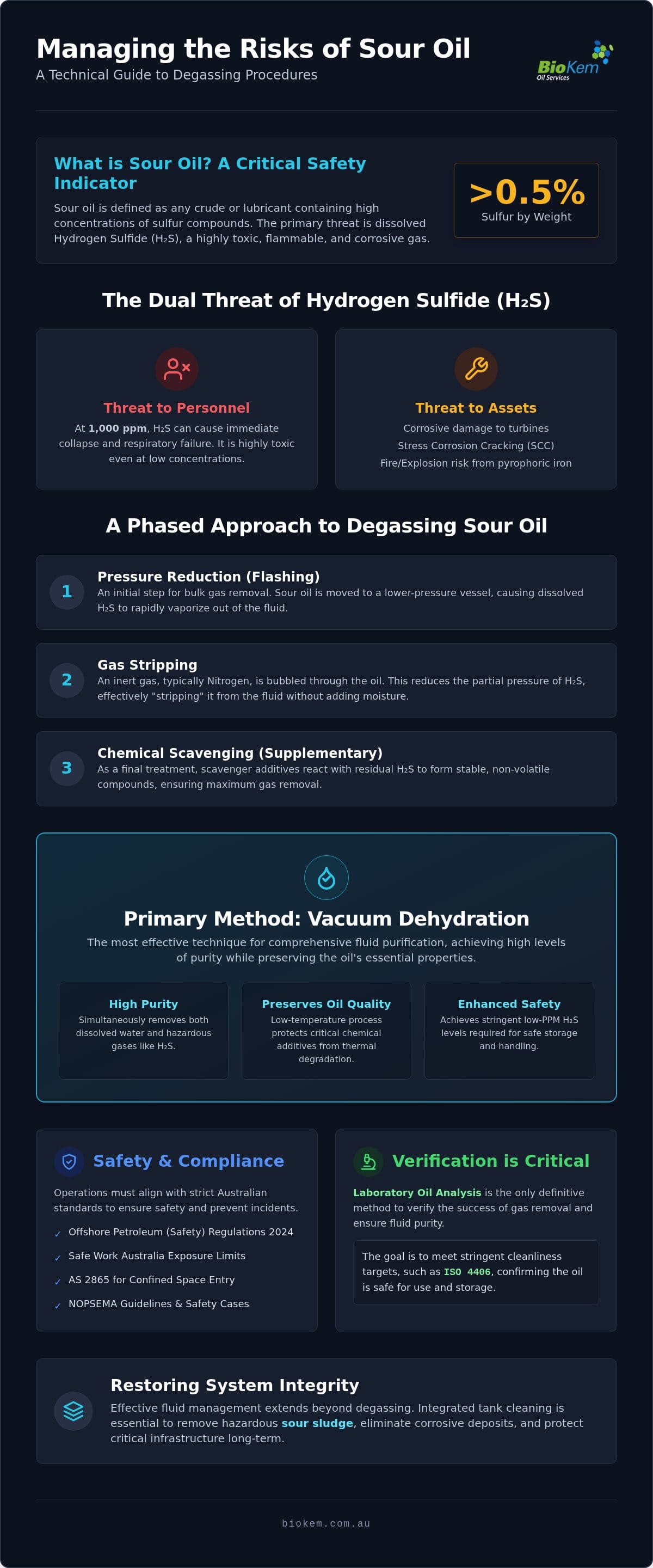
Sour oil is any crude or petroleum-based lubricant characterized by high concentrations of hydrogen sulfide (H2S) and other sulfur compounds. In the industrial context, a chemical threshold of greater than 0.5% sulfur by weight typically classifies a fluid as sour. This classification isn’t just a chemical label; it’s a critical safety indicator for site managers. Understanding Sour Oil is the first step in recognizing why specific procedures for degassing sour oil are mandatory for Australian operators to prevent asset degradation.
The presence of H2S introduces immediate physiological and mechanical hazards. From a safety perspective, H2S is highly toxic, even at low concentrations. It’s also flammable and can lead to the formation of pyrophoric iron sulfide within storage tanks and pipelines. These deposits can ignite spontaneously when exposed to air during maintenance, creating a high risk of fire or explosion. Beyond the immediate danger to personnel, dissolved gases compromise asset integrity through Stress Corrosion Cracking (SCC). This phenomenon causes sudden, brittle failure of high-strength alloys, potentially leading to catastrophic containment loss if the fluid isn’t treated correctly.
The Chemistry of Hydrogen Sulfide in Oil
H2S exhibits high solubility in various oil base stocks, particularly those with higher aromatic content. This solubility is highly sensitive to environmental changes. As temperature increases or pressure drops, the gas tends to liberate from the fluid, creating hazardous atmospheres in headspaces. The Henry’s Law constant for hydrogen sulfide in petroleum fluids defines the proportional relationship between the partial pressure of the gas above the liquid and its concentration within the oil at a constant temperature. This chemical equilibrium is why standard procedures for degassing sour oil often focus on manipulating pressure and temperature to force gas out of solution.
Operational Impacts of Non-Degassed Sour Oil
Leaving sour gases in the system has severe operational consequences. H2S reacts with moisture to form weak acids, which increase the total acid number (TAN) of the lubricant and reduce film strength. This leads to accelerated wear on critical components like turbines and compressors. Additionally, these gases act as catalysts for oxidation, promoting varnish formation in high-temperature systems. This varnish coats internal surfaces, restricting flow and causing valve sticking. For downstream processing, non-degassed fluids reduce equipment reliability and increase the frequency of unplanned maintenance shutdowns, impacting the long-term sustainability of the operation.
Core Procedures for Degassing Sour Oil Systems
Effective procedures for degassing sour oil integrate mechanical separation with chemical stabilization to ensure a safe, inert fluid. The initial phase often involves pressure reduction, commonly referred to as “flashing.” By directing sour oil into a lower-pressure vessel, the equilibrium shifts, causing dissolved H2S to rapidly evolve into a gas phase. This vapor is then safely managed through recovery units or flare systems. While flashing removes the bulk of the gas, it rarely achieves the low ppm levels required for safe long-term storage or transport.
To reach these stringent safety targets, operators utilize stripping gases like nitrogen or steam. Nitrogen is frequently the preferred medium in Australian industrial sites because it’s inert and doesn’t introduce moisture into the system. As nitrogen bubbles through the oil, it reduces the partial pressure of H2S, effectively “stripping” the toxic gas from the fluid. For systems with persistent residual sulfur, chemical scavenging serves as a supplementary treatment. These scavengers react with H2S molecules to form stable, non-volatile compounds, though careful monitoring is required to prevent these additives from affecting lubricant performance.
Vacuum Dehydration and Degassing
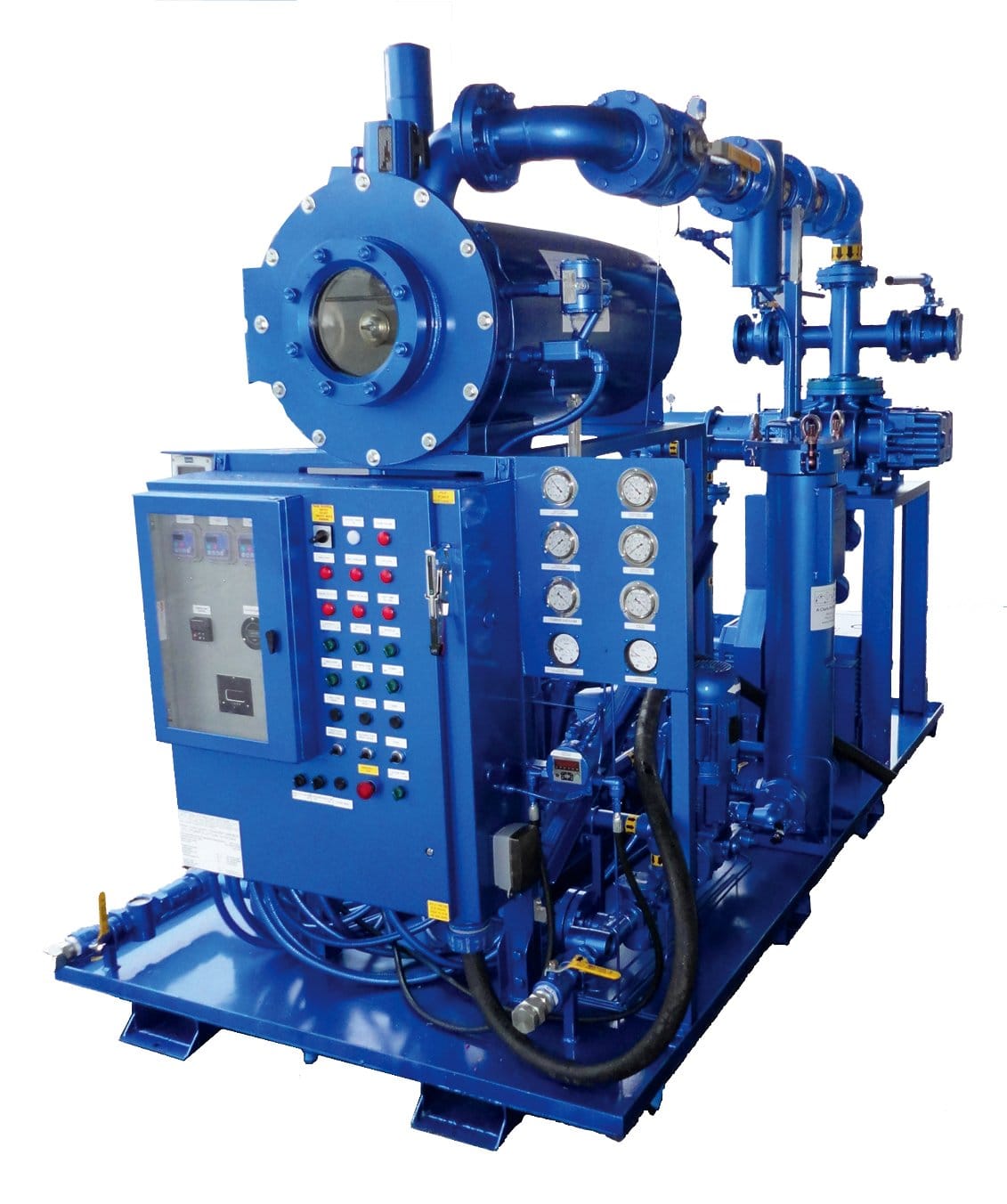
Vacuum dehydration stands as a primary mechanical method for comprehensive fluid purification. By creating a deep vacuum within a specialized chamber, the boiling point of both water and dissolved gases is lowered. This allows for the simultaneous removal of moisture and H2S without subjecting the oil to extreme temperatures. It’s a preferred method because it preserves the essential chemical additives within the oil while achieving high levels of purity. If your project requires immediate onsite capability, exploring vacuum dehydration equipment hire provides a scalable solution for managing contaminated inventories.
Thermal Degassing Techniques
Thermal degassing utilizes heat to reduce the solubility of H2S, accelerating its release from the oil. While effective, this technique requires a precise balance. Excessive heat can trigger thermal degradation and oxidation, leading to the varnish issues mentioned in previous sections. Safety is paramount here; heating volatile sour fluids increases headspace pressure and the risk of toxic exposure. Operators must maintain rigorous temperature controls and continuous gas monitoring to manage these risks. If you’re managing complex fluid inventories, BioKem offers specialized oil filtration and degassing solutions tailored to Australian regulatory requirements.
Safety Protocols and Australian Regulatory Standards
Safety in Australian oil and gas operations is governed by a strict hierarchy of controls designed to mitigate the extreme toxicity of hydrogen sulfide. When performing procedures for degassing sour oil, adherence to AS 2865 is mandatory for any task involving confined space entry, such as tank cleaning or internal inspections. This standard dictates rigorous atmospheric testing, permit-to-work systems, and the presence of a trained standby person. Given that H2S can cause respiratory failure within seconds at high concentrations, these protocols are legal requirements under state and Commonwealth work health and safety laws.
H2S Monitoring and Detection
Continuous monitoring requires a strategic array of both fixed and portable detection systems. Fixed H2S sensors should be positioned at low points where heavy gases accumulate and near potential leak sources like pump seals or venting valves. These sensors require regular calibration in sour environments to prevent the electrochemical cells from becoming desensitized. Alarm thresholds are typically set to trigger at the Safe Work Australia Workplace Exposure Standards: a 10 ppm Time-Weighted Average (TWA) for low-level alerts and a 15 ppm Short-Term Exposure Limit (STEL) for immediate evacuation. Personnel in high-risk zones must also utilize Self-Contained Breathing Apparatus (SCBA) to ensure a safe air supply during critical procedures.
Corrosion Management and Material Selection
The corrosive nature of sour fluids necessitates the use of NACE-compliant materials, specifically those meeting MR0175/ISO 15156 standards, for all degassing hardware. Even after the primary gas removal is complete, residual sulfur compounds can lead to the formation of acidic byproducts and varnish. Implementing varnish removal systems is a critical step in preventing these deposits from fouling sensitive control valves and sensors. Regular monitoring for internal corrosion in degassed storage assets ensures that the procedures for degassing sour oil have effectively mitigated the risk of Stress Corrosion Cracking (SCC) over the long term, protecting both the environment and the asset’s operational life.
Monitoring and Maintaining Degassed Oil Quality
Successful procedures for degassing sour oil conclude with a rigorous verification phase. Once the mechanical and chemical stages are complete, technicians must confirm that residual H2S levels fall below the 10 ppm threshold, aligning with Safe Work Australia exposure standards. This verification isn’t just about immediate safety; it’s a prerequisite for asset longevity. Undetected sulfur compounds continue to react with moisture, forming corrosive acids that degrade internal surfaces long after the initial treatment. Monitoring ISO 4406 cleanliness codes alongside sulfur content provides a comprehensive baseline for fluid health, ensuring that the degassing process hasn’t introduced or left behind particulate contamination.
Implementing a proactive maintenance strategy involves more than just gas removal. It requires a commitment to identifying the physical by-products of previous sour gas exposure. Particle counting serves as an early warning system, detecting the microscopic metallic debris that signals ongoing corrosion. By tracking these trends, site managers can intervene before a minor corrosion issue escalates into a catastrophic component failure, ultimately improving the environmental and operational sustainability of the entire system.
Laboratory Oil Analysis for Sour Systems
Laboratory oil analysis provides the high-fidelity data required for high-stakes industrial systems. Testing for Total Acid Number (TAN) reveals the extent of oxidation and acidic byproduct formation, while elemental sulfur analysis confirms the efficacy of the degassing treatment. To understand the physical impact on the machinery, technicians utilize filter ferrogram analysis to track asset health by examining wear particles. This forensic approach identifies specific alloy fragments, allowing operators to distinguish between expected wear and the brittle fractures associated with Stress Corrosion Cracking.
Onsite Verification Techniques
While laboratory results are definitive, onsite verification provides the real-time feedback necessary for immediate operational adjustments. Operators use patch test kits for immediate visual assessment of fluid contamination and varnish potential. For a more data-driven approach, real-time monitoring with particle pal technology allows for continuous tracking of ISO cleanliness levels. During active degassing operations, technicians should perform sampling every four hours to ensure the process is trending toward the desired purity levels without interruption. Integrated monitoring ensures your assets remain protected long after the initial treatment. You can verify complete compliance and fluid integrity by scheduling a comprehensive oil analysis and verification program with BioKem’s specialist laboratory.
Specialized Solutions for Sour Fluid Management
BioKem Oil Services provides a technical framework for Australian operators facing complex sulfur challenges. We integrate onsite vacuum dehydration with comprehensive tank cleaning to address the root causes of contamination. While previous sections detailed the technical procedures for degassing sour oil, the practical execution requires specialized hardware and local expertise to navigate NOPSEMA and state-based safety requirements. Our consultative support ensures that every stage, from initial gas stripping to final laboratory verification, aligns with regional environmental standards and operational goals.
Integrated services are particularly vital for critical storage assets where sour sludge has accumulated over time. This sludge often harbors high concentrations of H2S and pyrophoric iron sulfide, making standard fluid replacement ineffective and dangerous. By combining specialized tank cleaning with advanced degassing, we remove these hazardous residues entirely. Utilizing high-performance Filters S.p.A. hardware allows for precise particulate control, ensuring the system returns to service with a significantly lower risk of future asset degradation and Stress Corrosion Cracking.
For projects that extend beyond fluid maintenance into full site remediation or the safe removal of contaminated industrial structures, Rapid Demolition provides professional demolition and hazardous material handling services across New South Wales.
Onsite Degassing and Hot Oil Flushing
For comprehensive system decontamination, we often combine degassing with hot oil flushing. This dual-action approach removes dissolved gases while simultaneously scouring internal pipework of sulfur-related deposits and varnish. BioKem Oil Services maintains national deployment capabilities, allowing for rapid emergency degassing responses across Australia. This ensures that even in remote offshore or onshore locations, operators can achieve the necessary system cleanliness before returning critical machinery to active service, reducing the likelihood of unplanned downtime.
Equipment Hire for Degassing Projects
Large-scale maintenance shutdowns or specialized decontamination projects often require high-performance vacuum dehydrators on a project basis. Our equipment hire service provides Australian operators with access to industry-leading purification technology without the capital expenditure of a permanent installation. We provide full technical support and onsite training for personnel to ensure that all procedures for degassing sour oil are executed safely and efficiently. For ongoing maintenance requirements, we provide direct Filters S.p.A. Australian distribution for replacement elements and specialized filtration components, ensuring your systems maintain peak performance throughout their operational lifecycle.
Advancing Asset Integrity Through Rigorous Degassing
Securing industrial assets against the volatile nature of hydrogen sulfide requires a methodical and technically sound approach. This guide has detailed how integrating mechanical vacuum dehydration with precise chemical monitoring creates a stable operational environment. Implementing standardized procedures for degassing sour oil isn’t just a regulatory mandate under Australian safety standards; it’s a fundamental requirement for preventing Stress Corrosion Cracking and maintaining lubricant performance. By prioritizing these protocols, site managers protect both their personnel and their critical infrastructure from the high costs of corrosive failure.
BioKem provides the specialized expertise and hardware necessary to execute these complex operations. As an authorized Australian distributor for Filters S.p.A., we offer high-performance filtration systems backed by NATA-aligned laboratory oil analysis reports. Our comprehensive national onsite service deployment ensures that your facility receives expert support regardless of location. Contact BioKem for Specialist Degassing and Oil Purification Services to discuss a tailored solution for your sour fluid management needs. Taking proactive steps today ensures a safer, more sustainable future for your industrial operations.
Frequently Asked Questions
What is the most effective method for degassing sour oil?
The most effective approach combines pressure reduction with vacuum dehydration. This mechanical sequence forces dissolved hydrogen sulfide out of solution by manipulating the boiling point of the gases. Using vacuum-based systems is preferred in Australian industrial environments because it removes contaminants without subjecting the oil to the thermal stress of extreme heating. This method ensures the environmental and operational integrity of the fluid is maintained throughout the process.
How does hydrogen sulfide affect industrial lubrication systems?
Hydrogen sulfide reacts with system moisture to form weak acids that elevate the Total Acid Number and reduce the lubricant’s film strength. This chemical shift leads to accelerated component wear and the formation of heavy varnish deposits. Perhaps most critically, H2S causes Stress Corrosion Cracking in high-strength metal alloys. This can result in the sudden, brittle failure of critical assets like turbine rotors and pump seals if left untreated.
What are the Australian safety standards for handling sour oil?
Operators must adhere to AS 2865 for all confined space entries and Safe Work Australia’s Workplace Exposure Standards. These regulations establish a 10 ppm Time-Weighted Average and a 15 ppm Short-Term Exposure Limit for H2S. Offshore facilities are further governed by the Offshore Petroleum and Greenhouse Gas Storage (Safety) Regulations 2024, which are strictly overseen by NOPSEMA to ensure personnel safety and environmental compliance.
Can vacuum dehydration remove H2S from oil?
Yes, vacuum dehydration is a core component of the procedures for degassing sour oil. By creating a deep vacuum within a specialized chamber, the system lowers the vapor pressure of dissolved gases, allowing H2S to be liberated and safely extracted. This process is highly efficient as it simultaneously removes water, which prevents the formation of corrosive sulfuric acid and helps maintain the long-term stability of the lubricant.
How often should sour oil be analysed for gas content?
During active procedures for degassing sour oil, technicians should perform sampling every four hours to verify the rate of gas removal. Once the system reaches a stable state, monthly or quarterly laboratory analysis is recommended to ensure no re-contamination occurs. Continuous gas monitoring arrays must also remain operational in the headspace of storage tanks to detect any gas re-evolution from residual sludge or stagnant fluid pockets.
What is the role of chemical scavengers in degassing?
Chemical scavengers serve as a supplementary treatment by reacting with residual hydrogen sulfide to form stable, non-volatile compounds. They’re typically used when mechanical methods alone cannot reach the ultra-low ppm thresholds required for specific transport or storage applications. Site managers must carefully select scavengers that won’t interfere with the oil’s existing additive package or lead to the formation of secondary precipitates that could foul fine filtration systems.
Why is tank cleaning necessary during the degassing process?
Tank cleaning is necessary because sour sludge at the bottom of storage vessels often contains high concentrations of trapped H2S and pyrophoric iron sulfide. If this sludge isn’t physically removed, it will continuously re-contaminate fresh oil and release toxic vapors during maintenance activities. Integrated tank cleaning ensures a complete decontamination of the asset, preventing the rapid return of sour conditions once the primary degassing operation is finished.
What PPE is required for personnel performing degassing procedures?
Personnel must utilize specialized PPE, including Self-Contained Breathing Apparatus or supplied-air respirators in high-risk zones where gas concentrations may exceed exposure limits. Standard requirements include H2S-resistant gloves, chemical-resistant goggles, and personal gas detectors with audible alarms. All protective equipment must be maintained and calibrated according to Australian regulatory requirements to provide reliable protection during the management of hazardous sour fluids.