

A standard oil change is often the fastest way to ensure your equipment fails to reach its next scheduled maintenance interval. While draining and refilling fluid might seem sufficient, it does nothing to remove the sub-micron particulate and varnish precursors that settle in critical control valves. This is precisely why Solar turbines need to be oil flushed in accordance with Solar ES2184 before commissioning or after major overhauls. Relying on static fluid replacement leaves your bearings vulnerable to premature wear and risks your warranty standing.
We recognize the frustration of battling persistent varnish or failing to meet strict OEM cleanliness targets during critical commissioning phases. You’ll learn why professional high-velocity hot oil flushing is a physics-based requirement for removing contaminants that standard filtration cannot reach. This guide explains how achieving the mandatory ISO 16/14/12 cleanliness level through specialized equipment hire and oil analysis extends your mean time between failures. We’ll also preview how varnish mitigation and specialist oil filters protect your turbine’s longevity while supporting long-term operational efficiency.
Key Takeaways
- Understand the mandatory ISO 16/14/12 cleanliness standard required by Solar ES2184 to ensure system integrity during commissioning and major overhauls.
- Discover why Solar turbines need to be oil flushed in accordance with Solar ES2184 using Reynolds Numbers above 4,000 to achieve the turbulent flow necessary for scouring contaminants.
- Learn how varnish mitigation strategies address sub-micron particles that standard filters miss, preventing valve sticking and bearing failure.
- Explore the technical process of using external hot oil flushing rigs and specialized equipment hire to protect sensitive turbine components during maintenance.
- Ensure full warranty compliance and support long-term operational health by extending equipment life through precise oil analysis and documented cleanliness.
What is Solar ES2184 and Why is it Critical for Turbomachinery?
Solar ES2184 represents the proprietary engineering specification established by Solar Turbines to govern the decontamination of lubrication systems. It’s a rigorous protocol designed to ensure that the internal environment of the lube oil system is free from harmful debris before the turbine is ever engaged. This standard applies throughout the entire operational lifecycle, including initial commissioning, major overhauls, and during transitions between different oil brands. Understanding why Solar turbines need to be oil flushed in accordance with Solar ES2184 is a fundamental requirement for operators who prioritize asset reliability and strict warranty compliance.
In previous decades, a “visually clean” system might have been acceptable. Modern turbomachinery has changed that. Today’s high-speed turbines operate with incredibly tight tolerances where even sub-micron particles cause significant erosion. The shift to a “microscopically clean” requirement reflects the evolution of modern metallurgy and fluid dynamics. If you don’t meet the specific cleanliness levels defined by ES2184, you aren’t just risking a minor mechanical glitch; you’re potentially voiding the OEM warranty and inviting catastrophic failure during the first few hours of operation.
To better understand the complexity of these internal systems and how they are structured, watch this helpful video visualization:
The Role of ES2184 in Asset Lifecycle Management
The most vulnerable period for any turbine is the initial start-up phase. During the fabrication and installation of system piping, contaminants like weld slag, rust, and silica inevitably enter the circuit. Without a compliant flush, these materials lead to “infant mortality” of the bearings. ES2184 provides the necessary framework to scour these pollutants out. This logic also applies during major maintenance turnarounds. When a system is opened for repair, it’s exposed to environmental dust and debris. Following the ES2184 standard ensures that any debris introduced during the shutdown is removed before the unit returns to service.
Key Components of the ES2184 Specification
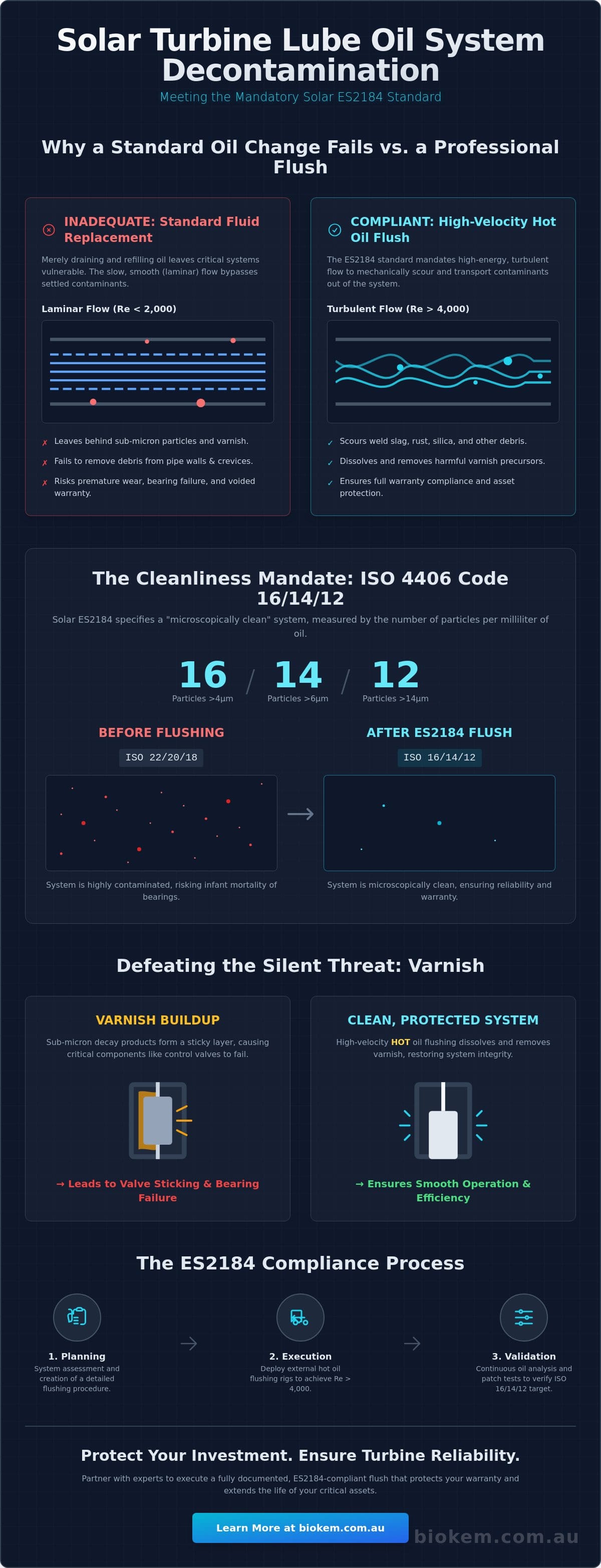
The technical core of the ES2184 specification is its reliance on the ISO 4406 cleanliness standard. For Solar Turbines, the required cleanliness level is strictly defined as ISO 16/14/12. Achieving this requires more than just high flow; it requires the correct physics. The process must achieve specific Reynolds Numbers and Turbulent Flow, typically exceeding a value of 4,000, to ensure the oil can lift and carry away particles lodged in pipe walls.
Executing this requires specialized hot oil flushing hardware that maintains high temperatures and velocities simultaneously. Finally, the standard demands rigorous documentation. BioKem Oil Services provides the expertise to ensure OEM inspectors receive verified oil analysis and patch tests to confirm the system has reached the 16/14/12 target. Without this paper trail, the flushing process is considered incomplete, and the turbine remains at risk.
The Physics of Compliance: Reynolds Numbers and Turbulent Flow
Merely pushing oil through a pipe isn’t the same as cleaning it. If the fluid moves in a smooth, layered fashion, it’ll slide right over the very contaminants you’re trying to remove. This is Why Solar turbines need to be oil flushed in accordance with Solar ES2184; the standard demands a specific mechanical state known as turbulent flow. Without this high-energy movement, the oil cannot generate the shear force needed to strip particulates and debris from the internal surfaces of the lubrication circuit.
To achieve this, engineers calculate the Reynolds Number (Re). This value depends on fluid velocity, pipe diameter, and kinematic viscosity. For a flush to be effective, the Re must exceed 4,000. At this point, the fluid transitions from laminar to turbulent, providing the scouring action required for compliance. If the flow rate is too low or the oil is too thick, the Re remains below this threshold, and the flush fails to meet OEM specifications. Calculating the required flow rate for the largest pipe diameter in the system is a critical step in the planning phase.
Laminar vs. Turbulent Flow: A Comparison
In laminar flow, the fluid travels in parallel layers with the slowest movement occurring at the pipe wall. This creates a “boundary layer” that shields contaminants from being swept away. Standard turbine pumps are designed for this smooth operation to minimize wear during normal use. However, a professional flushing process must break this layer. Turbulent flow creates vortices and eddies that mechanically lift weld slag and silica, carrying them toward the filtration skids.
The Impact of Temperature on Flushing Efficiency
Temperature is the primary lever for increasing the Reynolds Number because it directly reduces oil viscosity. BioKem Oil Services utilizes specialized hot oil flushing units to maintain oil temperatures between 60°C and 70°C. This heat doesn’t just improve flow dynamics; it also induces thermal expansion in the metal piping. By cycling the temperature, we help loosen stubborn scale that would otherwise remain bonded to the pipe walls. If you’re managing an upcoming maintenance turnaround, you can request a quote for specialized flushing equipment hire to ensure these technical parameters are met with precision.
The Varnish Problem: Why Standard Filtration Fails Solar Turbines
Standard filtration systems are designed to capture hard particles like metal shavings or silica, but they’re often powerless against the chemical degradation known as varnish. In the high-stress, high-temperature environment of a Solar turbine, oil molecules eventually succumb to oxidation and thermal distress. This process creates polar degradation products that are sub-micron in size. Because these contaminants are smaller than the pores of a typical 5 or 10-micron filter, they circulate freely through the system. This is a primary reason Why Solar turbines need to be oil flushed in accordance with Solar ES2184. The standard focuses on the mechanical energy of the flush to remove these “soft” contaminants that standard circulation simply cannot manage.
Varnish is frequently called the “silent killer” of industrial turbomachinery. Its polar nature causes it to migrate toward cooler metal surfaces, where it precipitates out of the oil and forms a sticky, enamel-like coating. This layer often develops in the most sensitive areas, such as servo valves and bearing housings. When these components become coated, they experience lag, sticking, or total seizure, leading to unexplained unit trips. Integrating varnish mitigation into the flushing protocol ensures that these precursors are stripped away before they can solidify and disrupt your operations.
How ES2184 Addresses Soft Contaminants
The ASTM D6439 Standard Guide emphasizes that a successful flush must address both hard particulate and soft degradation products. ES2184 aligns with these global benchmarks by mandating high-velocity flow to purge the entire lubrication circuit. A simple oil change is rarely sufficient because it leaves behind roughly 15-20% of the old, degraded fluid in “dead legs”—sections of piping where flow is stagnant. These pockets of old oil act as a catalyst, quickly contaminating the new charge. A compliant flush ensures these stagnant areas are thoroughly purged, replacing the chemical “seeds” of varnish with fresh, clean lubricant.
Long-term Benefits of a Varnish-Free System
Maintaining a system free of varnish does more than just prevent sudden shutdowns; it protects your secondary components and improves overall efficiency. Varnish acts as a thermal insulator. When it coats the internal surfaces of lube oil coolers, it significantly reduces heat transfer efficiency, causing the oil to run hotter and accelerate further degradation. Keeping the system clean also extends the service life of your high-performance Filters S.p.A. elements. When the oil is free from chemical sludge, these filters can focus on their primary task of capturing wear-related particulates, rather than becoming prematurely blinded by varnish deposits.
Executing an ES2184 Compliant Flush: The Professional Process
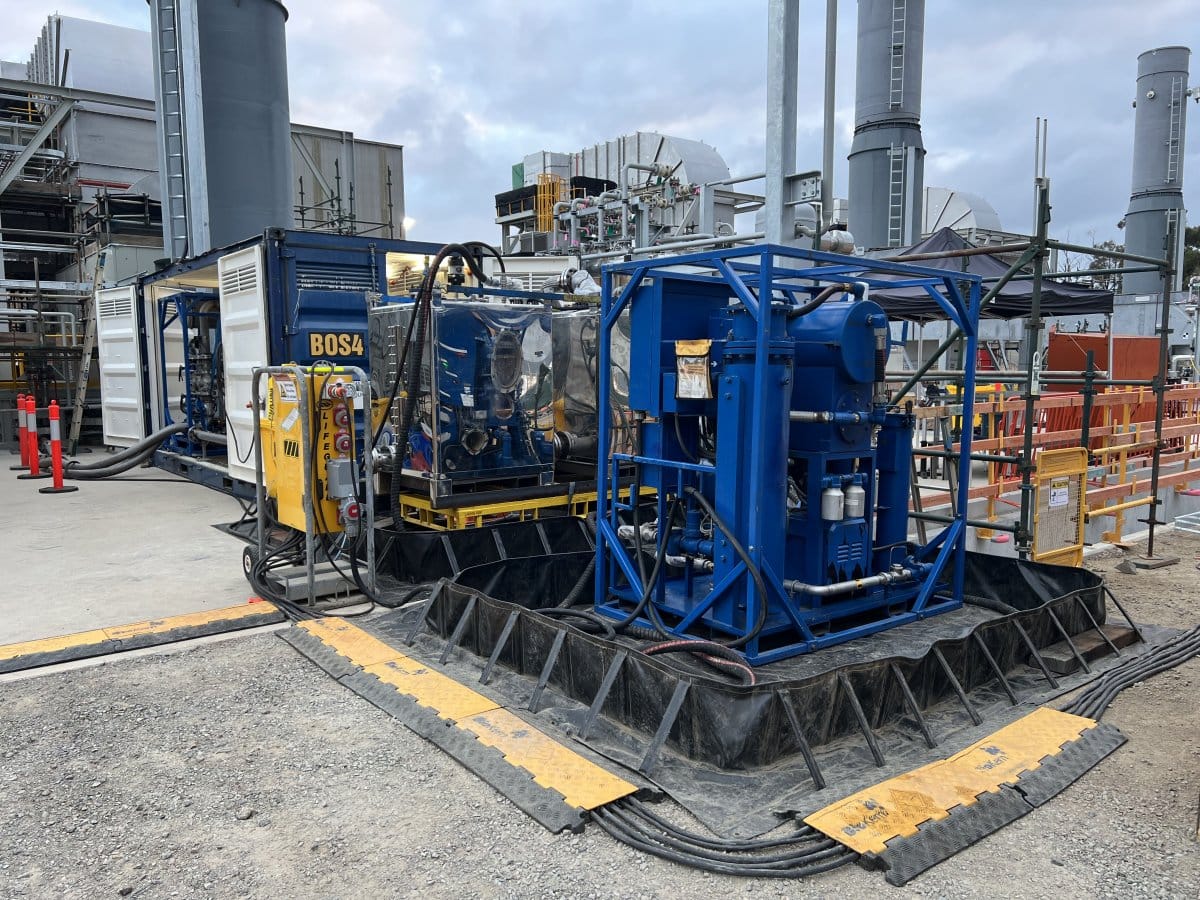
Moving from the theoretical physics of fluid dynamics to onsite execution requires a shift in hardware. This is Why Solar turbines need to be oil flushed in accordance with Solar ES2184; the turbine’s own internal lubrication system isn’t designed to generate the velocities required for deep cleaning. BioKem Oil Services utilizes external hot oil flushing rigs that operate independently of the turbine’s sump. These high-capacity skids provide the necessary flow and heat to reach the turbulent state without putting unnecessary stress on the unit’s internal pumps.
The process begins with a comprehensive system isolation. Before circulation starts, we must ensure that scoured debris doesn’t enter the turbine’s sensitive bearings or control valves. We install custom bypass manifolds and jumpers to create a closed loop that directs all fluid through our external filtration system. This protection is a non-negotiable step in maintaining the long-term integrity of the turbomachinery during a maintenance turnaround.
Step-by-Step Flushing Methodology
The flushing sequence follows a logical path to maximize the removal of both hard and soft contaminants. We focus on these core actions during the intervention:
- System Audit and Bypass: We map the lubrication circuit and install jumpers to protect critical components from scoured particulate.
- High-Velocity Circulation: We employ external pumps to achieve the mandatory Reynolds Number of 4,000, ensuring the entire pipe diameter is scoured.
- Thermal Cycling and Vibration: We cycle the oil temperature between 40°C and 70°C while applying mechanical vibration to the piping. This helps dislodge stubborn scale and weld slag that thermal expansion alone might not release.
- Multi-Stage Filtration: We use high-efficiency filters to capture debris in real-time as it’s lifted from the pipe walls.
Validation: How We Prove the System is Clean
Validation is the phase where data replaces assumptions. We don’t consider a flush complete until we have physical and digital proof of cleanliness. First, we install paddle flushing screens at strategic return points. These 100-mesh screens must remain free of visible debris for a specified duration to pass the physical inspection. This provides the immediate evidence required by many onsite engineers.
Once the screens are clear, we utilize onsite laser particle counting to verify that the fluid meets the ISO 4406 16/14/12 target. BioKem Oil Services then performs a final oil analysis to certify that the fluid’s chemistry and particulate levels are within OEM specifications. This documentation provides a clear audit trail for warranty validation and operational peace of mind. If you’re planning an upcoming outage, you can request a technical consultation for hot oil flushing services to ensure your system meets these rigorous standards.
BioKem’s Technical Advantage in Solar Turbine Maintenance
Achieving the rigorous ISO 16/14/12 cleanliness targets required by Solar Turbines demands more than just standard filtration. It requires a partner who understands the specific engineering nuances of the ES2184 specification. BioKem provides this expertise through specialized high-velocity hot oil flushing rigs that outperform traditional maintenance tools. This technical proficiency is the primary reason Why Solar turbines need to be oil flushed in accordance with Solar ES2184 using high-specification external rigs rather than internal system pumps. Our equipment is engineered to maintain the precise heat and flow parameters necessary to achieve turbulent flow across complex turbomachinery circuits.
We support Australia’s critical energy infrastructure with national service capabilities. From remote oil and gas facilities to metropolitan power generation plants, our team brings localized expertise to global scientific standards. We don’t just perform a service; we provide a documented guarantee of compliance. Every project concludes with a comprehensive report featuring oil analysis data and validated particle counts. This ensures your asset remains within warranty and is prepared for long-term operational success.
Proprietary Technology and Equipment Hire
BioKem utilizes high-capacity heating and filtration skids designed specifically for the high-volume requirements of gas turbine systems. These rigs feature multi-stage filtration and integrated heating elements that maintain optimal viscosity throughout the flushing cycle. For organizations with capable internal maintenance teams, we offer a comprehensive industrial oil filtration equipment hire service. This allows operators to access professional-grade technology while managing their own labor resources. To ensure a seamless connection to your specific hardware, we maintain an inventory of custom-engineered bypass manifolds designed for various Solar-specific turbine models, including Mars, Taurus, and Titan units.
Partnering for Reliability
A one-time flush is a reactive fix, but a truly proactive maintenance strategy integrates these technical interventions into the broader asset lifecycle. BioKem works closely with plant managers to schedule flushes during planned outages, minimizing the risk of unscheduled downtime. Our experience across the Australian industrial landscape has shown that compliant flushing significantly reduces the incidence of valve sticking and bearing wear. This commitment to precision helps extend the mean time between failures for your most expensive assets. If you are planning an upcoming maintenance turnaround, contact BioKem for a technical consultation on your Solar Turbine outage to ensure your system meets the ES2184 standard with absolute certainty.
Securing Long-Term Reliability for Your Turbomachinery Assets
Adhering to precise engineering standards is the only way to protect high-speed turbines from the catastrophic effects of contamination. By prioritizing turbulent flow and achieving a Reynolds Number above 4,000, operators can ensure that every internal surface is scoured clean of particulate and varnish precursors. This technical precision explains Why Solar turbines need to be oil flushed in accordance with Solar ES2184 to maintain warranty compliance and operational integrity. BioKem supports these efforts as the Australian distributor for Filters S.p.A. products, utilizing technicians who are deeply familiar with the unique requirements of the power and mining sectors.
Our commitment to documented oil cleanliness and extended equipment life provides the quiet confidence you’ll need during critical maintenance turnarounds. We invite you to Request a Technical Consultation for Your Solar Turbine ES2184 Flush to discuss your specific site requirements. Partnering with a specialist ensures your lubrication system remains a reliable asset rather than a liability. We look forward to helping you achieve peak efficiency for your next scheduled outage.
Frequently Asked Questions
What is the specific Reynolds number required for Solar ES2184 compliance?
Solar ES2184 requires a Reynolds number (Re) greater than 4,000 to achieve compliant flushing results. This specific value ensures the fluid transitions from a smooth, laminar flow to a chaotic, turbulent flow. Only turbulent flow possesses the mechanical energy necessary to lift and carry away particulates that are adhered to the internal walls of the lubrication piping.
Can I perform an ES2184 flush using the turbine’s internal lube oil pumps?
No, you shouldn’t use the turbine’s internal lube oil pumps for a compliant flush. Internal pumps are designed for consistent lubrication at specific pressures, not for the high-velocity circulation required to achieve turbulent flow. Using internal pumps also risks pushing contaminants directly into sensitive bearings and control valves, which should be protected by bypasses during the flushing process.
How long does a typical high-velocity oil flush take for a Solar Mars or Titan turbine?
A typical high-velocity oil flush for a Solar Mars or Titan turbine generally takes between 24 and 72 hours of active circulation. The exact duration depends on the length of the piping runs and the initial cleanliness of the system. We continue the process until the fluid consistently meets the ISO 16/14/12 target and the paddle screens remain clear of visible debris.
What is the difference between a standard oil change and an ES2184 compliant flush?
A standard oil change only replaces the fluid in the reservoir, whereas an ES2184 flush cleans the entire internal piping circuit. This is Why Solar turbines need to be oil flushed in accordance with Solar ES2184; a simple drain and fill leaves behind roughly 20% of the old oil and trapped particulates in stagnant areas. A flush removes these contaminants before they can damage new components.
Are paddle screens still required if we use laser particle counters for validation?
Yes, paddle screens remain a mandatory part of the validation process alongside laser particle counters. While laser counters provide precise data on microscopic particles for ISO 4406 reporting, paddle screens capture physical evidence of larger debris like weld slag or rust flakes. Both methods are required to satisfy OEM inspectors and ensure the system is completely free of harmful materials.
How often should a Solar Turbine undergo a high-velocity oil flush?
A Solar Turbine should undergo a high-velocity flush during initial commissioning, after any major overhaul, or when switching to a different oil brand. It’s also a best practice to perform a flush if oil analysis reveals a high varnish potential. Proactive flushing during scheduled outages prevents unscheduled downtime caused by valve sticking or bearing failure, supporting a more reliable maintenance cycle.
Does Solar ES2184 apply to both new installations and existing units?
Solar ES2184 applies to both new installations and existing units undergoing maintenance or repair. Why Solar turbines need to be oil flushed in accordance with Solar ES2184 is consistent throughout the asset’s life. New units require flushing to remove construction debris, while existing units need it to purge chemical degradation products and wear particulates that accumulate during thousands of hours of operation.