

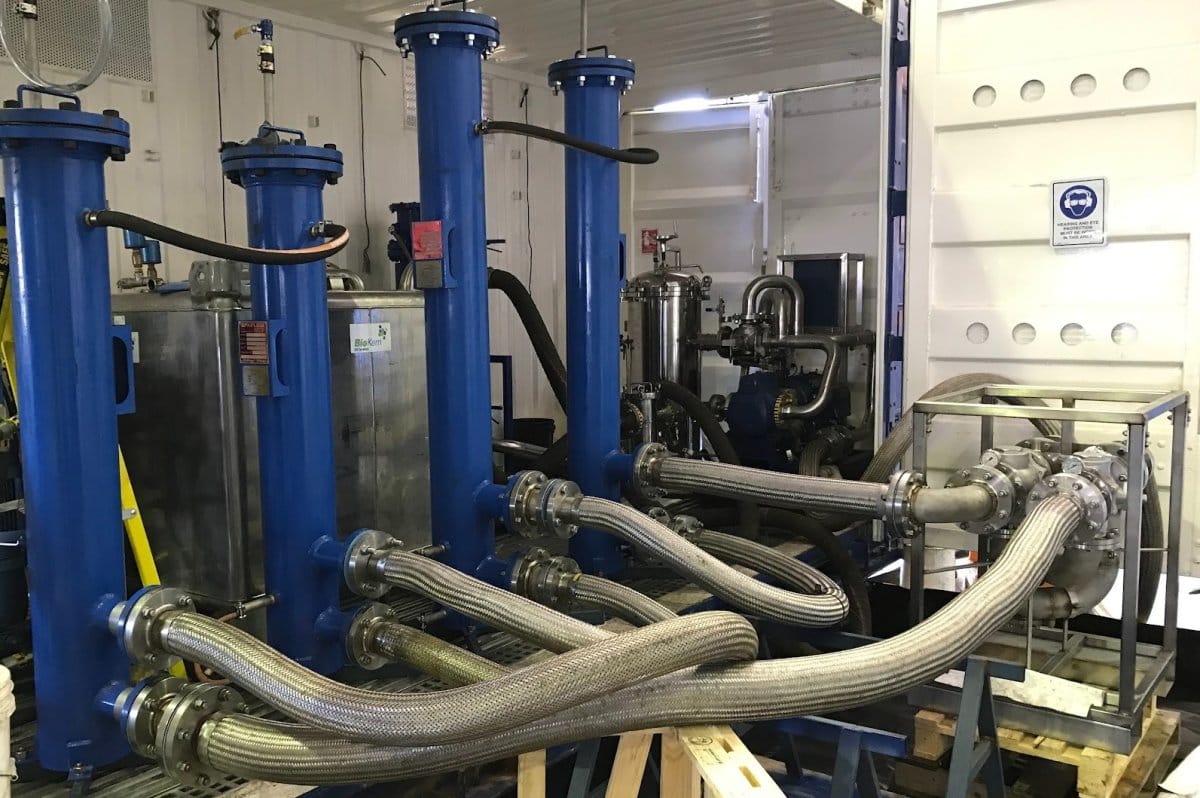
Achieving a Reynolds Number above 4,000 isn’t just a technical milestone; it’s the critical threshold where stagnant oil becomes a turbulent scouring agent capable of stripping sub-micron contaminants from internal surfaces. Most industrial operators recognise that reaching these high temperatures is essential for effective system decontamination. However, the rush to eliminate downtime often creates a dangerous trade-off between heating speed and system integrity. You’ve likely seen how improper thermal management can lead to oil degradation or, worse, safety incidents involving high-pressure fluid handling.
This guide explains how to balance Efficiency & Safety to achieve the temperature required for optimal maintenance without causing carbonaceous “cracking” or risking site leaks. We’ll explore the technical intersection of thermal dynamics and Australian safety standards to ensure your oil systems remain both pristine and compliant. We will detail the specific protocols needed to reach turbulent flow while protecting your long-term asset health and meeting local regulatory requirements.
Key Takeaways
- Understand the critical role of temperature in reducing oil viscosity to achieve the turbulent flow necessary for thorough system decontamination.
- Learn how to optimise Efficiency & Safety to achieve the temperature required. for heating large industrial lubricant volumes without compromising oil integrity.
- Evaluate the technical advantages of internal immersion versus external heat exchange to maximise energy efficiency during the flushing process.
- Identify essential safety boundaries, including Flash and Fire Points, to mitigate fire risks and thermal degradation during high-temperature operations.
- Discover best practices for gradual thermal ramp-up and the use of low watt-density equipment to protect gaskets and meet Australian industrial standards.
The Critical Role of Temperature in Industrial Oil System Maintenance
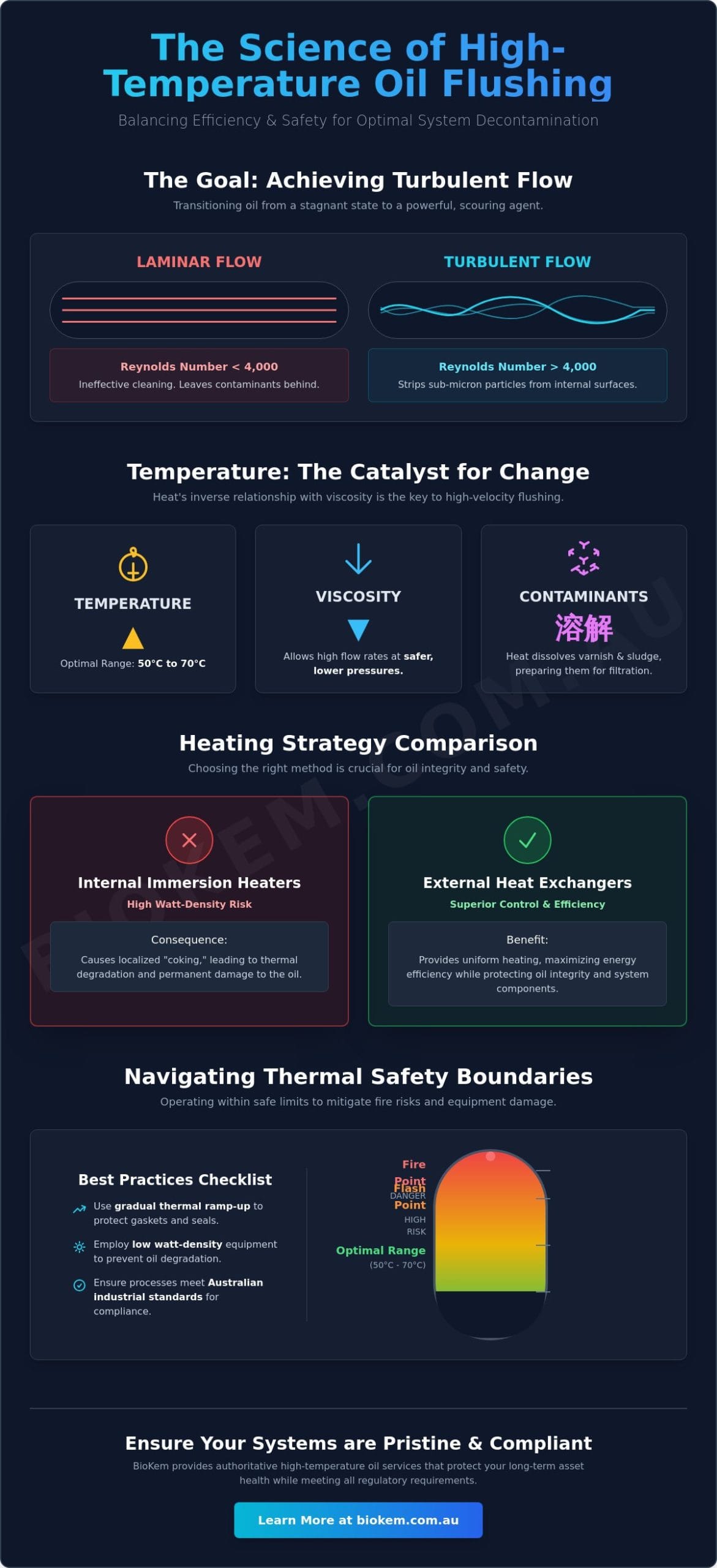
In the context of Australian heavy industry, where machinery uptime is critical, hot oil flushing stands as a vital maintenance procedure. Temperature serves as the fundamental mechanism to manipulate oil viscosity, transitioning the fluid from a laminar state to a high-velocity turbulent state. This transition is what we define as reaching the required temperature. It’s the precise point where the fluid’s internal friction decreases enough to allow a Reynolds number that exceeds 4,000. Achieving this state is non-negotiable for dislodging sub-micron particulates and ensuring a clean system. Engineers must prioritize Efficiency & Safety to achieve the temperature required. to prevent equipment damage while maximizing the cleaning action.
The Heat transfer fluid characteristics of industrial lubricants mean that as they absorb thermal energy, their molecular bonds become less resistant to flow. This physical change is the catalyst for the entire flushing process. Without sufficient heat, the oil remains too thick to reach the velocities needed to “scrub” the internal walls of complex pipework. This results in a superficial clean that leaves the most damaging contaminants behind. Therefore, temperature control isn’t just a preference; it’s a technical requirement for system integrity.
To better understand how these variables work in a practical setting, watch this demonstration of the process:
Why Viscosity Control Matters
Oil viscosity and temperature share a strict inverse relationship. As the temperature of the oil increases, its kinematic viscosity decreases significantly. In a typical Australian mining or power generation environment, hydraulic and lubrication oils often require heating to a range between 50°C and 70°C. This specific range is chosen because it lowers the viscosity enough to allow for high flow rates without reaching the flash point of the fluid or damaging sensitive seals. By reducing the viscosity, the flushing pumps can move the oil at much higher velocities while maintaining lower, safer pump pressures. This creates the turbulent energy necessary to lift heavy debris and transport it to the filtration units.
Thermal Impact on Varnish and Sludge
Heat does more than just change flow dynamics; it acts as a powerful solvent for chemical contaminants. Soft contaminants, such as sludge and oxidation by-products, often adhere to the cooler surfaces of the pipework and reservoir walls. By maintaining a consistent temperature, these polar compounds dissolve back into the oil, making them accessible for removal through a specialized varnish removal system. A common challenge in large-scale Australian installations is the presence of “cold spots” in dead legs or long external pipe runs. If the temperature drops in these sections, contaminants will quickly precipitate out of the oil and settle again. Maintaining Efficiency & Safety to achieve the temperature required. across the entire circuit is the only way to ensure a comprehensive decontamination that meets Australian regulatory and OEM standards.
Maximising Thermal Efficiency During the Flushing Process
Heating large volumes of industrial lubricants, often exceeding 10,000 litres in mining or power generation assets, requires a sophisticated understanding of thermal dynamics. Oil possesses a specific heat capacity roughly half that of water; however, its viscosity is highly sensitive to temperature fluctuations. To ensure the Efficiency & Safety to achieve the temperature required, engineers must calculate the precise kilowatt-hours needed to overcome the thermal inertia of the fluid and the surrounding metalwork. Relying on internal immersion heaters can be risky; high watt-density elements often cause “coking” or localized thermal degradation of the oil. In contrast, external heat exchangers provide superior control and energy efficiency in process heating by distributing thermal energy evenly through a secondary medium.
In the harsh Australian climate, from the Pilbara to the Hunter Valley, ambient conditions significantly impact thermal retention. Long pipe runs act as giant radiators, bleeding heat into the atmosphere. High-performance insulation is mandatory for maintaining the 50°C to 70°C range necessary for effective cleaning. Without it, the energy cost to maintain the target temperature increases by as much as 25% on exposed sites. High-flow pumps play a vital role here; they circulate the heated medium rapidly to ensure uniform distribution, preventing cold spots where contaminants might remain lodged.
The Physics of Turbulent Flow (Reynolds Number)
The Reynolds Number is the dimensionless metric that serves as the primary indicator of whether a flushing procedure will successfully remove debris from internal surfaces. Achieving the required temperature is the only way to reach Reynolds >4000 because heat reduces the fluid’s kinematic viscosity to a level where high-velocity flow becomes possible. While laminar flow allows particles to settle in the boundary layer near the pipe wall, turbulent flow creates a violent scrubbing action that dislodges sub-micron contaminants. Maintaining the Efficiency & Safety to achieve the temperature required ensures the fluid remains in this turbulent state throughout the entire circuit.
Energy-Efficient Heating Strategies
Modern onsite interventions utilize modular heating units that can be scaled based on the system volume. Using specialized hot oil flushing equipment can reduce total project duration by approximately 30% compared to traditional methods. This efficiency is gained through rapid heat-up times and the ability to maintain stable temperatures under high-flow conditions. We implement staged heating protocols to protect the infrastructure; this involves incremental temperature increases to prevent thermal shock to seals, gaskets, and sensitive instrumentation. If your system is showing signs of thermal degradation or buildup, our varnish removal system offers a targeted way to restore peak operational health.
Safety Protocols for High-Temperature Oil Handling
The primary objection to heating industrial fluids involves the inherent risk of fire and the potential for thermal degradation. Managing these risks demands a rigorous understanding of fluid chemistry and mechanical fail-safes. Technicians must distinguish between the Flash Point, where vapours momentarily ignite, and the Fire Point, where combustion becomes self-sustaining. In Australian industrial environments, maintaining a safety margin of at least 20°C below the Flash Point is a standard operational requirement. Balancing Efficiency & Safety to achieve the temperature required means implementing redundant control systems to prevent thermal runaway.
Reliable hardware is the first line of defence. Pressure relief valves should be calibrated to 110% of the maximum system operating pressure to prevent catastrophic failure if a blockage occurs. Automated temperature shut-off switches provide a critical fail-safe, instantly de-energising heaters if the fluid exceeds pre-set limits. Technicians working with these systems require specific Personal Protective Equipment (PPE) to mitigate the risks of pressurized hot oil leaks:
- Flame-resistant (FR) coveralls rated for industrial flash fire protection.
- High-temperature thermal gloves capable of resisting 120°C contact.
- Full-face shields combined with safety goggles to prevent ocular exposure.
- Heat-resistant safety boots with chemical-resistant soles.
Preventing Oil Degradation (Cracking)
Localized overheating at the heater element surface leads to carbonisation, often called “cracking.” This process breaks down hydrocarbon chains, creating sludge and reducing the oil’s lubricating properties. To prevent this, Biokem utilises low watt-density heaters, typically below 2.0 W/cm², which ensure a gentle heat transfer. Once the process is complete, a comprehensive oil analysis is necessary to verify that the fluid’s chemical integrity remains intact for long-term service.
Containment and Leak Detection
Temporary pipework and hoses are vulnerable points during a flush. We use high-temperature-rated hoses and Viton or PTFE seals to ensure 100% containment at elevated temperatures. The “Safety First” methodology incorporates paddle flushing screens, which allow for debris inspection without breaking the circuit’s integrity. Emergency response procedures must include 30-litre spill kits and a clear isolation protocol to manage any high-temperature oil release immediately. This structured approach ensures Efficiency & Safety to achieve the temperature required without compromising site environmental standards or personnel safety.
Best Practices for Achieving the Required Temperature Safely
Operational success in hot oil flushing depends on a focus on Efficiency & Safety to achieve the temperature required. Technicians must establish a clear baseline by recording ambient and system-start temperatures. This data allows for the calculation of the precise energy input needed to reach the target viscosity. A gradual ramp-up phase is essential; increasing temperatures by no more than 20°C per hour prevents thermal stress on gaskets and seals. Rapid heating causes uneven expansion in metallic joints, which often leads to leaks or permanent seal failure.
Implementing bypass loops is a critical safety measure. These loops divert hot fluid away from heat-sensitive components, such as delicate actuators or specific sensors, during the high-temperature phase of the flush. This ensures the system reaches the 60°C to 70°C range needed for turbulent flow without damaging expensive internal hardware.
Monitoring and Control Systems
Precision control relies on digital thermistors and flow meters that provide a continuous data stream to the operator. Using the Particle Pal range allows for real-time cleanliness tracking alongside temperature data. This integration ensures that as the oil thins and dislodges contaminants, the filtration system responds accordingly. Automated control valves play a vital role in temperature regulation; they adjust the flow through the heating unit to maintain a steady state once the target is reached. This automation removes the risk of human error and prevents the fluid from exceeding its flash point, maintaining Efficiency & Safety to achieve the temperature required for ISO 4406 cleanliness standards.
System Insulation and Environmental Factors
The Australian climate significantly impacts heating efficiency. In regions like the Pilbara, where ambient temperatures exceed 40°C, the energy required to reach the target is lower, but the risk of equipment overheating increases. Conversely, Victorian or Tasmanian winters require more robust heating strategies. We recommend temporary lagging for external pipework to maximize thermal retention. Without insulation, exposed industrial assets can experience a 15% drop in surface temperature due to wind-chill, particularly on coastal sites. This thermal loss forces the heating unit to work harder, increasing energy consumption and extending project timelines. Applying temporary insulation blankets ensures the heat stays within the fluid, accelerating the transition to turbulent flow.
Effective thermal management protects your assets while ensuring the flush is completed within the scheduled window. Biokem provides the technical expertise and equipment necessary to manage these variables on-site.
Ensure your next maintenance shutdown is handled with precision. Contact Biokem for professional hot oil flushing services today.
BioKem’s Authoritative Approach to High-Temperature Oil Services
BioKem stands as the Australian leader in technical oil management, providing critical support for the power generation and mining sectors. Our approach centers on a nature-based philosophy that prioritizes the molecular integrity of lubricants. We believe in preserving oil life through better science rather than aggressive chemical interventions that can compromise base oil stability. This methodology ensures that Efficiency & Safety to achieve the temperature required remain the dual pillars of every project we undertake.
We utilize specialized, low watt-density heating equipment to eliminate the risk of localized fluid degradation. Traditional high-density heaters often cause carbonisation and “coking” at the element surface, but our systems protect the fluid’s life cycle by distributing thermal energy evenly. This technical precision is vital for the maintenance of heat transfer systems in heavy industrial environments across the Pilbara and Hunter Valley. By managing the heat flux carefully, we prevent the premature oxidation of expensive synthetic and mineral oils.
Onsite Expertise and Equipment Hire
Managing a hot oil flush demands a precise balance between thermal energy and fluid velocity. BioKem technicians oversee this complex process onsite, ensuring that turbulent flow is achieved without compromising asset safety. We provide high-flow filtration units for equipment hire that are engineered to handle diverse viscosities at elevated temperatures. Our partnership as the Australian distributor for Filters S.p.A. gives our clients access to high-performance filter elements that maintain structural integrity under extreme thermal stress. These elements allow operators to reach target ISO 4406 cleanliness codes up to 40% faster than standard industry methods.
Comprehensive Reliability Solutions
Proactive lubrication management is the most effective way to extend asset life and ensure operational certainty. BioKem’s solutions reduce unplanned downtime by approximately 30% by addressing contamination and varnish at their source. We provide a guaranteed pathway to cleanliness that protects multi-million dollar turbines and hydraulic systems from the catastrophic effects of particulate wear.
Our commitment to Efficiency & Safety to achieve the temperature required ensures that your oil remains a functional asset rather than a waste product. It’s a strategy that aligns technical performance with environmental responsibility. Don’t wait for a system failure to address fluid health; a proactive flush can save thousands in component replacement costs. Contact BioKem for a technical consultation on your next hot oil flush to secure your plant’s operational future.
Securing Long-Term Asset Integrity Through Precision Thermal Management
Achieving the optimal temperature is critical for removing stubborn varnish and particulate contaminants from industrial oil systems. BioKem leverages over 15 years of industrial lubrication expertise to ensure these processes meet Australian regulatory standards and manufacturer specifications. We use specialized low watt-density heating technology to prevent localized oil degradation while maintaining the thermal energy necessary for a thorough clean. It’s a precise method that protects both the lubricant and the hardware from unnecessary stress.
Balancing operational Efficiency & Safety to achieve the temperature required. demands a technical approach that prioritizes both speed and risk mitigation. As the sole Australian distributor for Filters S.p.A., BioKem provides the high-performance filtration and heating systems needed to protect your machinery from premature wear. These technical solutions reduce environmental impact by extending oil life and improving system reliability. We’re ready to help you maintain peak operational health through proven scientific methods.
Optimise your system reliability with BioKem’s specialist Hot Oil Flushing services.
Your equipment deserves the highest standard of care to ensure it stays productive for years to come.
Frequently Asked Questions
What is the ideal temperature for hot oil flushing?
The ideal temperature for hot oil flushing typically ranges between 50°C and 60°C. Maintaining this specific thermal window ensures the oil’s viscosity drops sufficiently to transition from laminar to turbulent flow. BioKem’s technical protocols specify that 55°C is often the optimal balance for most ISO 32 and ISO 46 mineral oils used in Australian industrial machinery.
How does temperature affect the Reynolds Number in a hydraulic system?
Increasing the oil temperature directly raises the Reynolds Number by reducing the fluid’s kinematic viscosity. To achieve the turbulent flow necessary for cleaning, the Reynolds Number must exceed 4,000. For example, heating an ISO 46 oil from 20°C to 60°C reduces its viscosity from roughly 100 cSt to 15 cSt, which significantly boosts the Reynolds Number without increasing pump pressure.
Is it safe to heat oil near its flash point during a flush?
No, you must always maintain a safety buffer of at least 20°C below the fluid’s documented flash point. Prioritising efficiency & safety to achieve the temperature required means monitoring thermal levels constantly to prevent ignition risks. If a mineral oil has a flash point of 200°C, our technicians ensure the flushing temperature never exceeds the 80°C threshold for operational safety.
What happens if the oil is heated too quickly?
Heating oil too rapidly causes localized thermal degradation, often called “cracking,” at the surface of the heating element. This process creates carbon char and varnish that actually adds more contaminants to the system. To prevent this, BioKem uses heaters with a low watt density, typically below 2.3 watts per square centimetre, to ensure a gentle and uniform rise in temperature.
How do I know if my system has reached the required temperature for cleaning?
You should verify the temperature using calibrated digital thermistors placed at the return line, which is the furthest point from the heat source. Thermal equilibrium is confirmed when the return line temperature matches the supply temperature within a 5% margin for 30 consecutive minutes. This verification process ensures the system maintains the efficiency & safety to achieve the temperature required for effective particulate dislodgement.
Can high temperatures damage system seals or gaskets?
Yes, temperatures exceeding 80°C can cause standard Nitrile (NBR) seals to harden, crack, or lose their elastic memory. While Viton seals can withstand higher heat, we monitor temperatures closely to stay within the 50°C to 60°C range. This protective approach prevents the premature failure of internal components while still ensuring the fluid is thin enough to flush out microscopic debris.
Does BioKem provide the heating equipment for onsite oil flushing?
BioKem provides comprehensive onsite flushing services including 150kW high-capacity heating units and specialized filtration skids. Our equipment is specifically designed for the Australian mining and energy sectors, complying with AS 3000 electrical standards. We manage the entire process from mobilization to the final ISO particle count verification, so you don’t need to supply any hardware.
How often should a high-temperature system flush be performed?
A high-temperature flush should be performed every 3 to 5 years as part of a proactive maintenance strategy or immediately following a major component failure. Data from 2023 industrial reports suggests that regular flushing can extend the service life of hydraulic pumps by up to 200%. We recommend using annual oil analysis to monitor varnish precursors and determine the exact timing for your next service.