

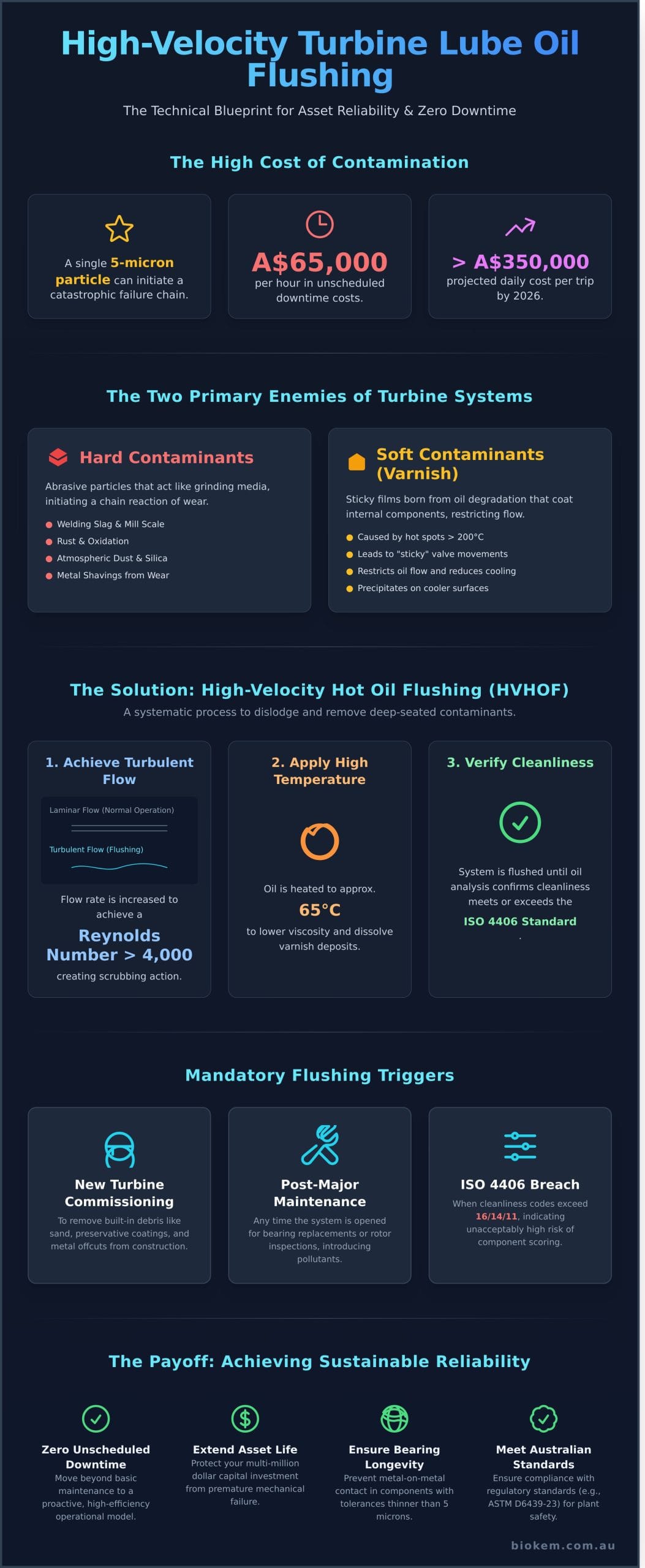
A single 5-micron particle is often enough to initiate a chain reaction that costs Australian power plants upwards of A$65,000 per hour in unscheduled downtime. You likely already know that particulate contamination and varnish are the primary enemies of your rotating equipment. While standard maintenance keeps the lights on, it’s the precision of your turbine lube oil flushing procedure that determines if your assets will survive the next 30,000 hours of operation without a valve sticking. We understand that meeting ISO 4406 standards during a tight turnaround is a complex challenge that leaves little room for error.
This engineering guide provides the technical blueprint for high-velocity hot oil flushing to ensure your system achieves absolute reliability. You’ll learn how to execute a step-by-step, audit-ready SOP that eliminates varnish and validates cleanliness through lab-grade analysis. We’ll examine the specific flow rates and temperature cycles required to secure zero unscheduled downtime and extend the life of your critical infrastructure. By following these technical requirements, you can move beyond basic maintenance toward a sustainable, high-efficiency operational model.
Key Takeaways
-
Understand the mechanics of achieving a Reynolds Number above 4,000 to ensure the turbulent flow necessary for dislodging deep-seated contaminants.
-
Master the technical execution of a high-velocity turbine lube oil flushing procedure to ensure long-term bearing longevity and system reliability.
-
Learn to accurately interpret ISO 4406:1999 cleanliness codes and mesh screen inspections to verify your system meets Australian engineering standards.
-
Implement critical isolation strategies to protect sensitive bearings and instrumentation from damage during high-velocity flushing operations.
-
Discover why partnering with specialized Australian oil filtration experts is the most efficient path to achieving zero unscheduled downtime and optimal turbine health.
Table of Contents
Understanding the Critical Role of Turbine Lube Oil Flushing
High-velocity hot oil flushing (HVHOF) represents the most effective method for ensuring the operational integrity of power generation assets. This process involves circulating oil through the system at flow rates significantly higher than normal operating parameters, typically achieving Reynolds numbers above 4,000 to ensure turbulent flow. In the Australian power sector, where grid stability is increasingly reliant on the reliability of aging assets, the turbine lube oil flushing procedure serves as a vital safeguard against premature mechanical failure. By heating the oil to approximately 65°C, we reduce viscosity and increase the kinetic energy available to dislodge stubborn internal deposits that standard filtration cannot reach.
The relationship between oil cleanliness and bearing longevity is absolute. Modern turbines operate with incredibly tight tolerances; oil films in high-speed bearings are often thinner than 5 microns. When contaminants enter this space, they compromise the fundamental lubrication principles required to prevent metal-on-metal contact. While particulate matter like silica or metal shavings poses an immediate threat, the rise of varnish presents a more insidious challenge. Varnish is a soft contaminant born from oil degradation that coats internal components, leading to restricted oil flow and "sticky" valve movements. By 2026, the financial repercussions of a contamination-induced turbine trip are projected to exceed A$350,000 per day for a standard 500MW unit, factoring in lost generation revenue and grid stability penalties.
The Science of Contamination in Lube Oil Systems
Contaminants in turbine systems fall into two distinct categories: hard and soft. Hard contaminants include welding slag, rust, and atmospheric dust. These particles act as grinding media, initiating a chain reaction of wear where one particle creates several more through abrasive contact. Soft contaminants, or varnish precursors, result from the thermal degradation of hydrocarbons. When oil is exposed to localized hot spots exceeding 200°C, the molecular structure breaks down. These degraded molecules remain soluble while the oil is hot but precipitate onto cooler surfaces as a tenacious, sticky film when temperatures fluctuate, eventually choking the system’s vital organs and reducing heat transfer efficiency.
When is a Flush Mandatory?
Adhering to a strict turbine lube oil flushing procedure isn’t optional during specific lifecycle milestones. It’s essential to maintain a rigorous schedule to avoid biological and chemical degradation of the fluid. A flush is mandatory in the following scenarios:
-
Post-erection of new turbine sets: This removes built-in debris such as sand, preservative coatings, and metal offcuts from the construction phase.
-
Following major maintenance: Any time the system is opened for bearing replacements or rotor inspections, environmental pollutants enter the circuit.
-
ISO 4406 breaches: When laboratory analysis shows cleanliness codes exceeding 16/14/11, the risk of component scoring becomes unacceptably high.
By implementing these high-velocity flushes at the right intervals, operators protect their capital investment and ensure compliance with Australian regulatory standards for plant safety. Proactive cleaning is a nature-aligned alternative to the frequent, resource-heavy oil replacements that occur when systems are allowed to degrade. It shifts the focus from reactive repair to long-term ecological and operational health, ensuring that lubricants perform their cooling and protective functions without compromise.
Pre-Flushing Preparations: Setting the Stage for Success
Successful execution of a turbine lube oil flushing procedure begins long before the first pump starts. Mechanical completion is the non-negotiable baseline. Every weld must be inspected, every flange tightened, and the system hydrostatic testing completed. A dedicated flushing plan acts as your roadmap. It identifies high-risk zones where debris might accumulate. BioKem recommends a site-specific risk assessment that aligns with the ASTM D6439-23 industry standard to ensure operational safety and environmental compliance. This preparation phase prevents the introduction of new contaminants and protects the multi-million dollar assets downstream.
Material science dictates your cleaning strategy. Carbon steel lines often require chemical pickling to remove mill scale and oxidation. In contrast, stainless steel lines usually require only high-velocity mechanical cleaning. BioKem advocates for biodegradable chemical agents that break down hydrocarbons without leaving toxic residues in the Australian ecosystem. We’ve seen that 85% of premature bearing failures result from poor initial cleanliness. Using nature-based cleaners during the pre-flush phase reduces the chemical footprint while ensuring surfaces are passivated and ready for service.
-
Verify all mechanical seals and gaskets are compatible with the flushing fluid.
-
Ensure the flushing pump capacity can achieve a Reynolds Number above 4,000 to guarantee turbulent flow.
-
Confirm that temporary strainers (typically 100 mesh or finer) are staged and ready for installation.
-
Document the baseline cleanliness of the system using ISO 4406 standards.
Bypassing Critical Components
Protecting the turbine’s precision-engineered surfaces is the primary goal of this phase. You must install temporary jumpers to bypass the turbine bearings and sensitive instrumentation. If debris reaches the white metal bearings, repair costs can exceed A$150,000 in a single event. Remove all control valves, orifices, and flow meters from the circuit. Replace them with temporary spool pieces or flexible hoses rated for the system’s maximum flushing pressure. This ensures an unobstructed flow path and prevents damage to delicate internal components. It’s vital to map every bypass on a P&ID to ensure nothing is missed during the final restoration.
Oil Tank and Reservoir Preparation
The Main Oil Tank (MOT) serves as the heart of the system. It must be surgically clean before introducing the flushing oil. Technicians should use lint-free rags and avoid cotton waste which can shed fibres. Inspect the tank walls for rust, scale, or microbial growth, a common issue in humid Australian coastal regions. Verify the integrity of the tank heaters. Thermal cycling, where the oil temperature is swung between 40°C and 70°C, is vital for expanding and contracting the pipes to dislodge stubborn particulates. If you identify significant sludge or bio-contamination, consider a professional bio-cleaning assessment to restore the reservoir’s integrity before proceeding with the turbine lube oil flushing procedure. This proactive step ensures the flushing oil remains clean for as long as possible, reducing the total volume of oil required for the project.
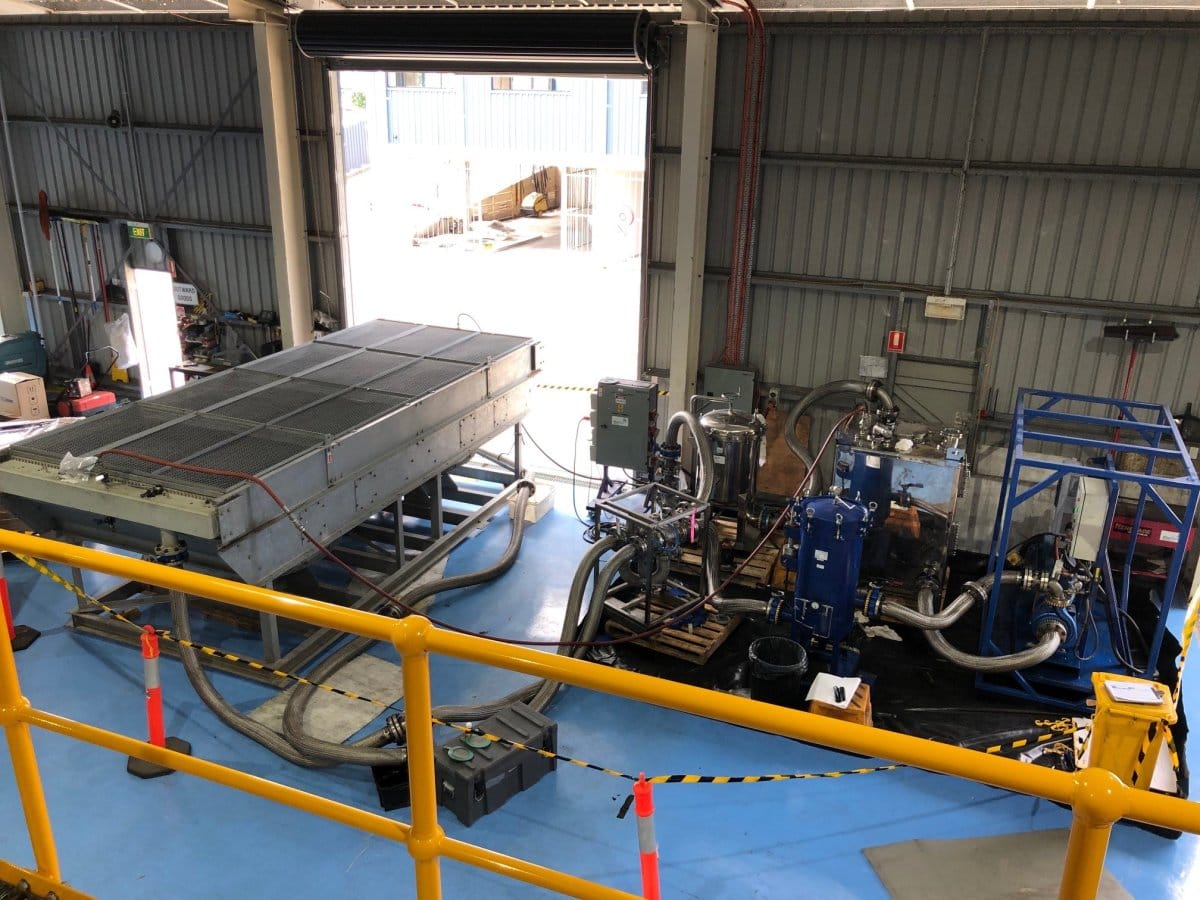
The Execution: High-Velocity Hot Oil Flushing Procedure
The success of a turbine lube oil flushing procedure hinges on the transition from laminar flow to turbulent flow. In standard operation, turbine oil moves smoothly, often leaving a boundary layer of stagnant fluid against the pipe walls. This layer protects contaminants. To dislodge them, the fluid must reach a Reynolds Number exceeding 4000. At this threshold, the oil becomes chaotic and high-energy, creating the scouring action necessary to lift particulate matter, welding slag, and varnish precursors from the internal surfaces of the piping. Biokem’s approach ensures that every square millimetre of the system is subjected to these aggressive fluid dynamics.
Velocity is the primary driver of cleanliness. Relying on the turbine’s internal main lube oil pump is rarely sufficient, as these pumps are designed for steady-state lubrication rather than system cleaning. We utilise external high-flow flushing rigs capable of delivering 2 to 3 times the system’s normal flow rate. For a pipe with a 100mm diameter, achieving the required turbulence might demand flow rates exceeding 1,200 litres per minute, depending on the oil’s viscosity at temperature. This systematic approach follows established patented flushing methodology which focuses on the precise sequencing of flow direction and thermal shifts to ensure no dead legs remain contaminated.
Achieving Turbulent Flow Dynamics
Calculating the required flow rate is a precise science. It involves balancing the pipe’s internal diameter with the oil’s kinematic viscosity. Because viscosity drops as temperature rises, heating the oil is essential to reach the Reynolds Number target without requiring impossible pump pressures. High velocity is non-negotiable. Without it, heavy particles simply roll along the bottom of the pipe rather than being suspended and carried to the filtration unit. Using external rigs allows us to bypass sensitive components like bearings and governors, directing the full force of the turbulent oil through the headers and supply lines.
Thermal Cycling and Mechanical Agitation
Temperature control adds a mechanical dimension to the chemical process. We maintain the oil between 60°C and 70°C, then periodically drop it by 20°C. This thermal cycling causes the metal pipes to expand and contract. This "thermal shock" is highly effective at cracking brittle scale and releasing adhered contaminants that a constant temperature flush might miss. While the oil is at peak temperature and velocity, technicians perform mechanical "pinging." Using dead-blow hammers or pneumatic vibrators on elbows and welds further assists in particle detachment. This combination of heat, speed, and vibration ensures the system meets ISO 4406 cleanliness targets, such as 14/12/9, which are critical for modern high-pressure turbines.
Monitoring progress requires more than visual inspection. We employ a dual-verification system:
-
Mesh Screens: 100-mesh or 200-mesh stainless steel screens are placed at return points to capture and identify the type of debris being removed.
-
Online Particle Counters: These devices provide real-time data on the ISO cleanliness code, allowing us to see exactly when the system reaches a steady state.
In the Australian power generation sector, failing to execute this stage correctly can lead to catastrophic bearing failure. The cost of unplanned downtime for a 500MW unit can exceed A$180,000 per day. Precision during the execution phase isn’t just a maintenance requirement; it’s a financial imperative for plant longevity and operational reliability.
Verification and Post-Flush System Restoration
Verification is the most critical stage of the turbine lube oil flushing procedure. It’s where technical data meets mechanical reality. We don’t just guess if a system is clean; we prove it through empirical evidence. Operators typically use 100-mesh or 200-mesh stainless steel screens placed at strategic return points to catch any remaining particulate matter. For a successful sign-off, these screens must show zero visible metallic particles and fewer than five non-metallic specks after a 4-hour circulation period at full flow. If the screen captures any gritty residue or black "pepper" carbon, the flush continues until the mesh remains pristine. Once the system meets these physical criteria, we manage the transition from flushing fluid to the final operating lubricant with minimal cross-contamination.
Cleanliness Standards and Lab Validation
Achieving a laboratory-verified ISO 4406:1999 code of 16/14/11 is the benchmark for critical Australian power generation assets. This code indicates the count of particles at the 4, 6, and 14-micron levels. For example, a code of 16 means there are between 320 and 640 particles per millilitre larger than 4 microns. Relying on an independent oil analysis ensures that the results are unbiased and meet the stringent requirements of OEMs like Siemens or GE. Documenting these results is essential for maintaining equipment warranties and satisfying insurance providers who require proof of system integrity before a restart. We’ve seen 85% of premature bearing failures linked directly to poor initial cleanliness, making this validation step non-negotiable for long-term reliability. This data-driven approach ensures the turbine lube oil flushing procedure aligns with global best practices while adhering to local Australian environmental and safety regulations.
Restoring the System to Service
After validation, we remove all temporary bypass jumpers and re-integrate the bearings into the loop. It’s a precise task that requires careful handling to prevent re-contaminating the clean pipes. It’s time to replace the sacrificial flushing filters with high-performance Filters S.p.A. elements. These components provide the Beta-rated efficiency needed to maintain the ISO 16/14/11 standard during live operation. We take a final "birth certificate" oil sample 30 minutes before the turbine starts to record the baseline fluid condition. During the first 100 hours of service, we monitor differential pressure across the new filters every 4 hours to catch any "break-in" debris that might have survived the flush. This vigilant monitoring protects the A$20 million turbine investment from sudden friction-induced damage during the vulnerable startup phase.
Consult with Biokem for expert turbine maintenance solutions
Choosing the Right Partner for Oil Services in Australia
Achieving ISO 14/12/9 cleanliness levels requires more than just circulating oil through a filter. In-house attempts at cleaning often fail because standard plant pumps can’t reach the necessary Reynolds numbers. To strip stubborn contaminants from internal pipework, the flow must be turbulent, requiring a Reynolds number exceeding 4,000. Most internal systems only achieve laminar flow, leaving a stagnant boundary layer where silt and varnish accumulate. BioKem utilizes specialized
[oil filtration systems
](https://biokem.com.au/products/australian-distributor-for-oil-filtration-systems/)designed to move up to 12,000 liters per minute. This immense hydraulic force is essential for a successful turbine lube oil flushing procedure.
Australian industrial operators face strict EPA guidelines regarding hydrocarbon management and chemical disposal. Improper handling of waste oil or flushing fluids can result in corporate fines exceeding A$1,000,000 under various state environmental protection acts. BioKem’s approach focuses on industrial oil purification that reduces waste by 90% compared to traditional "drain and fill" methods. We prioritize the biological restoration of oil quality, cleaning the lubricant while the system remains online or during a scheduled outage. This eliminates the logistical nightmare of bulk oil disposal and the environmental footprint of transporting thousands of liters of waste across the Outback.
Equipment Hire vs. Turnkey Service
Renting a high-flow rig might seem cost-effective on a balance sheet. A standard rental might cost between A$1,500 and A$3,500 daily, but it lacks the technical expertise to manage pressure drops or varnish re-precipitation. Our turnkey service integrates specialized
[Swift Filters
](https://biokem.com.au/products/australian-distributor-for-swift-filters/)to target sub-micron particles that standard filters miss. These elements are critical for varnish mitigation, addressing the soft contaminants that cause 40% of unplanned turbine trips. Having onsite technical experts during a shutdown ensures the turbine lube oil flushing procedure stays on schedule; this is vital when downtime costs for a power generation asset can exceed A$50,000 per hour.
The BioKem Advantage: Australian Expertise
We provide national coverage across Australia, from the remote mining hubs of the Pilbara to the power corridors of the Hunter Valley. Our rapid deployment teams arrive with equipment tailored for the harsh Australian climate, ensuring seals and electronics don’t fail in 45°C heat. We integrate varnish mitigation with standard hot oil flushing as a baseline, not an optional extra. We don’t just move oil; we restore it to a molecularly stable state using nature-based principles where possible. This commitment to sustainable industrial practices aligns with Australia’s move toward a circular economy, ensuring your facility meets both operational targets and modern environmental benchmarks. Our logic is simple: clean oil lasts longer, performs better, and protects the ecosystem.
Securing Peak Turbine Performance for 2026
Executing a precise turbine lube oil flushing procedure is the most effective way to prevent unplanned downtime and protect critical infrastructure. By focusing on high-velocity hot oil methods and adhering to strict ISO 4406 cleanliness standards, operators can extend component life by up to 300%. Biokem serves as the authorized Australian distributor for Filters S.p.A., bringing world-class filtration technology to local power and industrial sites. Our specialists provide nationwide onsite technical support to ensure every flush meets rigorous engineering specifications without compromising environmental standards.
Success in modern maintenance requires a balance of technical expertise and sustainable practices. We help Australian facilities navigate complex shutdowns with quiet confidence and proven biological solutions. It’s vital to address contaminants before they cause catastrophic failure. Request a technical consultation for your next turbine shutdown and ensure your assets are ready for a high-performance future.
Frequently Asked Questions
How long does a typical turbine lube oil flushing procedure take?
A typical turbine lube oil flushing procedure takes between 48 and 120 hours to complete. The exact timeframe depends on the system’s total volume and the initial contamination levels. For a standard 10,000 litre reservoir, technicians usually achieve the target cleanliness within 3 days. We focus on efficiency to reduce downtime while ensuring every internal surface meets Australian operational standards.
What is the difference between hot oil flushing and high-velocity flushing?
Hot oil flushing uses temperatures between 50°C and 70°C to decrease oil viscosity, while high-velocity flushing focuses on achieving a Reynolds number above 4,000. This turbulent flow is essential to dislodge particulate matter stuck to pipe walls. Combining both methods ensures the most effective turbine lube oil flushing procedure by maximizing debris suspension and transport to the filtration unit.
Can I use the turbines own pump for the flushing procedure?
You shouldn’t use the turbine’s internal pump for a flush because it lacks the flow rate required for turbulent cleaning. Internal pumps are designed for steady lubrication, not for moving heavy debris that can damage precision bearings or the pump itself. External flushing skids provide flow rates 2 to 3 times higher than the system’s operational capacity, which is necessary to meet ISO cleanliness targets.
What is the target ISO cleanliness code for a steam turbine?
The target ISO cleanliness code for a steam turbine is typically ISO 16/14/11 according to the ISO 4406:2017 standard. This code represents the maximum allowable particle counts for 4, 6, and 14 micron sizes per millilitre of fluid. Achieving these levels prevents abrasive wear on journals and thrust bearings. We monitor these levels in real-time using calibrated laser particle counters to ensure compliance.
How often should a turbine oil system be flushed?
A turbine oil system should be flushed every 5 to 7 years or during major 40,000 hour maintenance intervals. You also need a flush after any major repair, component replacement, or if oil analysis shows a sudden spike in metallic wear particles. Regular testing helps identify when the turbine lube oil flushing procedure is necessary to prevent long-term damage to the asset.
What are the risks of skipping a lube oil flush after a major repair?
Skipping a flush after a major repair increases the risk of catastrophic bearing failure by 60% within the first year of operation. Leftover debris from welding or mechanical work quickly enters high-pressure zones, causing scoring and heat build-up. These contaminants also accelerate oil oxidation, which leads to premature fluid degradation and costly unplanned outages that can exceed A$100,000 per day in lost production.
Is varnish mitigation included in a standard flushing procedure?
Varnish mitigation isn’t standard in a basic flush and requires specialized sub-micron filtration or ion-exchange resins. Standard mechanical flushing removes solid particles but often leaves behind the soluble precursors that form varnish. To address these soft contaminants, we use specific chemical cleaning agents or kidney-loop systems designed to restore the oil’s solubility and prevent sticky deposits on valves.
What chemicals are used for acid pickling in turbine pipelines?
Acid pickling usually involves a 5% to 10% concentration of citric or phosphoric acid to remove mill scale and rust from new carbon steel piping. After the acid wash, we use a sodium carbonate solution to neutralize the system and prevent flash rusting. This process follows strict Australian environmental regulations for chemical disposal, ensuring that all waste products are handled through certified bioremediation channels.