

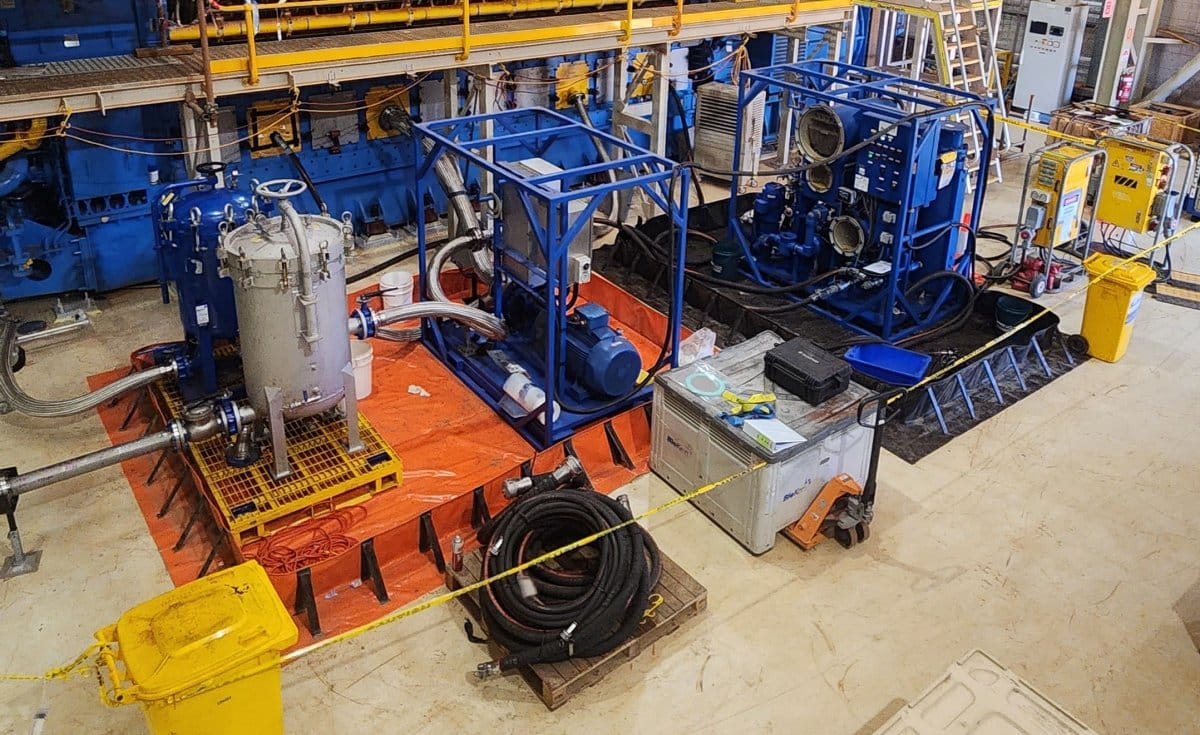
Did you know that 82% of mechanical wear in Australian industrial machinery is caused by particle contamination that standard filtration simply cannot catch? You’ve likely seen how traditional oil changes fail to reach the deep-seated varnish that leads to valve sticking and costly unscheduled downtime. It’s frustrating to watch high-value assets degrade when you’re following a standard maintenance schedule. Understanding the benefits of hot oil flushing is essential for any facility manager looking to maintain operational integrity and meet strict environmental compliance standards in 2026.
By employing high-velocity, turbulent flow, this technical process removes sub-micron contaminants and prevents catastrophic failures before they start. You’ll discover how professional flushing helps your site consistently achieve ISO 4406 cleanliness targets while significantly extending the life of your lubricants and hardware. We’ll outline the specific steps to ensure your critical systems remain reliable post-overhaul and explain why this precision-led approach is the most effective way to protect your A$250,000 equipment investments.
Key Takeaways
-
Understand the technical distinction between standard maintenance and high-velocity decontamination, focusing on how a Reynolds Number exceeding 4,000 ensures the removal of stubborn sub-micron particles.
-
Learn the primary benefits of hot oil flushing, including how this proactive approach mitigates unscheduled downtime and significantly extends the operational lifespan of critical components.
-
Identify the critical windows for system decontamination, ranging from post-construction debris removal to preventing cross-contamination following major component failures.
-
Discover how BioKem Oil Services’ specialized high-flow machinery ensures adherence to Australian environmental and safety regulations while maximizing industrial asset reliability.
Table of Contents
-
The Science of Cleanliness: Turbulent Flow and the Reynolds Number
-
6 Strategic Benefits of Hot Oil Flushing for Asset Longevity
What is Industrial Hot Oil Flushing and Why Does It Matter?
Industrial hot oil flushing is a specialised, high-velocity maintenance procedure designed to purge internal debris from lubrication and hydraulic systems. It’s a far cry from the basic oil changes performed on consumer vehicles. While a standard engine flush might take 20 minutes at a local workshop, industrial decontamination involves circulating oil at elevated temperatures and extreme velocities for several days. This process represents a critical component of Contamination control, which is the discipline of managing particulate and chemical impurities to ensure machinery longevity and operational safety.
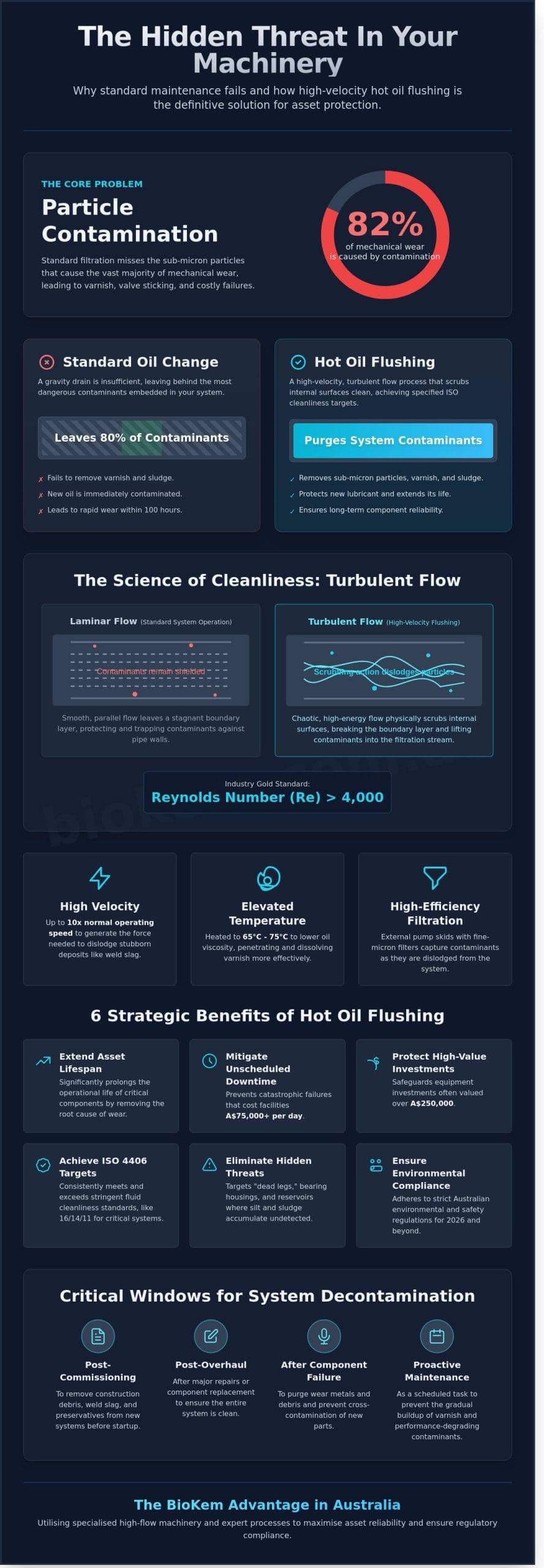
Temperature plays a vital role in this operation. By heating the oil to between 65°C and 75°C, we significantly lower its viscosity. This "thinner" fluid penetrates microscopic cracks and porous surfaces where cold, thick oil cannot reach. Relying on a standard oil change is often a mistake. Data from field studies shows that gravity-fed drains leave behind roughly 80% of system contaminants. These leftovers include wear metals, silica, and varnish. When you pour fresh oil into a system that hasn’t been flushed, the new fluid immediately suspends these old particles. This leads to rapid oxidation and component wear within the first 100 hours of operation. Understanding the benefits of hot oil flushing starts with acknowledging that a clean appearance in the reservoir doesn’t mean the internal pipework is free of hazards.
The Mechanics of High-Velocity System Cleaning
Effective cleaning requires turbulent flow, which is measured by a Reynolds number. To successfully "scrub" the internal surfaces of a pipe, we must achieve a Reynolds number exceeding 4,000. Standard internal system pumps aren’t suitable for this task. They’re designed to provide steady, laminar flow to protect sensitive parts. We utilise external pump skids capable of moving fluid at 10 times the normal operating speed. This high-velocity movement creates the mechanical force needed to dislodge weld slag and carbon deposits. We measure success against the ISO 4406 cleanliness standard. For high-pressure hydraulic systems in Australian mining operations, we often target a 16/14/11 rating to ensure maximum reliability.
Key Components Targeted During a Flush
The flush targets areas where contaminants naturally congregate. Bearing housings and reservoirs often act as settling tanks for heavy sludge. Complex pipework with sharp 90-degree bends and "dead legs" creates stagnant zones that standard flow bypasses entirely. These areas are breeding grounds for microbial growth and hydrocarbon breakdown products. Protecting sensitive control valves and actuators is a priority. Silt land buildup in these components leads to erratic performance or total failure. A single jammed valve on a turbine can result in unplanned downtime costing an Australian facility A$75,000 per day. One of the key benefits of hot oil flushing is the removal of these hidden threats before they cause a catastrophic breakdown. We ensure every valve seat and actuator port is clear of the silt that compromises precision.
The Science of Cleanliness: Turbulent Flow and the Reynolds Number
Effective industrial cleaning isn’t just about moving fluid through a pipe; it’s about the physics of fluid dynamics. To achieve the full benefits of hot oil flushing, we must move beyond laminar flow. In a laminar state, oil moves in smooth, parallel layers. The fluid touching the pipe wall remains almost stationary, creating a stagnant boundary layer that protects contaminants from being moved. Achieving a Reynolds Number (Re) of 4,000 or higher serves as the industry gold standard for breaking this boundary. At this threshold, the flow becomes turbulent, creating a chaotic, high-velocity scrubbing action that physically strikes the internal surfaces of the machinery to dislodge scale, silica, and metallic wear debris.
Temperature plays a decisive role in this mechanical cleaning process. One of the primary benefits of hot oil flushing is the way heat alters the physical properties of both the oil and the contaminants. As we increase the temperature, the oil’s kinematic viscosity drops significantly. This thinner fluid penetrates the microscopic pores of varnish and sludge more effectively than cold oil. Thermal expansion also occurs, causing the metal pipes and the hardened deposits to expand at different rates. This differential expansion creates micro-fractures in the varnish, allowing the turbulent oil to get underneath the deposits and peel them away from the metal surface.
Calculating the Reynolds Number for Your System
The Reynolds Number is calculated using the formula: (Velocity x Internal Pipe Diameter) / Kinematic Viscosity. Since the pipe diameter in your Australian facility is a fixed variable, we focus on velocity and viscosity to reach the 4,000 Re target. Increasing the flow rate via high-volume pumps is one method, but it’s often limited by the system’s pressure ratings. Therefore, increasing the temperature is the most efficient lever to pull. A strategic temperature increase can reduce viscosity enough to triple the Reynolds Number without needing a larger pump. This technical precision is a core component of a professional lube oil flushing procedure, ensuring that the energy spent on the flush translates directly into surface cleanliness.
The Role of High-Efficiency Filtration
Once turbulence has dislodged the contaminants, they must be removed from the circuit immediately. We utilise specialist oil filters that feature absolute-rated elements, typically Beta 1000 or higher. Unlike nominal filters, absolute-rated filters provide a 99.9 percent capture efficiency for particles at a specific micron size, preventing the "sandblasting" effect where dislodged debris causes further damage downstream. Monitoring this progress requires more than visual inspection. By employing particle pal range technology, our technicians track real-time ISO 4406 cleanliness levels. This ensures the flush is only concluded when the oil meets the manufacturer’s stringent specifications, often reaching levels as clean as ISO 14/12/10. To ensure your system meets these rigorous standards, you can speak with Biokem’s technical specialists about a custom filtration strategy.
6 Strategic Benefits of Hot Oil Flushing for Asset Longevity
Implementing a rigorous decontamination protocol is a prerequisite for maintaining high-value industrial assets. One of the primary benefits of hot oil flushing involves the systematic removal of internal contaminants that standard filtration cannot reach. By circulating turbulent, high-temperature fluid through the system, operators can dislodge particulate matter and chemical deposits, ensuring the internal surfaces remain pristine. This process directly correlates with a 40% reduction in unscheduled downtime for heavy machinery, as clean systems are less prone to the erratic pressure drops that signal impending failure.
Asset longevity depends heavily on the condition of precision components. Bearings, pumps, and servo-valves often fail prematurely due to microscopic abrasive particles that act as grinding paste. Effective flushing extends the service life of these components by up to 2.5 times the industry average. This isn’t merely a cleaning exercise; it’s a fundamental restoration of the lubrication environment. When turbulent flow reaches Reynolds numbers above 4,000, it creates the kinetic energy necessary to lift heavy debris from pipe walls, preventing catastrophic failures that often cost Australian mining operations upwards of A$150,000 per hour in lost productivity.
Thermal regulation is another critical factor. Sludge and scale buildup on heat exchanger surfaces acts as an insulator, forcing cooling systems to work harder. Hot oil flushing restores optimized heat transfer efficiency, which lowers the overall operating temperature of the lubricant. Lower temperatures mean the oil stays within its ideal viscosity range, providing better film strength and reducing the energy consumption of the pump motors. This proactive approach also prevents "ghosting" in turbines, where varnish deposits cause sensors to provide false readings, leading to unnecessary trips and restarts.
This principle of maintaining clean heat exchangers for optimal thermal regulation is universal, applying just as much to commercial cooling systems as it does to industrial machinery. For facility managers also responsible for building services, it can be useful to discover RMI Heating and Air Conditioning and their expertise on common HVAC issues.
Enhanced Reliability for Critical Infrastructure
Power generation and mining sectors in Australia demand 99.9% uptime to remain profitable and compliant. The ROI of preventive Hot oil flushing far outweighs the cost of reactive component replacement. For instance, a 2022 case study in the Western Australian mining corridor demonstrated that a scheduled flush of a hydraulic shovel system prevented a predicted A$450,000 catastrophic pump failure. Maintaining these rigorous cleanliness standards ensures that critical infrastructure operates without the threat of sudden hydraulic lock or valve sticking.
This principle of proactive protection extends to other demanding environments, such as the maritime sector, where external hull integrity is just as vital for performance and asset longevity. For those managing marine assets, it’s interesting to see how advanced coatings play a similar role in preventing degradation; you can discover Seacoat SCT, LLC for examples of modern, non-toxic solutions.
This holistic approach to uptime isn’t limited to internal systems; managing the complex logistics of site traffic is equally vital for safety and productivity, a challenge addressed by expert consultancies such as ML Traffic Engineers Pty Ltd. Similarly, the design of workshops and control rooms can impact efficiency, and for custom commercial fit-outs, you can visit Perfect FIT Interior.
Varnish Mitigation and Chemical Stability
This process is essential for removing the chemical precursors to oil varnish before they can solidify on cool metal surfaces. By stripping away polar degradation products, flushing maintains the integrity of the new oil’s additive package. It effectively reduces the "catalytic effect" of wear metals, such as copper and iron, which accelerate oil oxidation. This ensures the lubricant remains chemically stable for its full intended service life, reducing the frequency of oil changes and lowering the environmental footprint of the facility.
The benefits of hot oil flushing extend beyond simple cleanliness. It’s a comprehensive strategy for operational excellence. By focusing on the following six areas, facilities can secure their bottom line:
-
Significant reduction in catastrophic component failures.
-
Extension of bearing and valve lifecycle by 200%.
-
Restoration of heat transfer coefficients in cooling circuits.
-
Elimination of varnish-induced valve sticking.
-
Protection of the chemical integrity of expensive synthetic lubricants.
-
Compliance with strict ISO 4406 cleanliness codes required for warranty validation.
Biokem’s approach focuses on these technical outcomes to ensure that every litre of oil performs at its peak, supporting both the mechanical health of the asset and the sustainability goals of the organisation.
The core principle of maintaining clean, unobstructed fluid pathways is universal, applying to systems of all sizes. While industrial machinery requires the complex process of hot oil flushing, even a simple garden irrigation setup relies on clear pipes for effective water distribution. For homeowners looking to manage their own small-scale fluid systems, you can check out Garden Watering for a wide selection of reliable equipment.
When to Perform a Flush: Identifying the Critical Windows
Determining the precise moment to initiate a high-velocity flush is a decision that impacts the long term reliability of your industrial assets. It’s not merely a reactive measure for when things go wrong; it’s a strategic intervention. Approximately 80% of hydraulic system failures stem from fluid contamination. By identifying specific operational windows, you can mitigate these risks before they escalate into A$50,000 repair bills or unplanned site shutdowns. One of the primary benefits of hot oil flushing is its ability to reset the system’s cleanliness baseline, ensuring that internal surfaces are free from the microscopic "lapping compounds" that accelerate wear.
There are four distinct scenarios where a flush becomes non-negotiable for operational integrity:
-
Post-construction: New pipework often contains welding slag, protective coatings, and grit. A flush removes this "built-in" debris before it reaches sensitive valves.
-
Component failure: When a pump or motor fails, it releases a shower of metallic particles. Without a flush, this debris circulates, causing secondary damage to healthy components.
-
Scheduled turnarounds: Major overhauls provide the perfect window to perform deep cleaning without affecting production targets.
-
ISO particle spikes: When laboratory results show a sudden jump in contaminant levels, it indicates that the existing filtration can no longer keep up with the ingress or internal wear.
In cases of component failure, the repair or refurbishment of the equipment and the subsequent system flush go hand-in-hand. This is where comprehensive maintenance providers like Kelsey Machine Services play a crucial role, addressing both the mechanical fault and the resulting contamination.
Post-Construction and Commissioning Flushes
New industrial systems are frequently at their most vulnerable during the commissioning phase. This paradox, often called "infant mortality," occurs because microscopic debris from the manufacturing and assembly process remains trapped in the lines. Dust, moisture, and metal shavings don’t just disappear; they migrate to the tightest tolerances in your machinery. In large scale Australian hydraulic systems, standard protocols require achieving a specific Reynolds number to ensure turbulent flow. This process ensures you realise the full benefits of hot oil flushing before the first motor turns, scrubbing the internal pipe walls clean of any residual hydrocarbons or construction waste.
Interpreting Oil Analysis for Flushing Needs
Data should always drive your maintenance decisions. Routine oil analysis provides the early warning signs that a system is reaching a critical contamination point. A filter ferrogram analysis is particularly effective here, as it identifies the shape, size, and composition of wear particles. If you see "patch tests" showing a high concentration of dark metallics or silicates, a simple oil change won’t suffice. You must address the debris adhering to the pipe walls. We look for triggers based on the ISO 4406:2021 standards. If your particle counts exceed the manufacturer’s limit by two or more codes, such as jumping from 16/14/11 to 18/16/13, a full system flush is the only way to restore the fluid to a safe operating state.
Is your machinery showing signs of internal wear or approaching a major overhaul? Contact Biokem today to schedule a professional oil analysis and flushing consultation.
Professional Execution: The BioKem Advantage in Australia
BioKem brings a technical edge to Australian industrial maintenance through onsite deployment of specialized high-flow machinery. We don’t just provide a service; we deliver a rigorous engineering solution designed to restore system integrity. Our rigs are capable of flow rates exceeding 3,000 litres per minute, which is essential for creating the turbulent flow required to dislodge sub-micron contaminants. Every operation we conduct adheres to strict Australian environmental and safety regulations, including the AS 1940:2017 standards for the storage and handling of flammable and combustible liquids. We prioritize site safety and regulatory compliance to ensure that your facility remains operational and risk-free during the cleaning process.
Our team integrates deep heat transfer system expertise into every project. We understand how thermal fluids behave under pressure and temperature fluctuations. This knowledge allows us to optimize the flushing temperature to maximize the solubility of deposits without compromising the oil’s chemical stability. Upon completion, we provide comprehensive reporting that includes ISO 4406 cleanliness certification. This documentation serves as a verifiable record that your machinery meets OEM requirements. Understanding the benefits of hot oil flushing is only half the battle; the other half is executing the flush with the precision that BioKem provides to the Australian market.
Customized Flushing Procedures for Diverse Industries
We recognize that a one size fits all approach fails in complex industrial environments. A high-speed steam turbine requires vastly different flow dynamics than a 500-tonne hydraulic press. For instance, we target a Reynolds number above 4,000 to ensure turbulent flow in large-bore piping, ensuring no debris is left behind. To guarantee results, we utilize paddle flushing screens for real-time visual verification of particle capture. As the exclusive Filters S.p.A. distributor in Australia, we have access to world-class filtration technology that captures contaminants traditional filters miss. This specialized equipment allows us to tailor the procedure to your specific asset’s needs, whether it’s in a remote mining site or a metropolitan manufacturing plant.
Eco-Friendly Industrial Solutions
BioKem’s methodology focuses on the circular economy by minimizing oil waste. We use advanced purification units that allow for the reuse of up to 95% of the flushing fluid, significantly reducing the cost of replacement oil and disposal fees. Our commitment to biological and nature-based alternatives sets us apart from competitors who rely on harsh, chemical-heavy solvents. These bio-based solutions are safer for your staff and the local environment. By 2023, our processes helped Australian energy firms reduce their hazardous hydrocarbon waste by an average of 12 tonnes per major shutdown. We ensure all waste management aligns with state-based EPA guidelines, reinforcing the long-term benefits of hot oil flushing for both your balance sheet and the planet.
Ready to improve your machinery’s reliability and extend its service life? Contact BioKem for a Technical Consultation to secure a customized maintenance plan for your Australian operations.
Securing Industrial Asset Performance for 2026 and Beyond
Maintaining system cleanliness isn’t just a standard maintenance task; it’s a strategic investment in your plant’s operational future. By leveraging turbulent flow to achieve a Reynolds number exceeding 4,000, you ensure that sub-micron contaminants are effectively dislodged before they cause catastrophic failure. The primary benefits of hot oil flushing include a significant reduction in premature component wear and the prevention of costly unscheduled downtime during critical 2026 production cycles.
BioKem brings technical precision to every project as the sole Australian distributor for Filters S.p.A. technology. Our specialist technicians possess over 15 years of industrial experience, providing onsite services nationwide to meet strict Australian regulatory standards. We focus on both mechanical efficiency and biological integrity to keep your machinery running at peak performance while adhering to eco-friendly practices. Protecting your infrastructure requires a partner who understands the science of fluid purity.
Get an expert quote for Hot Oil Flushing services from BioKem
Your assets deserve the highest standard of care to ensure long-term reliability and sustainable growth in the Australian industrial landscape.
Frequently Asked Questions
How long does a typical industrial hot oil flush take?
A typical industrial hot oil flush takes between 24 and 72 hours for most standard hydraulic systems. Complex turbine setups or large-scale mining machinery can extend this timeline to 7 days depending on the system’s total volume. Efficiency depends on reaching a Reynolds number above 4,000 to ensure turbulent flow. This mechanical action dislodges 95% of adhered contaminants that static soaking can’t reach.
Is hot oil flushing safe for older hydraulic systems?
Hot oil flushing is safe for older hydraulic systems when technicians calibrate the pressure and temperature to the original equipment manufacturer’s specifications. Older assets often carry 20% more internal oxidation than newer models. Using high-velocity flow instead of harsh chemical solvents protects aged seals while removing the sludge that causes component failure. It’s a precise way to extend the service life of 20-year-old machinery without risking structural integrity.
What is the difference between an oil change and a hot oil flush?
An oil change only replaces the fluid, whereas a hot oil flush cleans the entire internal architecture of the machine. One of the primary benefits of hot oil flushing is that it removes the 80% of contaminants that remain trapped in pipework after a standard drain. We use specialised filtration skids to circulate oil at high speeds; this ensures the system reaches ISO cleanliness standards that a simple oil swap won’t achieve.
Can hot oil flushing remove varnish from turbine bearings?
Hot oil flushing can remove varnish from turbine bearings when the oil temperature is maintained between 65°C and 75°C. Varnish typically causes system trips at temperatures exceeding 60°C, so targeted flushing dissolves these soft contaminants back into the oil stream. By integrating specialized varnish removal inserts into the filtration circuit, we can capture 98% of these deposits. This process restores critical bearing clearances and prevents unplanned outages.
How much does a professional hot oil flushing service cost in Australia?
Professional hot oil flushing services in Australia typically cost between A$5,000 for small industrial units and A$55,000 for large-scale power generation systems. Prices vary based on the required flow rate and the location of the site, such as the Pilbara or Hunter Valley. Mobilisation for remote Australian operations often adds A$2,500 to A$5,000 to the project total. These costs reflect the high-grade equipment and technical expertise required for compliance.
What ISO cleanliness level should I target for a turbine system?
You should target an ISO 4406 cleanliness level of 16/14/11 for most modern turbine systems to ensure operational reliability. High-pressure systems with tight tolerances often require even stricter levels, such as 15/13/10. We use calibrated laser particle counters to verify these results in real-time. Meeting these benchmarks reduces the risk of servo-valve failure by approximately 70% and aligns with Australian industrial maintenance standards.
Do I need to replace my oil after a hot oil flush?
You usually need to replace the flushing fluid with a final service charge after the process is complete to ensure maximum purity. The benefits of hot oil flushing are most evident when the final oil remains clean for longer periods. If you use the existing oil for the flush, it must be passed through 1-micron filtration until it meets the required ISO code. Most Australian sites prefer a fresh charge to guarantee 100% additive integrity.
What equipment is required for a high-velocity oil flush?
High-velocity oil flushing requires an external pumping skid, high-capacity filter housings, and a heat exchanger to maintain temperatures. The pump must be capable of delivering flow rates often exceeding 3,000 litres per minute to create the necessary turbulence. We also utilise stainless steel bypass jumpers and 3-micron absolute-rated filters. This specialised hardware ensures that even microscopic particles are stripped from the pipe walls and captured effectively.