

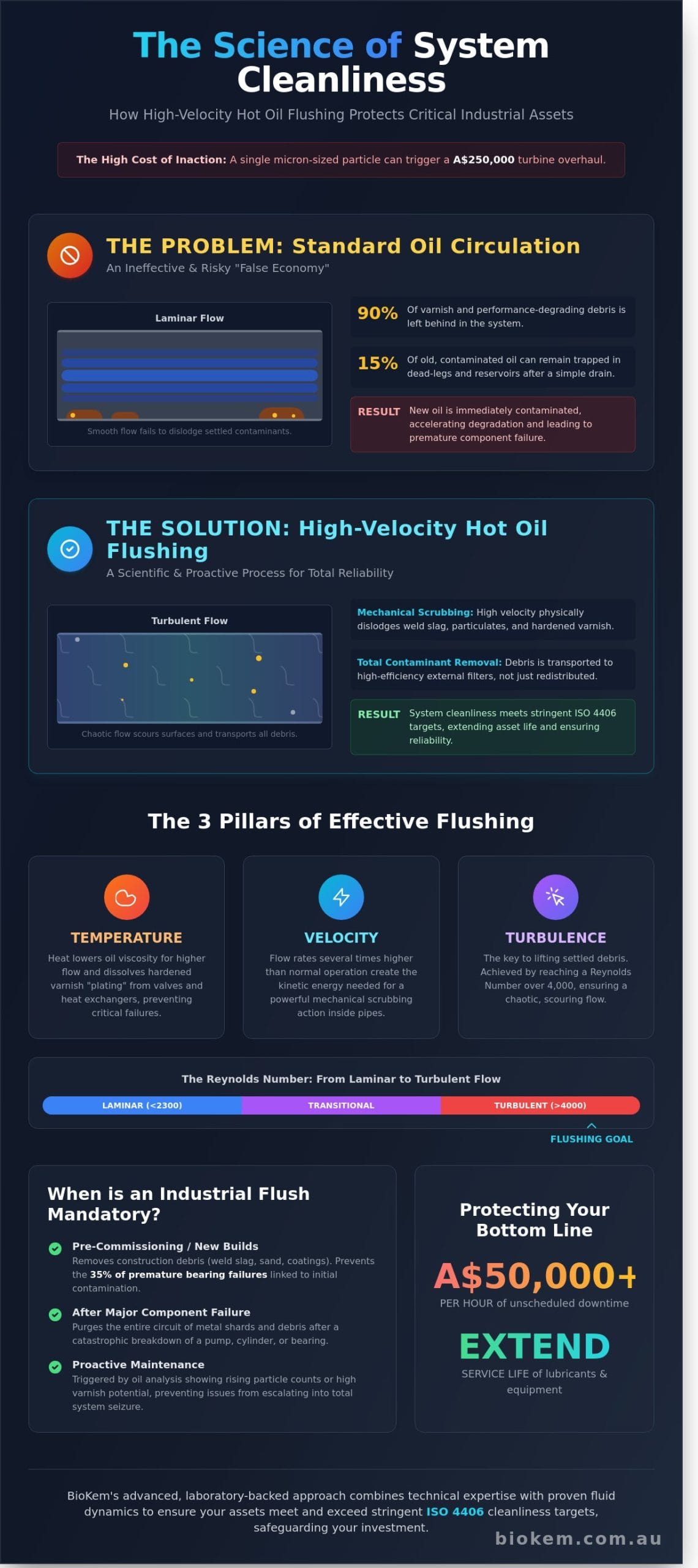
A single micron-sized particle can trigger a chain reaction leading to a A$250,000 turbine overhaul during peak production. It’s a frustrating reality for maintenance managers across Australia that standard oil circulation often leaves behind 90% of the varnish and debris responsible for critical valve sticking. Understanding exactly how hot oil flushing works is the only way to effectively dislodge these contaminants by leveraging high-velocity turbulent flow rather than simple, ineffective circulation.
You’ll learn how to achieve stringent ISO 4406 cleanliness targets and significantly extend the service life of your expensive industrial lubricants through precise thermal and mechanical control. This guide breaks down the technical interplay between Reynolds numbers, thermal expansion, and high-efficiency filtration protocols. We’ll outline the scientific roadmap to ensure total system reliability before commissioning or after a major overhaul, protecting your operational budget and your assets from the high costs of unscheduled downtime.
Key Takeaways
- Discover how hot oil flushing works as a high-velocity mechanical scrubbing process, distinguishing these critical industrial-scale operations from standard automotive engine flushes.
- Learn how to calculate and leverage the Reynolds Number (Re) to ensure turbulent flow, which is essential for dislodging stubborn contaminants from internal piping.
- Understand the critical role of temperature in dissolving varnish “plating” on sensitive components like heat exchangers and valves to prevent catastrophic system failure.
- Explore the strategic implementation of high-flow pumping skids and filtration units to safely bypass sensitive assets while maintaining Australian industrial compliance.
- Gain insight into BioKem’s advanced laboratory-backed approach, combining technical expertise with environmentally conscious practices to extend the life of your industrial assets.
Understanding Hot Oil Flushing: Industrial vs. Automotive Contexts
Hot oil flushing is a specialized high-velocity cleaning process designed to remove contaminants from the internal surfaces of piping and sensitive mechanical components. It’s a critical maintenance procedure for heavy industrial assets. Unlike a simple oil change, this process uses heat and high flow rates to mechanically scrub the interior of a system. This ensures that the lubricant circulating through your bearings is as clean as the day it was refined. In the Australian mining and power generation sectors, where downtime costs can exceed A$50,000 per hour, this level of cleanliness isn’t optional.
It’s vital to distinguish industrial-scale flushing from the “engine flushes” often discussed on automotive forums. Consumer engine flushes typically involve adding a chemical solvent to a car’s crankcase for ten minutes before draining. Industrial flushing is a purely mechanical and thermal operation. It involves circulating specialized fluids at velocities several times higher than normal operating speeds. This process is essential for the lifecycle of turbines, large compressors, and complex hydraulic systems that power our national infrastructure.
A standard oil change is often a false economy for large systems. Gravity draining typically leaves up to 15% of old, contaminated oil trapped in “dead-legs,” valve manifolds, and the bottom of large reservoirs. These remnants contain concentrated particulates and oxidation byproducts. When you add new oil, these trapped contaminants immediately seed the fresh batch, degrading its performance. This is how hot oil flushing works to protect your investment; it physically forces these hidden pockets of debris out of the system and into high-capacity filtration units.
When is an Industrial Flush Mandatory?
Pre-commissioning is the most critical time for a flush. New piping often contains construction debris such as weld slag, silica sand, and preservative coatings. In 2023, a study of Australian industrial startups found that 35% of premature bearing failures were directly linked to debris left behind during construction. You also need a flush after a major component failure. If a pump or cylinder undergoes a catastrophic breakdown, metal shards migrate throughout the entire circuit. Proactive maintenance is the final trigger. When oil analysis shows rising particle counts or a high varnish potential, a flush prevents these issues from escalating into a total system seizure.
The Limitations of Standard Oil Circulation
Normal system operation relies on laminar flow. This is a smooth, layered movement where the oil near the pipe walls moves much slower than the oil in the center. This flow pattern fails to dislodge settled particulate. It creates what engineers call the “sand dune” effect, where contaminants settle in low-flow areas and stay there, regardless of how many times you change the oil. Understanding The Physics of Cleanliness is key to solving this problem.
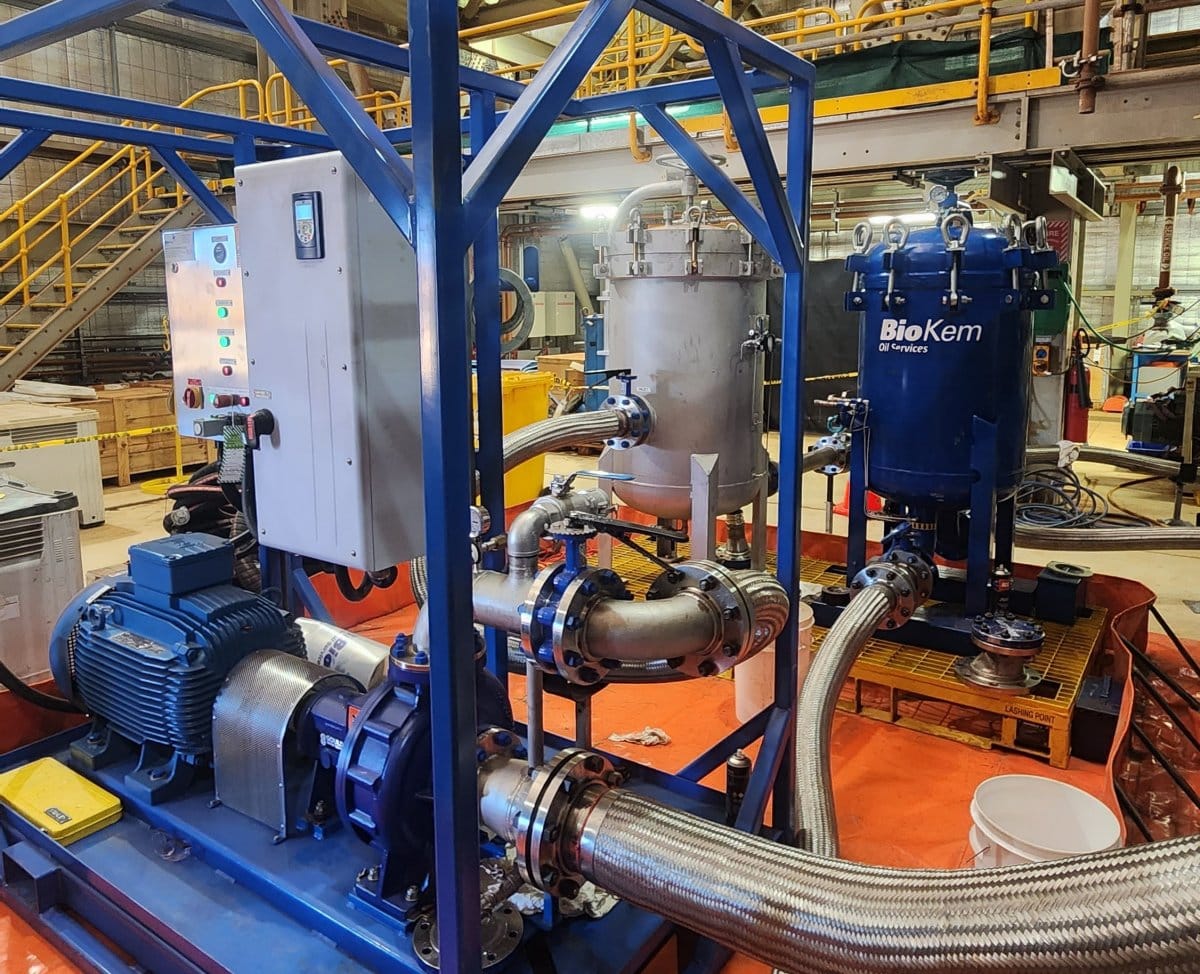
To remove these “dunes,” the fluid must reach a state of turbulence. This is exactly how hot oil flushing works in a professional setting. By increasing the oil temperature, we lower its viscosity, which allows for much higher velocities. Hot oil flushing and filtering services from BioKem utilize external high-flow pump skids to achieve Reynolds numbers above 4,000. This level of turbulence creates the scouring action needed to lift heavy particulates and transport them to the filters, overcoming the mechanical limitations of the system’s internal pumps.
The Physics of Cleanliness: How Heat and Turbulence Remove Contaminants
Understanding how hot oil flushing works begins with fluid dynamics, specifically the transition from passive lubrication to active mechanical cleaning. In standard operations, oil flows through piping in a laminar state, which is smooth and orderly. While this protects bearings during runtime, it allows microscopic particulates, welding slag, and oxidation products to settle in “dead zones” or adhere to pipe walls. To remove these threats, we must convert the fluid into a high-velocity tool that physically scrubs the internal surfaces of the lubrication system.
This scrubbing action relies on kinetic energy. By forcing fluid through the system at rates significantly higher than normal operating parameters, we create a chaotic flow that dislodges stubborn debris. This process aligns with high-velocity flushing best practices, ensuring that the force applied to the pipe walls exceeds the adhesive forces holding the contaminants in place. Without this mechanical energy, even the most expensive synthetic oils cannot effectively clean a fouled system.
Achieving Turbulent Flow (Reynolds Number > 4000)
The success of an industrial flush is measured by the Reynolds Number (Re). The Reynolds Number is the dimensionless quantity used to predict fluid flow patterns. For a flush to be effective, the Re must exceed 4000, the point where flow becomes fully turbulent. In contrast, most internal pumps on Australian industrial machinery are sized only for laminar flow, typically maintaining an Re below 2000 to ensure smooth delivery to bearings.
Calculating the required flow rate is a critical engineering step. It requires balancing fluid velocity, pipe diameter, and the oil’s moving viscosity. Because the internal pumps are insufficient, Biokem utilizes external high-flow pump skids capable of moving thousands of litres per minute. This ensures every centimetre of the piping network experiences the chaotic, multi-directional impact required to lift heavy particulates. Achieving this state is the only way to guarantee that 95% or more of built-up debris is successfully transported to the filtration unit.
The Role of Thermal Shock and Solubility
Heat is the second pillar of the flushing process. Increasing the oil temperature to between 60°C and 70°C serves two vital purposes. First, it dramatically reduces the oil’s viscosity. Thinner oil moves faster and reaches a turbulent state with less pressure, making the entire operation more energy-efficient. Second, heat increases the oil’s solubility, allowing it to dissolve varnishes and hold a higher concentration of contaminants in suspension until they reach the filters.
We also employ thermal shock by cycling the temperature during the flush. Rapidly changing the oil temperature causes the metal piping to expand and contract. This microscopic movement is often enough to crack brittle scale or rust away from the pipe’s interior. To verify the effectiveness of these physics in real-time, technicians use paddle flushing screens. These screens provide a visual and physical record of the debris being removed, ensuring the system meets ISO 4406 cleanliness standards before the job is called complete.
Maintaining these high standards protects your capital intensive assets from premature wear. If you are concerned about the internal health of your machinery, consider professional oil analysis and maintenance services to establish a baseline for your equipment. By applying these rigorous physical principles, we transform oil from a simple lubricant into a powerful cleaning agent that extends the life of every bearing in your system.
Why Temperature and Velocity Matter for Varnish Mitigation
Varnish represents the final stage of oil degradation. It consists of soft, polar molecules that result from the oxidation of hydrocarbons within the lubrication system. These sticky byproducts remain suspended in the oil while the system operates at peak temperature, but they quickly “plate out” as temperatures drop. This phenomenon occurs most frequently on cooler metal surfaces, such as heat exchanger tubes and valve internals, where the varnish hardens into a tenacious film. Understanding the “Solubility Window” is vital to understanding how hot oil flushing works to restore system integrity. By raising the oil temperature above 60°C, the solubility of the fluid increases, allowing it to re-dissolve these semi-solid deposits back into the liquid phase. This transition is critical because mechanical scraping alone cannot reach every internal crevice of a complex piping network.
Success depends on maintaining a delicate balance between thermal energy and fluid dynamics. We adhere to the guidelines established in ASTM D6439, which provides the technical framework for cleaning and flushing industrial lubricant systems. Without reaching a high-velocity, turbulent flow state, specifically a Reynolds number exceeding 4,000, the oil simply glides over the varnish layers. High-velocity flushing creates the mechanical shear necessary to strip these contaminants from the pipe walls. This method is the gold standard for how hot oil flushing works in high-stakes environments like mining and power generation. Once dissolved or suspended, these particles must be immediately captured by high-efficiency filtration. Without 0.5 to 3-micron filtration active during the flush, the varnish will simply migrate and re-deposit elsewhere when the oil cools. This process reduces the environmental footprint of the operation by extending the life of the existing oil charge, aligning with modern Australian sustainability mandates.
Solving the “Sticking Valve” Problem
Varnish buildup is a primary cause of servo-valve lag in power generation assets. Even a microscopic layer of 5 microns can cause spool sticking, leading to erratic turbine behavior or costly emergency trips. In Australian peak-load plants, a single unplanned outage can result in losses exceeding A$150,000 per day. The turbulent action of hot oil flushing physically scours these critical components. For facilities facing chronic degradation, integrating a dedicated varnish removal system ensures long-term mitigation by continuously removing oxidation byproducts before they can solidify. This proactive approach prevents the sticky “soft” varnish from ever reaching the plating stage.
Verification via ISO 4406 Cleanliness Codes
We quantify the success of a flush through the ISO 4406 standard. Most Australian industrial specifications for high-speed bearings now demand a cleanliness target of 16/14/11 or better. Achieving these numbers requires side-stream filtration units capable of processing the entire oil volume multiple times per hour. We don’t rely solely on automated particle counters, as they can sometimes misinterpret air bubbles or water droplets. Using patch test kits provides visual, undeniable proof of system cleanliness. This membrane patch colorimetry (MPC) testing reveals the actual varnish potential remaining in the fluid, ensuring the asset is protected against premature wear and thermal instability. It’s a transparent way to verify that the biological and mechanical health of the system is restored.
The Step-by-Step Industrial Hot Oil Flushing Process
Understanding how hot oil flushing works requires a focus on fluid dynamics and thermal expansion. It’s a scientific method designed to remove contaminants that standard filtration cannot reach. The process begins with a comprehensive system audit where engineers identify every “dead leg” and sensitive component within the lubrication circuit. This ensures the cleaning fluid reaches every internal surface at the required velocity.
Preparation and Component Bypassing
Before the flush begins, technicians must isolate “no-go” zones. High-precision components like bearings, control valves, and actuators are extremely sensitive to the debris dislodged during the cleaning cycle. We install temporary jumpers and bypass blocks to create a continuous loop, protecting these assets while allowing for maximum flow velocity. This circuit is then connected to external oil filtration systems and high-capacity pumping skids. These external units provide the necessary power to achieve turbulent flow, which is often 2 to 3 times the system’s normal operating flow rate.
Specialised jumpers are essential for maintaining the loop’s integrity. By bypassing the bearings, we can safely circulate oil at high speeds without risking mechanical damage from dislodged scale or weld slag. This preparation phase typically accounts for 30% of the total project time but is vital for a successful outcome.
Execution and Real-Time Monitoring
Once the loop is secure, the heating phase begins. We raise the oil temperature to between 50°C and 70°C. This temperature range is optimal because it lowers the oil’s viscosity and causes the metal piping to expand slightly, which helps crack and loosen stubborn varnish and carbon deposits. This is the core of how hot oil flushing works; the heat prepares the contaminants, and the velocity removes them. We target a Reynolds number of at least 4,000 to ensure the flow is turbulent enough to scour the pipe walls effectively.
- Flow Reversal: We periodically reverse the direction of the oil. This ensures that “shadow zones” behind elbows and tees are thoroughly cleaned.
- Mechanical Agitation: Technicians often use pneumatic vibrators or manual tapping on the pipework to help dislodge trapped particulates.
- ISO Cleanliness Tracking: We use calibrated laser particle counters to monitor the oil’s ISO 4406 code every 15 to 30 minutes.
Final validation occurs when the system maintains a specific cleanliness target, such as ISO 15/13/10, for a minimum of three consecutive hours. We don’t rely on visual inspections. Instead, we use data-driven verification to ensure the system meets Australian regulatory and OEM standards. After reaching the target, we drain the flushing oil, remove the jumpers, and restore the original components. A final leak test and a small-scale circulation check confirm the system is ready for full operation. This rigorous approach can extend the life of industrial bearings by over 50% by eliminating the primary cause of early-stage wear.
Protect your critical infrastructure from internal contamination. Contact Biokem today for a technical consultation on your next maintenance shutdown.
Implementing a High-Velocity Flushing Programme with BioKem
Understanding how hot oil flushing works is the first step toward asset longevity. However, executing this process requires significant technical oversight to prevent unintended system damage. If a flush is performed without precise pressure control, it can rupture internal seals or force contaminants deeper into sensitive bearing clearances. BioKem provides the onsite expertise necessary to manage these variables. Our technicians monitor flow rates and temperatures in real-time, ensuring the system reaches the turbulent flow required to dislodge stubborn varnish without exceeding the design limits of your hardware.
BioKem’s technical methodology integrates high-flow equipment with rigorous laboratory analysis. We don’t just circulate oil; we use a data-driven approach to verify cleanliness. Our technicians explain how hot oil flushing works to site managers to ensure every bypass and valve is correctly positioned for maximum debris removal. By using onsite particle counters and moisture sensors, we provide immediate verification that the system has reached the target ISO 4406 cleanliness levels. This eliminates guesswork and ensures that the machinery is ready for immediate, reliable restart.
Environmental responsibility is a core component of our service delivery. Many industrial operations traditionally dispose of contaminated oil, which leads to high replacement costs and significant ecological footprints. BioKem’s purification technology extends the life of existing oil stocks, often achieving a 75% reduction in waste oil disposal volumes. By removing water, particulate matter, and oxidation products, we restore the fluid’s chemical stability. This circular approach reduces the need for new lubricant purchases, saving thousands of Australian dollars while aligning with modern ESG (Environmental, Social, and Governance) standards.
During a 2022 maintenance shutdown for a power station in the Hunter Valley, BioKem identified critical varnish accumulation in a gas turbine’s lubrication circuit. The high-velocity flush removed 4.2 kilograms of particulate matter that standard bypass filtration had failed to capture. This targeted intervention prevented a projected A$1.2 million component failure and restored the system to an ISO 4406 14/12/9 cleanliness standard. The project was completed 12 hours ahead of schedule, allowing the facility to return to the grid without delay.
Specialised Equipment and National Support
Our fleet features high-flow pumping skids capable of delivering 4,500 litres per minute, alongside advanced vacuum dehydration units. As the Australian distributor for Filters S.p.A., BioKem provides local access to world-leading filtration technology. We maintain a strong service presence across the continent. Whether your assets are located in the industrial hubs of Queensland or the remote mining regions of Western Australia, our mobile teams provide consistent, high-standard technical support to keep your operations running.
Next Steps for Asset Reliability
Reliability starts with a clear understanding of your fluid’s current condition. We recommend beginning with a comprehensive system audit to determine varnish potential and particle load. Combining high-velocity flushing with advanced oil analysis, such as filter ferrograms, creates a total fluid management solution that tracks wear patterns over time. This proactive stance prevents the catastrophic bearing failures that lead to unplanned downtime. Contact BioKem Oil Services today to schedule your high-velocity flush and secure your asset’s operational future.
Protect Your Industrial Assets with High-Velocity Precision
Understanding how hot oil flushing works is critical for maintaining the operational integrity of high-value Australian industrial infrastructure. Effective decontamination requires more than just circulating warm oil; it demands achieving a Reynolds Number greater than 4000 to create the turbulent flow necessary for dislodging sub-micron contaminants and stubborn varnish. BioKem serves as the sole Australian distributor for Filters S.p.A., providing specialized equipment that meets these exact scientific parameters. We don’t rely on guesswork. Our process includes onsite laboratory-grade oil analysis and ISO 4406 verification to prove your system’s cleanliness in real-time. This level of technical precision ensures your hydraulic and lubrication systems operate at peak efficiency while staying compliant with local environmental regulations. By investing in a high-velocity flushing programme, you’re proactively preventing varnish-related failures and extending the service life of your machinery. It’s a strategic move that safeguards your bottom line and supports sustainable industrial practices across your site. Ready to optimize your system’s performance?
Request a Technical Consultation for Your Onsite Oil Flushing Project
We look forward to partnering with you to achieve a cleaner, more reliable industrial future.
Frequently Asked Questions
How long does a typical industrial hot oil flush take?
A typical industrial hot oil flush takes between 24 and 72 hours for standard turbine or hydraulic circuits. Complex systems with extensive pipework can extend to 10 days to achieve the required ISO 4406 cleanliness levels. We monitor the process continuously to ensure contaminants like varnish and particulates are fully suspended. This timeframe ensures the fluid reaches the thermal energy needed to dislodge stubborn debris without compromising the integrity of the system components.
Can I use my system’s existing pump for the flushing process?
You generally cannot use your system’s existing pump because it lacks the flow rate required to achieve turbulent flow. Most internal pumps are sized for operational efficiency, not the high velocity needed for scouring pipe walls. Biokem utilizes external high-flow flushing skids that deliver up to 4,000 litres per minute. This external equipment is essential for understanding how hot oil flushing works to remove 98 percent of internal contaminants effectively.
What is the ideal Reynolds Number for an effective hot oil flush?
The ideal Reynolds Number for an effective hot oil flush is 4,000 or higher to transition from laminar to turbulent flow. For maximum scouring efficiency, we aim for a Reynolds Number exceeding 10,000. This high-velocity movement creates the necessary scrubbing action against the internal surfaces of the piping. Achieving these specific hydraulic conditions is a core part of how hot oil flushing works to prevent premature bearing failure in Australian industrial plants.
Is hot oil flushing safe for older hydraulic systems with degraded seals?
Hot oil flushing is safe for older hydraulic systems provided the temperature remains within the seal manufacturer’s 60 to 70 degree Celsius limit. We conduct a pre-flush audit to identify Viton or Nitrile components that might be sensitive to thermal shifts. Our technicians follow Australian Standard AS 4024 to ensure pressure and temperature levels don’t exceed the safe operating window for aged infrastructure. This careful monitoring prevents leaks while still removing harmful sludge.
How do I know when the flushing process is complete?
The flushing process is complete when three consecutive oil samples meet the specified ISO 4406 cleanliness code, such as 16/14/11. We use calibrated laser particle counters to verify these results on-site. If the particle count doesn’t drop below the target for two hours, the flush continues. This data-driven approach ensures your bearings are protected by fluid that meets or exceeds the original equipment manufacturer’s specifications.
What is the difference between hot oil flushing and vacuum dehydration?
Hot oil flushing removes solid particulates and varnish through high-velocity turbulence, while vacuum dehydration targets dissolved water and gases. Flushing is a mechanical cleaning of the pipes; dehydration is a purification of the oil itself. In many Australian mining operations, we combine both methods. This dual approach removes 99.9 percent of moisture and achieves the target micron rating for solid contaminants simultaneously.
Will flushing remove “hard” scale and rust from inside the pipes?
No, hot oil flushing won’t remove hard scale or deeply bonded rust from internal pipe surfaces. These stubborn oxides require a chemical pickling process or mechanical pigging before the final oil flush. Flushing is designed to capture loose debris, weld slag, and carbon deposits. If your pipes show more than 15 percent internal corrosion, we recommend a multi-stage decontamination strategy to protect your sensitive hydraulic valves.
How often should a turbine system undergo hot oil flushing?
A turbine system should undergo hot oil flushing during initial commissioning and subsequently every 48 to 60 months. Major overhauls or significant component replacements also trigger a mandatory flush to clear built-in contaminants. Regular oil analysis under Australian conditions might indicate an earlier intervention if varnish potential ratings exceed 30. Proactive flushing every five years can extend the lifespan of your critical bearings by up to 200 percent.