

Uncategorised

Could a single micron-sized particle cost your operation A$25,000 per hour in unscheduled downtime? Industry data confirms that 80% of hydraulic system failures stem directly from fluid contamination. You understand that maintaining system cleanliness is the baseline for operational survival, yet the complexity of managing large-scale infrastructure often leads to overlooked varnish and debris. BioKem Oil Services delivers professional hot oil flushing services australia wide to bridge this gap, utilizing high-velocity turbulent flow to strip contaminants that standard filtration simply cannot reach.

You’ll discover how our technical approach protects your critical assets from premature component wear and ensures full compliance with ISO 4406 cleanliness standards. We address the specific logistical challenges of mobilizing specialized equipment to remote Australian sites, providing a clear path to extended asset life and verified system integrity. This guide explores the engineering behind turbulent flow, the impact of hydrocarbon purity on efficiency, and the practical steps to eliminate valve sticking before it halts your production.

Key Takeaways

  • Understand why high-velocity flushing is essential for removing “built-in” contaminants like welding slag that standard filtration systems cannot capture.
  • Learn the engineering science of turbulent flow and how achieving the correct Reynolds Number is the mathematical threshold for a truly clean system.
  • Discover how to mitigate the “silent killer” of oil varnish by integrating chemical cleaning with high-temperature flushing to prevent valve sticking.
  • Master the interpretation of ISO 4406 and NAS 1638 standards to ensure your system cleanliness is verified by independent laboratory data.
  • Partner with BioKem for professional hot oil flushing services Australia-wide, providing turnkey solutions for critical assets in the Pilbara, Hunter Valley, and beyond.

The Critical Role of Hot Oil Flushing in Australian Heavy Industry

Hot oil flushing services australia provide a vital safeguard for high-stakes industrial operations. This specialized process involves circulating oil through lubrication and hydraulic circuits at high velocities to purge internal debris. It’s not a simple oil change. To be effective, the fluid must reach a Reynolds number greater than 4,000, creating the turbulent flow necessary to scrub the internal walls of the pipework. This mechanical energy dislodges particulates that would otherwise remain dormant until they migrate into sensitive components during peak operation. It’s a proactive measure that ensures the internal cleanliness of a system meets or exceeds ISO 4406 standards before the first start-up.

To better understand this technical process, watch this overview of the equipment used in the field:

Standard filtration systems often fail to capture “built-in” contaminants that originate during the manufacturing and assembly phases. Statistics from the power generation sector indicate that 80% of hydraulic system failures are directly attributable to fluid contamination. In the Australian mining industry, a single unplanned shutdown of a hydraulic excavator can cost an operator upwards of A$25,000 per hour in lost production. This makes hot oil flushing a form of essential insurance for multi-million dollar assets like steam turbines and centrifugal compressors. Spending A$40,000 on a professional flush is a logical hedge against a A$3 million catastrophic failure caused by a stray piece of welding slag.

Contaminant Sources in Industrial Systems

Industrial systems are rarely pristine at the point of assembly. Primary contaminants include welding scale, rust, and metallic debris left behind during the fabrication of pipe spools. Secondary contaminants are particularly prevalent on Australian worksites, where environmental dust, silica, and moisture penetrate systems during transport or storage. These particles initiate a “Chain Reaction of Wear,” where one hard particle creates several more through abrasive contact. Implementing rigorous Contamination control through high-velocity flushing stops this cycle before it damages expensive pumps and bearings.

When is Hot Oil Flushing Required?

Pre-commissioning is the most frequent requirement for hot oil flushing services australia. New builds must be verified clean to protect the manufacturer’s warranty and ensure a reliable start-up. Post-overhaul or major component replacement also demands a flush, especially if a previous pump failure has distributed metallic shards throughout the circuit. Finally, routine maintenance for high-criticality assets is necessary when dealing with sensitive servo valves. These components often have tolerances of 1 to 5 microns, meaning particles invisible to the naked eye can cause the valve to stick, leading to total system instability.

Biokem’s approach focuses on achieving these cleanliness targets while minimizing environmental impact. By using high-efficiency filtration and bio-based cleaning agents where applicable, we ensure that your assets are protected without compromising your sustainability goals. Our technical teams utilize real-time particle counters to provide immediate verification that the system has reached the required cleanliness level, providing peace of mind for site managers across the country.

The Engineering Science: Why Velocity and Temperature Matter

Effective decontamination isn’t achieved through simple fluid circulation. It requires a fundamental shift in fluid dynamics. Most industrial systems operate under laminar flow, where oil moves in smooth, parallel layers. While this state is efficient for power transmission, it’s useless for cleaning. Particles smaller than 5 microns often remain trapped in the stagnant boundary layer against the pipe wall. To dislodge these contaminants, we must achieve turbulent flow. This creates the chaotic, high-energy movement necessary to physically scrub the internal surfaces of the pipework and transport solids to the filtration suite.

Calculating the Reynolds Number for Your System

The distinction between an ineffective flush and a successful project lies in the Reynolds Number (Re). This dimensionless value determines the flow regime within a pipe. The formula used is Re = (velocity x diameter) / kinematic viscosity. For high-quality hot oil flushing services australia, BioKem engineers target a Reynolds Number exceeding 4000. This is the industry gold standard for decontamination. Anything lower remains in the transitional or laminar zones, leaving silt and scale behind. We calculate specific flow rates for every project, ensuring even large-bore pipework reaches the kinetic energy required to suspend and transport debris to our high-capacity filter elements.

Temperature plays a critical role in this calculation. As oil temperature increases, its kinematic viscosity decreases. For instance, heating ISO VG 46 hydraulic oil from 40°C to 65°C reduces viscosity by approximately 70%. This reduction allows for significantly higher velocities without increasing system pressure to dangerous levels. Heat also acts as a solvent, softening varnish and sludge that have baked onto metal surfaces over years of operation. By maintaining a delta between the oil and the ambient pipe temperature, we create thermal expansion and contraction that helps break the bond between the pipe wall and stubborn contaminants.

The Importance of High-Velocity Rigs

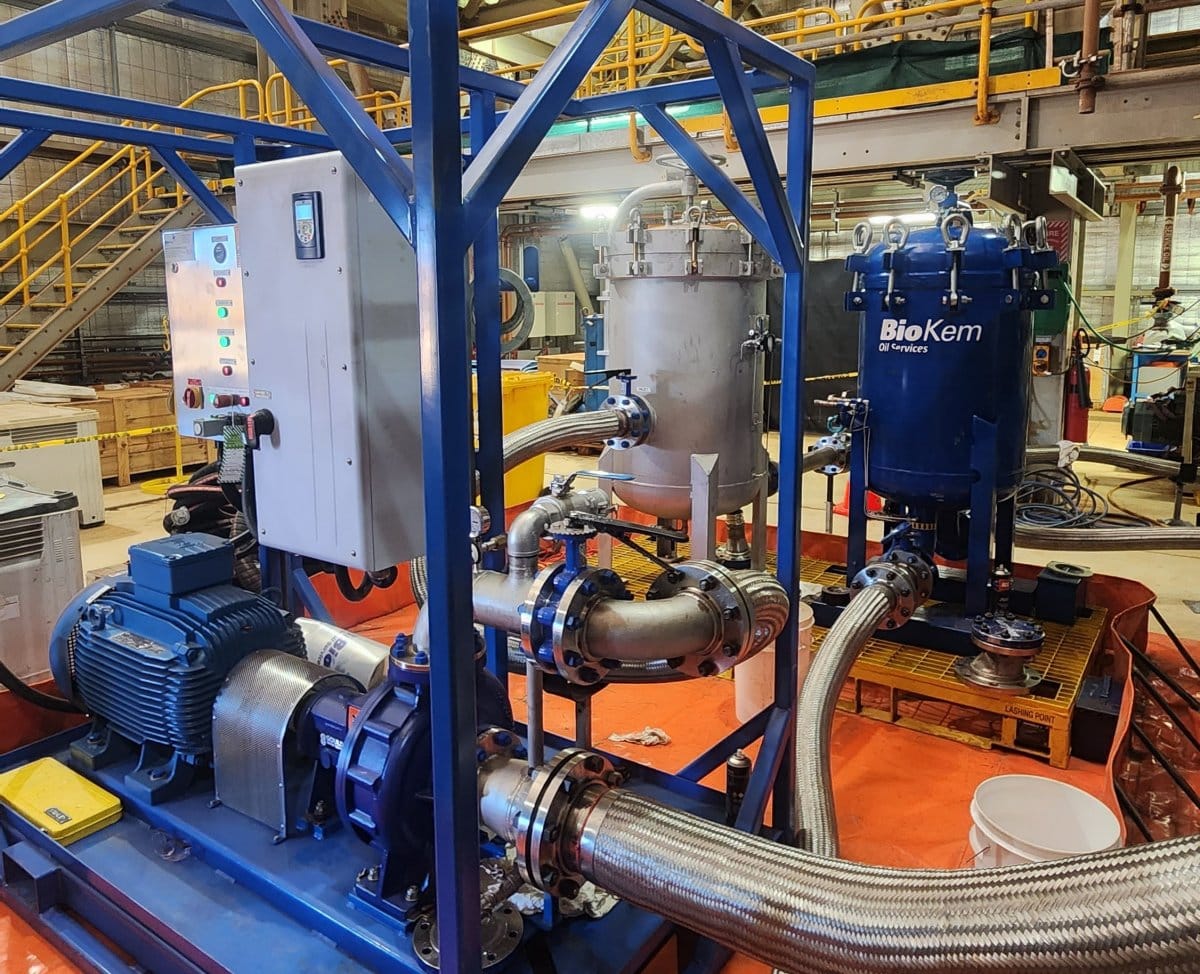
Standard system pumps are designed for steady-state operation, not for decontamination. They rarely provide the flow volume needed to hit the Re >4000 threshold across all pipe diameters. BioKem utilizes proprietary high-flow rigs capable of delivering up to 4,500 litres per minute, depending on the system requirements. We use custom-engineered bypass blocks to isolate sensitive components like servo valves and actuators, protecting them from the high-velocity debris stream. During the process, we integrate paddle flushing screens to provide real-time mechanical verification of debris removal. This physical evidence provides immediate feedback on the progress of the flush before final oil samples are taken.

Final verification must align with international benchmarks to ensure long-term component reliability. We aim for targets defined by ISO 4406 and NAS 1638, which quantify particulate counts per millilitre of fluid. Achieving an ISO 15/13/10 rating or better often requires flow rates 10 to 12 times higher than the system’s normal operating parameters. If you’re unsure if your current maintenance schedule meets these rigorous standards, you can request a professional fluid analysis to establish a baseline for your critical machinery. This scientific approach ensures that hot oil flushing services australia provide a measurable return on investment through extended equipment life and reduced unscheduled downtime.

Hot Oil Flushing Services Australia: The Definitive Guide to Industrial System Reliability

Varnish Mitigation and Chemical Cleaning Synergy

Varnish serves as the silent killer within Australian industrial hydraulic and lubrication systems. This resinous, sub-micron byproduct of oil degradation adheres to internal metal surfaces, creating a sticky film that traps hard contaminants. It is responsible for approximately 70% of unplanned outages in high-speed rotating equipment. When varnish accumulates on servo-valves, it causes stiction, leading to erratic control or total system seizure. While hot oil flushing services australia efficiently remove particulate matter, they often fail to dislodge these chemically bonded deposits on their own. Physical turbulence cannot always overcome the polar attraction of varnish to metal surfaces.

To address this, BioKem employs a dual-stage approach that integrates chemical cleaning agents with high-velocity flushing. These specialized chemicals work to solubilize the varnish, breaking its bond with the metal and suspending it within the oil for removal. This process is essential because even a layer of varnish as thin as 5 microns can restrict oil flow and increase friction. Our varnish removal systems ensure that internal components return to a “bare metal” clean state before the final oil charge is introduced. This synergy prevents the new oil from being immediately contaminated by residual oxidation products left behind by standard mechanical flushing.

Turbine Oil Varnish: A Power Generation Challenge

Peaking turbines in the Australian energy market are particularly vulnerable to varnish due to frequent start-stop cycles. These thermal fluctuations accelerate oil oxidation. Varnish acts as an insulator on heat exchangers, often raising bearing temperatures by 5 to 12 degrees Celsius. We utilize Membrane Patch Colorimetry (MPC) testing, according to ASTM D7843 standards, to quantify varnish potential. An MPC value above 30 indicates a high risk of a turbine trip, necessitating immediate intervention to protect the asset’s operational availability.

Post-Flush Protection and Oil Purification

Maintaining system cleanliness after the initial flush requires a transition to long-term mitigation. We integrate Filters S.p.A. technology to provide continuous sub-micron filtration that captures soft contaminants before they can settle as varnish. In a recent application involving a GE Frame 9 gas turbine, this precision flushing and filtration approach reduced MPC values from a critical 45 to a stable 12. This intervention prevented costly “trips” during peak demand periods, saving the operator an estimated A$150,000 in lost generation revenue. By combining hot oil flushing services australia with advanced purification, we ensure that Siemens or GE turbines operate within strict OEM cleanliness specifications, extending the life of both the lubricant and the hardware.

BioKem’s methodology prioritizes the chemical stability of the system. We don’t just move the dirt; we eliminate the chemical precursors of system failure. This commitment to technical precision ensures that your critical infrastructure remains resilient against the hidden costs of oil degradation and varnish buildup.

Verification Standards: Navigating ISO 4406 and NAS 1638

Verification isn’t a mere formality; it’s the scientific proof that your critical assets are protected. In the high-stakes environment of Australian mining and subsea operations, guessing about fluid cleanliness leads to catastrophic component failure. Biokem utilizes independent laboratory verification to provide an unbiased assessment of oil health. This ensures that hot oil flushing services australia deliver measurable results rather than just visual improvements. We rely on the ISO 4406 standard, which utilizes a three-digit code to represent the quantity of particles at 4μm, 6μm, and 14μm per millilitre of fluid. For example, a code of 18/16/13 indicates a specific concentration range that technicians use to determine if the flush is complete.

While ISO 4406 is the modern benchmark, some legacy projects in Western Australia and Queensland still reference NAS 1638. This older standard categorizes contamination into 12 classes based on particle counts within specific size ranges. ISO 4406 is generally preferred because it tracks the smallest particles that cause the most significant “silt” build-up in modern, high-tolerance valves. To bridge the gap between laboratory results and real-time progress, we use patch test kits for immediate onsite visual confirmation. These kits allow our team to identify large scale debris or unusual wear patterns before the final samples are sent for microscopic analysis.

Onsite Analysis vs. Laboratory Reporting

Precision monitoring during the flushing process prevents unnecessary downtime. We utilize the particle pal range to provide real-time digital readouts of fluid cleanliness. This allows us to adjust flow rates or temperatures instantly based on live data. When a system shows persistent contamination, we employ filter ferrogram analysis to identify specific wear metals like brass, copper, or steel. This diagnostic approach tells us exactly which component is failing. Every project concludes with a formal Cleanliness Certificate, a legal and technical document required for warranty compliance and project handover.

Establishing Cleanliness Targets

Setting the right target is a balance of engineering necessity and economic reality. High-pressure hydraulic systems typically require a stringent target of ISO 16/14/11. Demanding a level of “as clean as possible” isn’t a valid engineering goal; it leads to “diminishing returns” where the cost of extra flushing hours outweighs the marginal benefit to the equipment. In 2023, industry data suggested that 75% of hydraulic failures are avoidable through proper contamination control. We work with your engineers to set targets that maximize ROI by balancing the flushing duration with the specific sensitivity of your components.

Ensure your machinery meets international cleanliness standards with our certified verification processes. Contact Biokem for expert hot oil flushing services today.

BioKem’s National Hot Oil Flushing Solutions

BioKem operates under a strict ‘Cleanliness First’ philosophy. This turnkey approach to hot oil flushing and filtering ensures that industrial systems achieve optimal Reynolds numbers for turbulent flow, effectively dislodging sub-surface contaminants. We don’t just provide equipment; we deliver a complete engineering solution that targets 98% contaminant removal. Our technical teams combine high-level fluid engineering with onsite execution excellence to ensure every system meets or exceeds ISO 4406 cleanliness codes.

Our footprint extends across the continent, providing specialized hot oil flushing services australia wide. We maintain a constant presence in Australia’s primary industrial hubs, including the Pilbara, Hunter Valley, and Bowen Basin. This regional expertise allows us to understand the specific environmental stressors, such as extreme heat and fine particulate dust, that affect machinery in these locations. By deploying local knowledge alongside global technical standards, we provide a reliable buffer against system failure.

Environmental responsibility sits at the core of our operations. We utilize a ‘green’ approach to waste oil management that differentiates us from traditional service providers. Through advanced bioremediation and microbial treatments, we manage hydrocarbons in a way that prioritizes ecological health. This biological method breaks down waste into non-toxic components, helping our clients meet strict Australian environmental regulations while reducing the total volume of hazardous waste generated during a flush by up to 60%.

Mobilisation and Onsite Logistics

Managing equipment deployment to remote mine sites requires a logistical precision that BioKem has refined over 15 years of operation. We maintain a fleet of modular, containerised flushing units designed for rapid transport to the most isolated regions of Western Australia and Queensland. Safety is our non-negotiable priority. Our teams and equipment are fully compliant with Tier 1 site requirements for major operators like Rio Tinto and BHP. We operate a 24/7 shutdown support model for critical path projects, recognizing that every hour of delay can cost an operation upwards of A$85,000 in lost revenue. Our 100% safety compliance record ensures that we integrate seamlessly into your existing site protocols without administrative delays.

Beyond Flushing: Total Fluid Management

BioKem’s expertise extends beyond a single service event. We integrate our flushing protocols with comprehensive heat transfer system maintenance to ensure long-term thermal efficiency. Our ongoing oil analysis programs act as an early warning system, identifying varnish and oxidation before they lead to component seizure. This proactive data-driven approach has been shown to extend the service life of hydraulic components by as much as 45%. By monitoring fluid health continuously, we help partners transition from reactive repairs to a predictive maintenance model. This reduces the frequency of emergency hot oil flushing services australia and stabilizes maintenance budgets.

Don’t leave your critical infrastructure to chance. Contact BioKem today for a customized flushing scope and a detailed quote tailored to your specific site requirements. Our engineering team is ready to design a solution that maximizes your uptime and protects your capital investment.

Optimising System Integrity Through Precision Engineering

Maintaining industrial reliability requires more than routine maintenance; it demands a scientific approach to fluid cleanliness. Achieving a turbulent flow with a Reynolds number exceeding 4,000 ensures that sub-micron contaminants and varnish are effectively stripped from internal surfaces. By adhering to strict ISO 4406 or NAS 1638 verification standards, you protect your Tier 1 assets from premature failure and unscheduled downtime. BioKem has delivered these specialized hot oil flushing services australia wide since 2011, providing the technical expertise needed for complex hydraulic and lubrication systems.

As the sole Australian distributor for Filters S.p.A., we combine global filtration technology with local NATA-aligned oil analysis reporting to guarantee measurable results. Our team’s experience with Tier 1 infrastructure projects ensures your system meets the highest operational benchmarks. It’s time to move beyond guesswork and implement a data-driven cleaning strategy that extends component life and supports your facility’s environmental goals. Request a Technical Consultation for Your Next Flushing Project to secure your machinery’s future performance today.

Frequently Asked Questions

How long does a typical hot oil flush take?

A typical hot oil flush requires 24 to 72 hours to achieve the target ISO 4406 cleanliness code. The exact duration depends on the total pipe length and the initial contamination level of the system. Large scale industrial circuits with over 5,000 litres of fluid often require the full 72 hour window to ensure turbulent flow removes all particulate matter from internal surfaces.

What is the difference between oil filtration and hot oil flushing?

Oil filtration removes contaminants from the fluid itself; however, hot oil flushing targets the internal surfaces of the piping and components. Flushing uses high-velocity turbulent flow, often reaching Reynolds numbers above 4,000, to dislodge stubborn scale and debris. This process ensures your hot oil flushing services australia provider removes 95% of built-up varnish that standard kidney-loop filtration can’t reach.

Can hot oil flushing be performed while the machine is running?

Hot oil flushing is an offline maintenance procedure that requires the machinery to be decommissioned during the service. The system’s internal pumps are bypassed, and external high-flow pumping units are connected to circulate the fluid. Performing this while the machine’s operational risks 100% component failure due to the high-velocity turbulent flow and dislodged particles entering sensitive valves or bearings.

What chemicals are used during a hot oil flush?

BioKem utilizes biodegradable, nature-based solvency enhancers that comply with AS 1940-2017 standards for chemical storage and handling. These eco-friendly agents break down hydrocarbon deposits without the use of harsh, synthetic acids. Our biological alternatives ensure 0% toxic residue remains in the system, protecting both the machinery’s seals and the local Australian environment from chemical contamination.

Is hot oil flushing necessary for new hydraulic installations?

Yes, hot oil flushing is essential for new hydraulic installations to remove “built-in” contaminants like welding slag, silica sand, and metal shavings. Statistics from the British Fluid Power Association indicate that 80% of early-life hydraulic failures result from poor initial system cleanliness. A professional flush ensures the system meets the manufacturer’s warranty requirements and achieves the required ISO 4406 16/14/11 cleanliness standard from day one.

How much does hot oil flushing cost in Australia?

The cost of hot oil flushing services australia typically ranges from A$5,500 for small systems to over A$35,000 for complex industrial plant commissioning. Final pricing depends on the system’s total volume, the number of bypass loops required, and the onsite duration. Investing in this preventative maintenance reduces the risk of unplanned downtime, which can cost Australian mining operations up to A$150,000 per hour in lost productivity.

What certifications should a flushing provider hold?

A reputable provider should hold ISO 9001 for quality management and ISO 14001 for environmental responsibility. Technicians should be trained in Australian WH&S regulations and hold relevant “Work Safely at Heights” or “Confined Space Entry” tickets where applicable. BioKem ensures all fluid analysis is performed in NATA-accredited laboratories, providing 100% transparency and data accuracy for every cleanliness certificate we issue.

Can BioKem provide equipment for hire if we have our own technicians?

BioKem offers high-flow flushing rigs and particle counters for hire to companies with their own qualified technical teams. We provide equipment capable of flow rates up to 4,000 litres per minute, ensuring you can achieve the necessary turbulence for a successful flush. Our hire agreements include a 20-point safety check and technical documentation to ensure your onsite staff can maintain Australian safety standards throughout the project.