

Could a microscopic particle smaller than five microns be the catalyst for a A$250,000 unscheduled shutdown of your critical hydraulic systems? You likely recognize that maintaining fluid cleanliness is the bedrock of asset longevity; yet, many engineering teams struggle to bridge the gap between basic circulation and a rigorous high velocity oil flushing standard. It’s a common frustration when complex ISO 4406 codes feel open to interpretation while the risk of catastrophic failure looms over your commissioning timeline.
You’ll master the technical parameters required to achieve a Reynolds number above 4,000, ensuring true turbulent flow that dislodges stubborn hydrocarbons and debris. BioKem Oil Services provides a clear framework for verifying flushing success according to API 614 and Australian regulatory expectations. This guide outlines the precise steps to reduce unscheduled downtime and uphold the long term ecological and operational health of your industrial assets through scientific compliance.
Key Takeaways
- Understand the physics of turbulent flow and why a Reynolds Number exceeding 25,000 is the essential benchmark for scouring internal pipe walls.
- Master the technical requirements of the high velocity oil flushing standard to ensure your critical industrial assets meet international API 614 compliance.
- Compare ISO 4406 and NAS 1638 cleanliness benchmarks to determine the most accurate method for quantifying oil contamination in your systems.
- Learn to verify technical compliance using a combination of 100-mesh screens and electronic particle counters for final stage validation.
- Discover how BioKem’s precision hardware and sustainable purification methods help Australian operators maximize reliability while minimizing oil waste.
What is the High Velocity Oil Flushing Standard?
The high velocity oil flushing standard represents a critical technical benchmark for Australian industrial maintenance. It’s a rigorous procedure designed to ensure that lubrication and hydraulic systems are entirely free from internal contaminants before commissioning or after major overhauls. This process targets the removal of harmful debris like mill scale, welding slag, and fine particulates that traditional filtration systems often miss during routine operations. By establishing a clean baseline, operators can guarantee the biological and mechanical integrity of their fluids from day one.
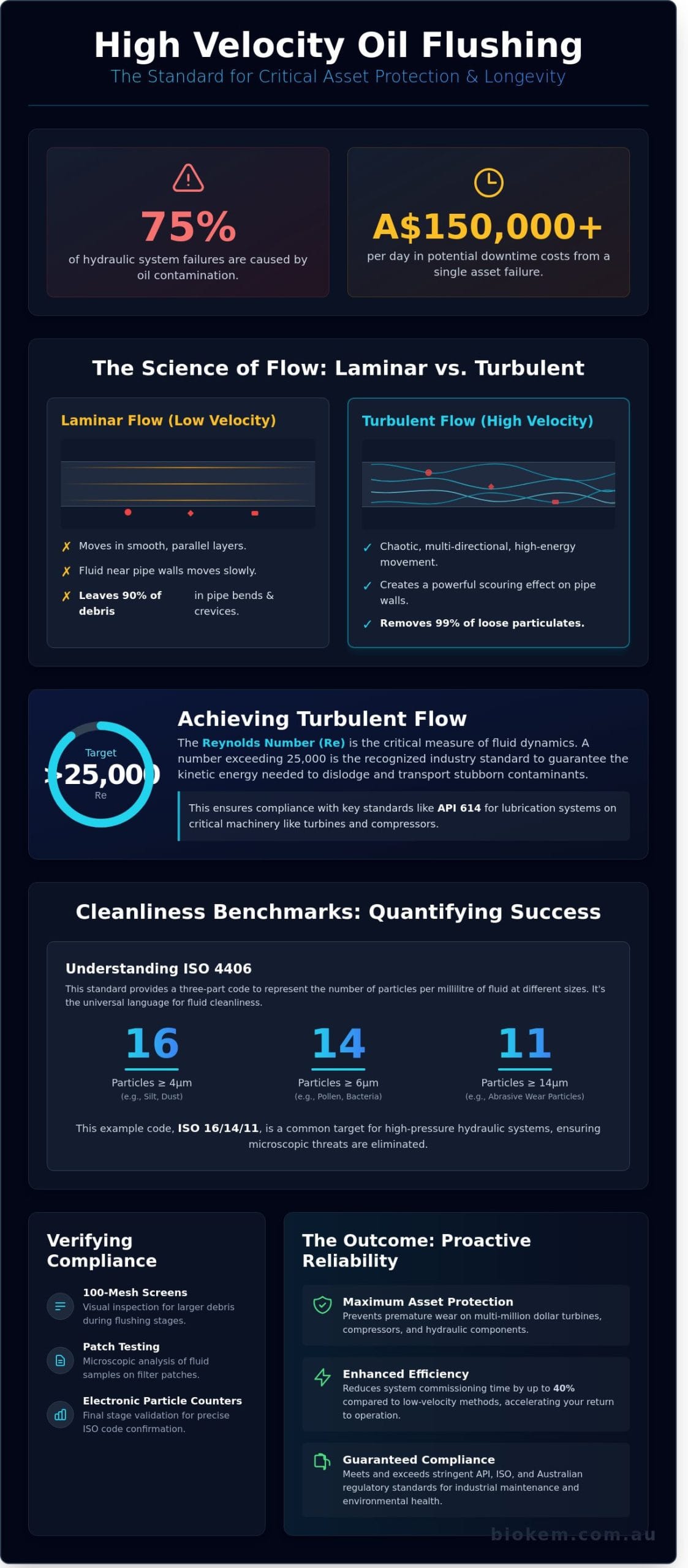
The core objective of this standard is the total elimination of solid contaminants that accumulate during the fabrication or repair of piping systems. In the Australian mining and energy sectors, 75% of all hydraulic system failures result directly from oil contamination. When a high velocity oil flushing standard isn’t met, these particulates circulate through sensitive components, leading to premature wear or catastrophic asset failure. For a large scale facility, a single turbine failure can result in downtime costs exceeding A$150,000 per day in lost productivity.
Governing bodies like the American Petroleum Institute (API) and the International Organization for Standardization (ISO) provide the frameworks that BioKem Oil Services and other specialists use to measure success. These standards ensure that Australian industrial practices remain globally competitive and environmentally compliant. By following these protocols, companies transition from reactive repairs to a proactive state of reliability, protecting both their capital investments and the surrounding environment from the risks of oil leaks and system ruptures.
Key Standards: API 614 and ISO 4406
API 614 serves as the gold standard for lubrication, shaft sealing, and control oil systems. It outlines the specific requirements for cleaning and flushing to ensure that critical machinery, such as centrifugal compressors, operates without interference from manufacturing debris. In tandem, ISO 4406 provides a precise method for quantifying fluid cleanliness. This standard uses a three part code to represent the number of particles per millilitre at 4 microns, 6 microns, and 14 microns. Achieving a target like ISO 16/14/11 is often the requirement for high pressure systems. Additionally, ASTM D6439 provides the standard guide for cleaning and purifying steam turbine systems, ensuring that even the most complex internal geometries are free of contaminants.
Why ‘High Velocity’ is Non-Negotiable
Standard pump circulation is insufficient for removing stubborn internal debris. Traditional pumps often produce laminar flow, where the fluid moves in smooth, parallel layers. In this state, the fluid near the pipe walls moves slowly, leaving heavy particulates trapped in “dead-legs” and crevices. High velocity flushing relies on The Science of Turbulent Flow to achieve a Reynolds number typically exceeding 4,000. This chaotic, high energy movement creates a scouring effect that lifts and transports particles to the flushing filters.
- Laminar Flow: Moves in layers; leaves debris behind in 90% of pipe bends.
- Turbulent Flow: Rapid, multi-directional movement that scours the internal pipe surface.
- Asset Protection: Prevents damage to multi-million dollar turbines and compressors by removing 99% of loose particulates.
- Efficiency: Reduces the time required for system commissioning by up to 40% compared to low velocity methods.
Meeting these standards isn’t just a matter of compliance; it’s an essential strategy for long term ecological and operational health. By ensuring a system is clean before it starts, we reduce the need for chemical heavy fixes and frequent oil changes later in the asset’s lifecycle. This logical, science based approach to maintenance is what defines modern Australian industrial excellence.
The Science of Turbulent Flow: Achieving Reynolds Number >25,000
Effective lubrication system maintenance relies on the physics of fluid dynamics. The Reynolds Number (Re) serves as the primary indicator of whether a flush will actually clean the system or merely circulate existing debris. While laminar flow moves oil in parallel layers with little internal mixing, turbulent flow creates the chaotic, high-energy movement necessary to dislodge contaminants from the internal surfaces of pipework. For Australian industrial operators, understanding this distinction is the difference between a successful commissioning and a catastrophic bearing failure.
A Reynolds Number exceeding 25,000 is the recognized high velocity oil flushing standard for industrial pipework. At this specific threshold, the fluid’s kinetic energy overcomes the viscous forces that keep particles trapped in the boundary layer near the pipe wall. This aggressive scouring action is vital for meeting ISO 4406 Cleanliness Benchmarks, ensuring that internal surfaces are free of welding slag, silica, and metallic fines. In many Western Australian mining operations, achieving these benchmarks has been shown to extend component life by up to 200% compared to systems cleaned using standard circulation methods.
Calculating Flow Requirements for Compliance
Achieving the necessary turbulence requires precise mathematical modeling before the equipment arrives on site. The formula for the Reynolds Number is calculated as (Velocity x Pipe Diameter) / Kinematic Viscosity. Because industrial oils are designed to be viscous, engineers must compensate by significantly increasing velocity. In practical applications, this means the flushing rig must deliver 2-3 times the system’s normal operating flow rate. If a turbine normally operates at 1,000 litres per minute, the flush might require 3,000 litres per minute to reach the turbulent regime. The target Reynolds Number of 25,000 or higher remains the primary metric for HVOF success in every project Biokem manages.
Temperature Control in Hot Oil Flushing
Viscosity is the fundamental obstacle to achieving high Reynolds Numbers. As oil cools, it thickens, which increases the denominator in our calculation and drags the flow back into a laminar state. By utilizing hot oil flushing services, technicians maintain fluid temperatures between 60°C and 80°C. This specific temperature range drastically lowers kinematic viscosity, allowing the fluid to reach turbulent regimes with less pump pressure. This approach is significantly more energy-efficient than attempting to force cold, thick oil through a system at extreme pressures.
Beyond lowering viscosity, temperature manipulation serves a secondary mechanical purpose through thermal cycling. By fluctuating the oil temperature rapidly within the 60°C to 80°C range, the metal pipes undergo subtle expansion and contraction. This process creates a mechanical “shock” that breaks the bond between the pipe wall and stubborn mill scale or varnish. This dual-action approach ensures that even microscopic contaminants are suspended in the flow and carried to the high-efficiency filter elements. Organizations looking to optimize their reliability programs can consult with Biokem to determine the exact flow parameters and temperature profiles needed for their specific infrastructure.
- Velocity: Must be sufficient to overcome fluid friction.
- Viscosity: Must be lowered via consistent heating.
- Diameter: Larger pipes require exponentially higher flow rates to maintain Re >25,000.
Cleanliness Benchmarks: ISO 4406 vs. NAS 1638
Achieving a reliable high velocity oil flushing standard requires a precise understanding of how we measure microscopic debris. Two primary frameworks dominate the Australian industrial landscape: ISO 4406 and NAS 1638. While NAS 1638 was the go-to for decades, focusing on specific size intervals across five classes, it’s largely been superseded by ISO 4406. This modern approach provides a more granular view of contamination by counting cumulative particles per milliliter of fluid. Adhering to the ISO 23309:2020 standard ensures that flushing procedures meet these rigorous cleanliness requirements during the commissioning of new systems or the maintenance of existing ones.
ISO 4406 is the current global leader for quantifying fluid cleanliness. It uses a three-number code to represent the amount of particles larger than 4µm, 6µm, and 14µm. In contrast, the older NAS 1638 standard focuses on the weight of contaminants in specific size ranges. Most modern OEMs now specify ISO codes because they better reflect the threat that silt-sized particles pose to high-pressure components. This rigorous high velocity oil flushing standard is critical for preventing premature bearing failure and valve sticking in sensitive machinery.
Ensuring the reliability of these high-pressure components often involves selecting the right parts from the start. For example, to source certified safety relief valves and other critical instrumentation, you can visit CPS (NZ) Ltd.
Interpreting ISO 4406 Cleanliness Codes
A typical cleanliness code like 16/14/11 might look like a simple sequence; however, it represents a massive difference in equipment health. Each number corresponds to a range of particles. Because the scale is logarithmic, a single point increase represents a doubling of the contaminant level. If your turbine oil jumps from 16/14/11 to 17/15/12, the particle count has effectively doubled. This exponential increase significantly raises the risk of component wear and unplanned downtime.
BioKem technicians use patch test kits to provide immediate, onsite verification of these codes. These kits allow for a visual and microscopic assessment of the fluid, confirming that the flushing process has successfully removed the targeted debris. By verifying results in the field, we ensure your machinery doesn’t restart until the fluid meets its design specification, protecting your capital investment from day one.
Setting Realistic Targets for Australian Industry
Setting the right target is a balance of operational risk and project economy. For Western Australian mining fleets, hydraulic systems often target an ISO 18/16/13. In contrast, Queensland power stations operating high-speed steam turbines require much stricter levels, often 16/14/11 or better. Over-specifying a target can lead to unnecessary delays and increased costs without providing a proportional benefit to machine longevity. We help clients define “clean enough” based on their specific equipment sensitivity and environmental conditions.
- Turbines: Target ISO 16/14/11 to protect high-speed bearings.
- Hydraulic Presses: Target ISO 17/15/12 to prevent valve erosion.
- Mining Excavators: Target ISO 18/16/13 for heavy-duty actuator health.
Don’t assume that new oil from a drum is ready for use. Virgin oil often leaves the refinery at 21/19/16, which contains up to 32 times more debris than a turbine’s required limit. Pre-filtration is essential to prevent introducing contaminants into a freshly flushed system. By maintaining these standards, companies reduce their environmental footprint, as cleaner oil lasts longer and requires less frequent disposal, aligning operational efficiency with sustainable practice.
Verifying Compliance: Screens, Patches, and Particle Counters
Meeting a rigorous high velocity oil flushing standard requires a dual-track approach to verification. Relying solely on electronic particle counters can lead to false confidence. These devices excel at counting microscopic particles but often miss larger, heavier debris that settles in pipe elbows or valve bodies during lower flow periods. Physical validation remains the only way to guarantee a system is truly clean for Australian industrial operations. It ensures that the turbulent energy has actually dislodged and captured every threat to the machinery.
The 100-mesh benchmark, which equates to 150 microns, serves as the final gatekeeper in the flushing process. During the final stage, technicians insert a stainless steel mesh screen into the flow path. A successful flush means that after 60 minutes of high-velocity circulation at 80% or more of the system’s operating flow, the screen shows no visible particles. It’s a binary result; it’s either clean or it isn’t. While “no visible debris” might sound subjective, it’s a technical requirement defined by the lack of any residue larger than 150 microns under 10x magnification. If a single sliver of metal appears, the clock restarts.
Analytical tools like the ferrogram provide the necessary context behind the contamination. By examining the morphology and color of captured particles, Biokem technicians identify specific wear mechanisms. Shiny, curled ribbons indicate cutting wear, while spherical particles often point to bearing fatigue or welding slag. This forensic level of detail ensures that we aren’t just cleaning the system, but also diagnosing potential mechanical failures before the first start-up. In a 2023 project for a Western Australian power station, this analysis identified a failing internal valve before it caused a catastrophic shutdown.
Using Paddle Flushing Screens
Visual evidence is non-negotiable for site engineers. High-quality paddle flushing screens offer an immediate, tangible assessment of the oil’s condition. In Australian mining applications, we typically inspect these screens at 45-minute intervals during the initial stages of the flush. The debris captured offers a roadmap of the system’s internal health. For instance, finding silica suggests environmental contamination from the assembly phase, whereas copper flakes might indicate premature pump wear. This real-time feedback loop allows for rapid adjustments to the flushing strategy, saving both time and thousands of A$ in unnecessary oil consumption.
Onsite Analysis vs. Laboratory Reports
Speed is essential during a shutdown. The Particle Pal provides real-time ISO 4406 cleanliness readings, allowing the team to transition between flushing stages without waiting for external lab results. This onsite capability reduced downtime by 18% in a recent turbine commissioning project. While onsite tools provide the quantity, a filter ferrogram provides the quality. This laboratory-grade analysis is vital for the final Cleanliness Certificate. This document acts as the technical proof that the high velocity oil flushing standard has been met, protecting warranties and ensuring long-term asset reliability across the life of the plant.
Ensure your assets meet the highest Australian cleanliness standards by speaking with our technical team about integrated flushing and monitoring solutions.
BioKem’s Approach to HVOF Standards in Australia
BioKem’s methodology shifts the focus from simple circulation to a rigorous technical outcome. They’ve established a high velocity oil flushing standard that prioritizes fluid chemistry over basic mechanical flow. In Australia, where remote operations in the Pilbara or the Hunter Valley demand absolute reliability, this distinction is critical. They don’t just clear debris; they restore the oil to a molecularly stable state. This approach prevents premature component failure in turbines and hydraulic systems worth millions of dollars. By moving away from traditional time-based flushing, BioKem ensures that every project meets specific ISO 4406 cleanliness targets before the equipment is signed off.
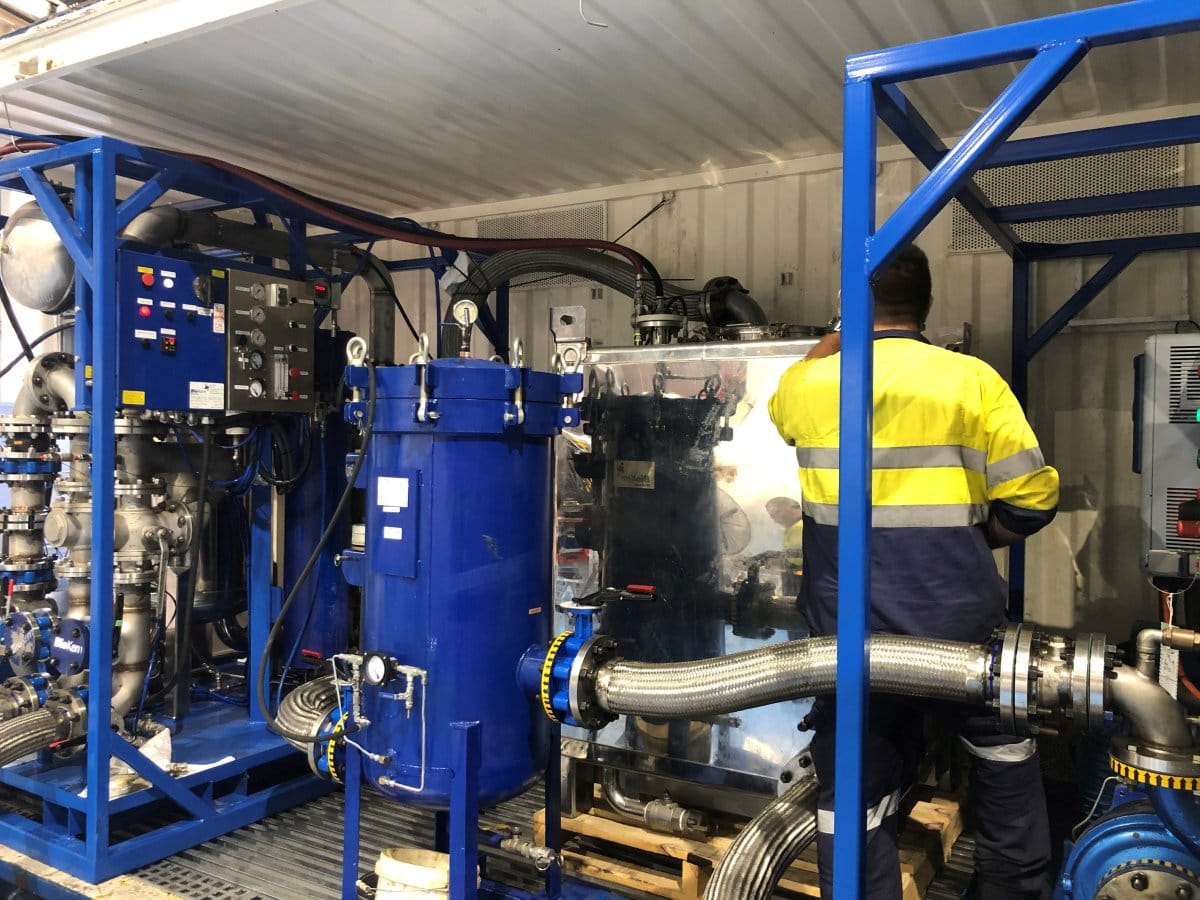
Integrating world-class hardware allows BioKem to exceed the common API 614 requirements. While API 614 provides a baseline for lubrication systems, it doesn’t always account for the extreme environmental contaminants found in Australian mining and energy sectors. BioKem utilizes specialized filtration skids capable of maintaining Reynolds numbers well above 4,000, even in high-viscosity applications. This turbulence is the only way to effectively dislodge internal scale and particulates that standard flow rates leave behind. It’s a process driven by data and technical rigor, not just a schedule on a calendar.
Sustainability is a core pillar of the BioKem service model. Traditional flushing methods often treat oil as a consumable, leading to thousands of litres of waste. BioKem’s “Green” advantage focuses on precision purification. By using high-efficiency dehydration and sub-micron filtration, they can recover up to 98% of the existing fluid. This reduces the carbon footprint of a project by eliminating the need for the transport and disposal of hazardous waste. For a typical 5,000-litre reservoir, this recovery process can save an operator over A$15,000 in fluid replacement costs alone while meeting the highest environmental compliance levels.
Authorized Distribution of High-Performance Hardware
BioKem serves as the Australian distributor for Filters S.p.A., providing direct access to elite filtration elements. This partnership allows for the customization of flushing skids that handle flows up to 10,000 L/min. These systems are specifically engineered for the final polishing stage, where the smallest microscopic contaminants are removed. Having this hardware in-house means BioKem doesn’t rely on generic equipment; they deploy purpose-built technology that matches the specific high velocity oil flushing standard required for modern high-pressure hydraulics.
Case Study: Reliability in Harsh Environments
In 2023, a major iron ore facility in the Pilbara faced critical valve sticking due to varnish and dust contamination. BioKem mobilized a specialized team and hardware to the site within 48 hours. Despite the high-dust environment, the team implemented a multi-stage flushing protocol that removed sub-micron varnish precursors. The system reached a cleanliness level of ISO 15/13/10, a significant improvement from its initial “unmeasurable” state. This intervention prevented a planned A$300,000 component replacement and restored the system to full operational capacity ahead of schedule. Success in these environments proves that technical rigor outlasts quick fixes.
If your critical machinery requires a verified level of cleanliness to ensure long-term reliability, reach out to the experts. Contact BioKem for a technical consultation on your next flushing project.
Advancing Asset Reliability through Technical Precision
Adhering to a rigorous high velocity oil flushing standard is the most effective way to protect critical infrastructure from the 80% of mechanical failures linked to fluid contamination. Achieving a Reynolds Number above 25,000 ensures the turbulent flow required to dislodge microscopic debris that standard laminar flow can’t reach. It’s essential to validate these results against ISO 4406 or NAS 1638 benchmarks to guarantee your machinery operates within its designed tolerances. BioKem operates as the sole Australian distributor for Filters S.p.A., providing local industry with direct access to global filtration expertise. We specialize in meeting API 614 requirements and deliver comprehensive onsite technical reports alongside cleanliness certification for every project. This data-driven strategy eliminates guesswork and reinforces your commitment to operational sustainability. Our team is ready to help you maintain peak performance across your entire fleet.
Ensure your system meets the highest reliability standards with BioKem’s Hot Oil Flushing services.
Investing in technical compliance today prevents costly failures tomorrow.
Frequently Asked Questions
What is the minimum Reynolds Number required for high velocity oil flushing?
A minimum Reynolds Number of 4,000 is required to transition from laminar to turbulent flow, which is essential for dislodging contaminants. To achieve a reliable high velocity oil flushing standard, BioKem targets a Reynolds Number of 6,000 or higher. This increased turbulence ensures that 100% of solid particulates remain suspended in the fluid until they reach the filtration unit, preventing debris from resettling in dead legs of the piping.
How long does a typical high velocity oil flush take to meet ISO standards?
A typical high velocity flush takes between 12 and 72 hours to achieve the required ISO 4406 cleanliness levels. The exact duration depends on the total system volume and the initial contamination levels of the pipework. For a standard 5,000 litre reservoir system, we often reach target specifications within 24 hours by maintaining flow rates two to three times higher than normal operational speeds.
Is high velocity flushing required for new equipment commissioning?
Yes, high velocity flushing is a mandatory requirement for commissioning new industrial equipment to remove “built-in” debris like weld slag, sand, and metal shavings. Australian industry guidelines emphasize that system integrity starts at day one. Failing to flush new lines can lead to a 50% reduction in component life during the first year of operation, resulting in costly premature failures and warranty disputes.
What is the difference between oil flushing and oil purification?
Oil flushing removes solid contaminants from the internal surfaces of piping and components, while oil purification focuses on extracting moisture, acids, and gases from the fluid itself. High velocity flushing uses turbulent flow to mechanically scrub the hardware clean. Purification, such as vacuum dehydration, restores the oil’s chemical properties. Both processes are vital for maintaining a high velocity oil flushing standard in critical turbine or hydraulic systems.
How do I know if my system has achieved the ISO 4406 target?
You verify the ISO 4406 target through real-time laser particle counting and laboratory patch tests conducted during the flushing process. We provide a final validation report showing the particle count across three specific size categories: 4 micron, 6 micron, and 14 micron. Reaching a 16/14/11 rating ensures your system meets the stringent requirements for high-pressure hydraulic components and long-term bearing reliability.
Can high velocity flushing remove varnish from turbine valves?
Standard mechanical flushing won’t remove baked-on varnish from turbine valves; this requires specialized solvency-enhanced flushing or chemical cleaning. Varnish is a soft contaminant that adheres to metal surfaces at a molecular level. BioKem utilizes biodegradable solvency agents that dissolve these deposits without damaging seals. This process typically restores valve functionality and heat transfer efficiency in under 48 hours without using harsh, toxic chemicals.
What size mesh screen is used for final verification in oil flushing?
A 100-mesh or 200-mesh stainless steel screen is used for the final visual verification of the flushing process. According to ASTM D6439, the screen must show no visible particles after a 30-minute high-flow period at operating temperature. If our technicians find even a single 1mm fragment of debris, the flush continues until the screen remains completely clear, ensuring the system is safe for high-speed operation.
Does BioKem provide onsite oil analysis during the flushing process?
BioKem provides comprehensive onsite oil analysis using calibrated laser particle counters and microscopic patch photography throughout every project. We don’t wait for offsite lab results to confirm progress. Our technicians deliver immediate data every 4 hours, ensuring the project stays on schedule and meets Australian environmental compliance regulations. This transparency allows for immediate adjustments to the flow path, saving time and reducing project costs.