

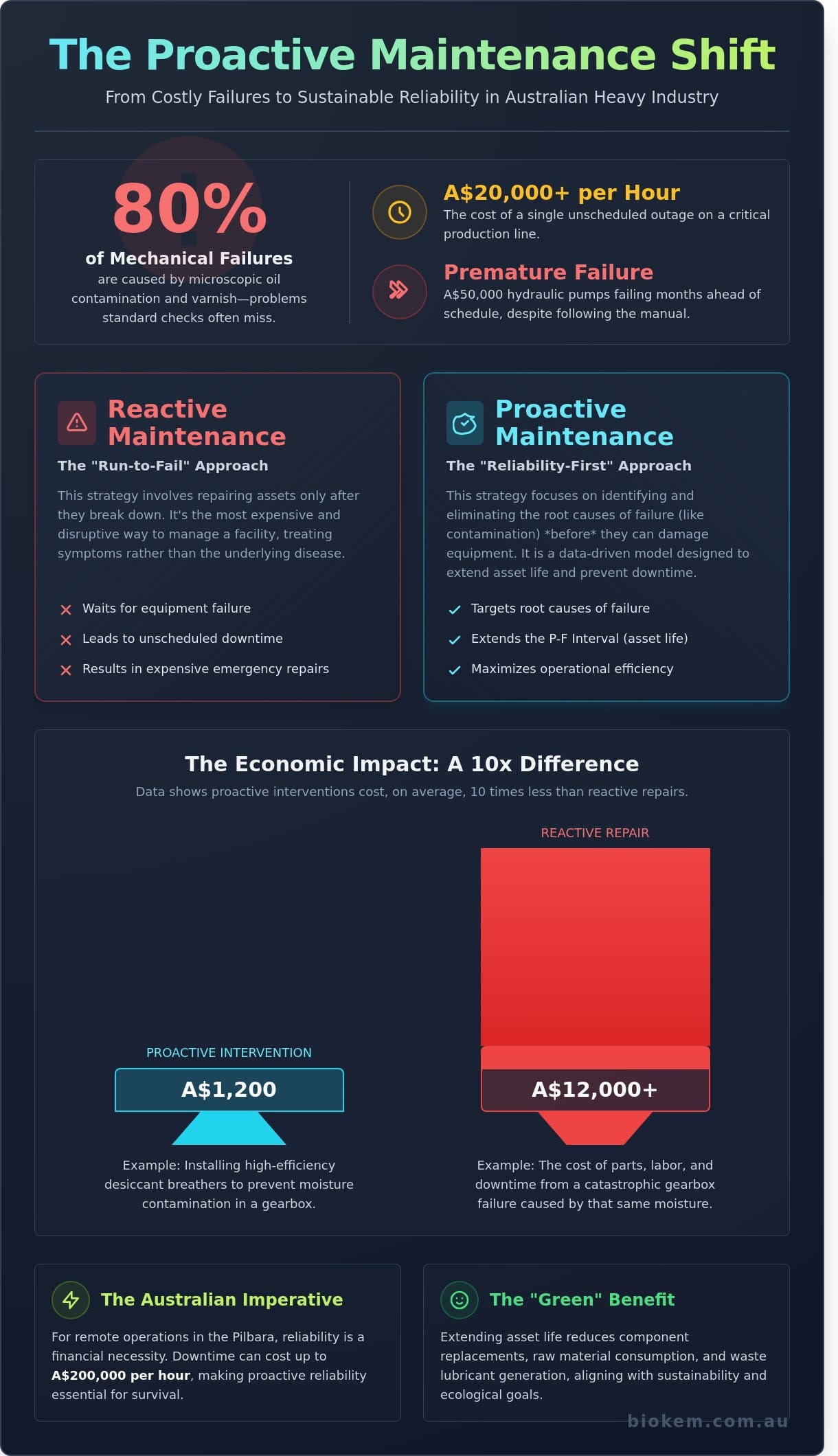
Research indicates that up to 80% of oil-related mechanical failures in Australian heavy industry stem from microscopic contamination and varnish that standard time-based checks miss. It’s a sobering reality when a single unscheduled outage on a critical production line can cost an operation upwards of A$20,000 per hour in lost productivity. You’ve likely felt the frustration of watching a A$50,000 hydraulic pump fail months before its scheduled replacement, even when your team has followed the manufacturer’s preventive manual to the letter. This disconnect exists because traditional schedules treat the symptoms rather than the source. By adopting a data-driven proactive maintenance strategy, you can pivot from expensive, reactive firefighting to a system that targets the biological and chemical root causes of equipment degradation.
You know that keeping your assets running isn’t just about ticking boxes; it’s about protecting your bottom line and meeting Australian environmental standards. We’ll show you exactly how to transition your facility toward a model that eliminates varnish and manages hydrocarbons with scientific precision. This guide outlines the technical framework needed to achieve zero unscheduled downtime and a clear ROI on every dollar of your maintenance spend. We’ll explore the specific steps to move your team away from emergency repairs and toward a sustainable, high-performance future.
Key Takeaways
- Shift from costly “run-to-fail” cycles to a reliability-first mindset specifically tailored for the rigours of Australian heavy industry.
- Identify how targeting the root causes of mechanical wear-namely lubrication contamination-serves as the cornerstone of an effective proactive maintenance strategy.
- Master the maintenance hierarchy to clearly distinguish between basic time-based preventive tasks and high-impact proactive interventions.
- Implement a data-driven 5-step framework to establish baseline ISO 4406 cleanliness targets and measure asset health accurately.
- Learn how advanced technical interventions like vacuum dehydration and flushing can improve operational efficiency and long-term ecological health.
What is a Proactive Maintenance Strategy? Moving Beyond the Repair Cycle
A proactive maintenance strategy represents a fundamental shift in how industrial assets are managed across Australia. Instead of waiting for a component to show signs of wear, this methodology focuses on identifying and treating the root causes of failure before they can manifest in the system. In the context of Australian heavy industry, we’re seeing a rapid transition away from the “Run-to-Fail” mindset toward a “Reliability-First” approach. This evolution is driven by the realization that reacting to problems is the most expensive way to manage a facility.
The economic impact of this shift is stark. Industry data indicates that proactive interventions typically cost 10 times less than reactive repairs. For example, spending A$1,200 on high-efficiency desiccant breathers to keep moisture out of a gearbox can prevent a catastrophic failure that would cost upwards of A$12,000 in parts and labor. While condition-based maintenance monitors the health of a machine to predict when it might fail, cause-based maintenance targets the environmental factors, such as particulate contamination or chemical degradation of lubricants, that lead to that failure in the first place.
To better understand this concept, watch this helpful video:
The Core Philosophy: Treating the Disease, Not the Symptom
We can view industrial maintenance through a medical lens. Preventive maintenance is like an annual checkup to see if you’re sick. A proactive maintenance strategy is the healthy diet and exercise that prevents the illness from developing. This philosophy focuses on extending the P-F Interval, which is the critical window between the first sign of a potential failure and the actual functional failure of the asset. By optimizing the three main pillars, design, installation, and the operating environment, engineers can significantly delay the onset of mechanical degradation. It’s about ensuring that hydrocarbons remain clean and that the system operates within its original design parameters.
Why Industrial Australia is Shifting to Proactive Models
Remote operations in Western Australia and Queensland face unique logistical hurdles that make reliability a top priority. When a primary crusher fails in the Pilbara, the cost of downtime can reach A$200,000 per hour, excluding the massive expense of mobilizing specialized technicians to a remote site. Reliability isn’t just a goal; it’s a financial necessity for survival in a competitive global market. Australian standards for asset management, such as AS ISO 55001, increasingly reflect this, pushing companies toward stricter compliance and better ecological stewardship.
Extending asset life also provides a clear “Green” benefit that resonates with modern corporate responsibility. By reducing the frequency of component replacements, companies lower their consumption of raw materials and reduce the volume of waste lubricants generated. This aligns with environmental compliance requirements and the growing demand for sustainable industrial practices. BioKem Oil Services views this as a biological imperative, where keeping machinery efficient is the first step toward a lower environmental footprint. Many Australian mining and energy sectors are now adopting these models to meet both A$ profitability targets and their long-term sustainability commitments.
The Mechanics of Proactivity: Targeting Root Causes in Lubrication
Mechanical failure isn’t an inevitable part of industrial operations. It’s a symptom of neglected fluid health. Industry research confirms that 80% of all mechanical wear is the direct result of contaminated lubrication. This statistic highlights why a traditional “fix it when it breaks” approach is financially unsustainable for Australian enterprises. A robust proactive maintenance strategy shifts the focus from repairing damage to eliminating the conditions that cause it. The primary metric for this shift is ISO 4406, which quantifies the number of solid particles in a fluid sample at three specific micron levels. Maintaining these levels within strict limits prevents the ‘Chain Reaction of Failure’. This process begins when a single hard particle enters a high-pressure zone, creating abrasive wear that generates thousands of additional metallic fragments. By following a structured Guideline on Proactive Maintenance, reliability engineers can establish clear targets that extend component life by 200% or more.
Oil Cleanliness: The Foundation of Asset Reliability
Precision is the hallmark of modern machinery. High-precision servo valves in Australian mining and manufacturing plants often operate with clearances as small as 2 to 5 microns. When particles larger than these gaps enter the system, they don’t just cause wear; they cause immediate stiction and erratic valve response. It’s a common misconception that “new” oil is clean oil. In reality, oil delivered in drums or bulk often arrives with an ISO cleanliness code of 21/19/16, which contains up to 32 times more contaminant than a typical hydraulic system requires. Pre-filtration is mandatory to ensure these hydrocarbons don’t introduce external threats to the system. For immediate, onsite verification of fluid health, using patch test kits provides a visual and quantitative assessment of particulate levels before the oil even touches your assets. This immediate feedback loop is vital for maintaining the integrity of high-value components.
Varnish and Oxidation: The Silent Killers of Turbines
While solid particles cause physical abrasion, chemical instability causes internal “sludge” that is equally destructive. Thermal stress within turbines and high-cycle hydraulic systems causes oil molecules to break down through oxidation. This chemical degradation creates sub-micron, polar contaminants that remain dissolved in hot oil but precipitate out as soft, sticky deposits when the oil cools or reaches low-flow areas. This is varnish. It coats internal surfaces, increases friction, and acts as an insulator that reduces the efficiency of heat exchangers. In a typical A$50 million gas turbine, even a thin layer of varnish on a bearing can lead to a catastrophic trip. A proactive approach involves monitoring the Membrane Colorimetric Tendency (MPC) of the oil. Implementing a specialized varnish removal system allows operators to extract these polar contaminants before they plate out on critical metal surfaces. This intervention ensures that chemical stability is maintained, preventing the costly downtime associated with sticking valves and overheated bearings.
Effective lubrication management requires a blend of technical precision and the right diagnostic tools. If you’re looking to enhance your site’s reliability, consider how a tailored fluid management program can reduce your long-term operational costs and environmental footprint.
Proactive vs. Preventive vs. Predictive: The Maintenance Hierarchy
Industrial reliability relies on a clear understanding of the maintenance hierarchy. While many operators use these terms interchangeably, they represent distinct levels of technical maturity. Preventive maintenance is the most common entry point. It functions on a fixed schedule, much like changing your car’s oil every 10,000 kilometres. It’s a time-based approach that ignores the actual condition of the lubricant or the machine. While it offers a basic safety net, it’s often inefficient and fails to account for varying operational loads or environmental stressors.
Predictive maintenance moves a step higher by focusing on condition-based monitoring. Instead of a calendar, technicians use sensors to detect high vibration, thermal changes, or acoustic anomalies. This tells you that a failure is imminent. However, it still focuses on the symptom of the problem. A proactive maintenance strategy represents the peak of this hierarchy. It identifies and eliminates the root causes of failure before they manifest as wear. According to EPRI’s Proactive Maintenance Guideline, this method focuses on extending machinery life by controlling the environmental conditions, such as fluid cleanliness and temperature, that lead to degradation.
Why Preventive Maintenance Often Fails
Preventive maintenance remains popular because it’s easy to schedule, but it carries hidden risks and costs. For many Australian heavy industry sites, the “if it isn’t broken, don’t fix it” mantra is replaced by “fix it because the calendar says so.” This leads to several systemic issues:
- Intrusive Maintenance: Opening a sealed hydraulic system for a scheduled inspection often introduces airborne silica or moisture. This “human-induced” contamination can trigger immediate component wear.
- The Bathtub Curve: Reliability engineering uses the Bathtub Curve to show that equipment has a high “infant mortality” rate. Frequent, unnecessary interventions increase the likelihood of a machine failing shortly after it’s put back into service.
- Economic Waste: Discarding healthy, high-performance oil simply because of a date is a significant financial drain. In a typical Australian mining operation, premature oil changes can result in an unnecessary spend of over A$25,000 per year across a small fleet.
The Synergy: Building a Hybrid Reliability Framework
A sophisticated proactive maintenance strategy doesn’t replace other methods; it refines them. By implementing root-cause controls, you reduce the sheer volume of work required by preventive teams. This allows your maintenance budget to be redirected toward high-value activities. Data is the bridge between these strategies. Using regular oil analysis provides a biological and chemical profile of your systems. This data allows you to extend drain intervals safely while ensuring that hydrocarbons remain within optimal performance specifications.
Hardware plays a vital role in this hybrid model. Relying on standard factory filters is rarely enough for the harsh Australian climate. Integrating high-performance hardware, such as products from Filters S.p.A., ensures that your proactive measures are physically supported. These systems provide the sub-micron filtration necessary to keep ISO 4406 cleanliness codes at levels that prevent the “sandblasting” effect of particulate contamination. This shift from reacting to symptoms to controlling the environment creates a sustainable, eco-friendly operational model that reduces both waste and downtime.
Building a Robust Proactive Strategy: A 5-Step Implementation Framework
Implementing a proactive maintenance strategy requires moving beyond the “fix it when it breaks” mentality. It’s a disciplined approach to hydrocarbon management that targets the root causes of machine wear before they manifest as mechanical failure. By following a structured framework, Australian industrial operations can extend component life by up to 200%.
Step 1: Audit and Baseline. You can’t manage what you don’t measure. Start by auditing your current ISO 4406 cleanliness levels and reviewing the last 24 months of failure history. If your hydraulic systems are consistently operating at ISO 22/20/18, you’re likely seeing 80% more wear than a system maintained at 16/14/11. This baseline provides the data needed to calculate your potential return on investment.
Step 2: Set Targets. Define specific “Clean” and “Dry” targets for every critical asset. For high-pressure systems with servo valves, aim for moisture levels below 100 ppm and particle counts of ISO 15/13/10. These targets shouldn’t be generic; they must reflect the specific tolerances of your equipment’s most sensitive components.
Step 3: System Modification. Upgrade your hardware to prevent contaminant ingress. This includes installing high-efficiency desiccant breathers and upgrading seals. Standard breathers often fail to stop 2-micron particles or ambient humidity from entering the reservoir, especially in high-humidity coastal environments across Queensland and Western Australia.
Step 4: Mechanical Intervention. Perform an initial deep clean to remove legacy contaminants. Techniques such as hot oil flushing are essential for removing varnish and built-up sludge that standard filtration can’t reach. This step ensures your new, clean oil isn’t immediately degraded by residual contaminants in the pipework.
Step 5: Continuous Monitoring. Transition to a rigorous sampling and analysis program. Monthly laboratory analysis combined with on-site testing ensures your targets remain within the defined parameters. This creates a feedback loop that validates the effectiveness of your hardware upgrades.
Phase 1: Identifying Criticality and Setting Standards
Effective asset management starts with a criticality analysis. Rank your machinery based on the cost of downtime, which often exceeds A$15,000 per hour in heavy industrial sectors, and the sensitivity of its internal components. Use this data to justify your proactive maintenance strategy spend. Implementing particle pal technology allows for real-time data collection. This enables your team to detect particle ingress or oil degradation instantly, rather than waiting weeks for a lab report to return from a metropolitan center.
Phase 2: Execution and Sustenance
Successful implementation relies on the human element. Train your staff on “Clean Oil” handling protocols to ensure new oil isn’t contaminated before it even enters the machine. Transitioning doesn’t mean stopping production. You can manage the shift by using bypass filtration systems that clean the oil while the asset is live. If capital expenditure is a barrier, utilize industrial oil filtration equipment hire to bridge the gap during the initial cleanup phase. This allows for immediate ISO level improvements without a large upfront investment in permanent hardware. Beyond technical training, supporting your team’s lifestyle with quality Australian personal care is also a priority; read more about the professional hair care range at Hair Pamper.
Ready to reduce your operational risks and improve fluid longevity? Contact Biokem for a comprehensive site audit and start your journey toward zero-failure performance today.
Partnering for Reliability: How BioKem Executes Proactive Oil Management
Implementing a proactive maintenance strategy requires more than just scheduling oil samples; it demands technical execution that many internal teams aren’t equipped to handle. BioKem acts as the technical partner that manages the heavy lifting of fluid recovery and system decontamination. By focusing on root cause removal rather than just symptom management, we help Australian operators extend the life of their lubricants and critical machinery components.
The financial logic for professional oil purification is clear. Replacing a 5,000-litre reservoir of hydraulic oil can cost upwards of A$30,000 when you account for the lubricant price, labor, and environmental disposal fees. In contrast, onsite purification using vacuum dehydration and high-efficiency filtration typically costs 55% to 70% less. This approach doesn’t just save money; it keeps high-quality base oils in service and reduces the carbon footprint of your operations by eliminating the need for virgin oil production and waste transport.
To ensure world-class results, BioKem partners with global leaders like Filters S.p.A. This collaboration provides our clients with access to sophisticated hardware designed for the most demanding industrial environments. Whether it’s removing dissolved water from a turbine or stripping varnish from a compressor, we use science-backed technology to return fluids to their optimal chemical state. For operations requiring temporary access to specialized purification equipment, our comprehensive industrial oil filtration equipment hire solutions provide immediate access to vacuum dehydration units and high-flow flushing rigs without the capital expenditure commitment.
Onsite Technical Interventions
Effective contamination control often begins before a machine even starts. BioKem provides high-velocity hot oil flushing for new or overhauled systems to remove weld scale, silica, and construction debris. This process ensures that your proactive maintenance strategy starts from a baseline of zero contamination. We also specialise in heat transfer system maintenance, where we focus on removing carbon deposits that degrade thermal efficiency. Our national footprint allows for rapid deployment across Western Australia, Queensland, New South Wales, and beyond, ensuring that even remote mine sites or offshore platforms have access to 24/7 technical support.
The BioKem Advantage: Science-Based Reliability
BioKem’s philosophy is rooted in biological and eco-friendly industrial solutions. We don’t rely on harsh chemicals that can damage seals or create secondary waste streams. Instead, we use nature-based alternatives and advanced mechanical separation to achieve cleanliness levels that exceed ISO 4406 standards. Our experts understand the specific regulatory requirements of the Australian industrial sector, ensuring that every intervention remains compliant with local environmental laws. A proactive maintenance strategy focusing on oil health can reduce component wear by up to 70% in hydraulic systems.
Reliability isn’t a matter of luck; it’s a result of precise engineering and consistent monitoring. By choosing a partner that understands the chemistry of your lubricants and the physics of your machinery, you protect your capital investments from avoidable failures. It’s time to move beyond reactive oil changes and embrace a system that prioritises fluid health and environmental responsibility.
Take the first step toward total fluid reliability. Audit your assets and start your proactive journey today by contacting the BioKem technical team.
Future-Proofing Your Assets Through Technical Precision
Transitioning from a reactive cycle to a robust proactive maintenance strategy isn’t just about reducing downtime. It’s about a fundamental shift toward eliminating the root causes of failure before they manifest. By prioritizing precise lubrication management and technical filtration, Australian industrial operators can extend asset life by up to 200% compared to traditional reactive methods. Success requires a structured five-step framework that integrates high-efficiency technology with consistent onsite monitoring. This approach ensures compliance with Australian standards while significantly lowering the total cost of ownership.
BioKem brings over 15 years of industrial oil purification expertise to your facility. As the sole Australian distributor for Filters S.p.A., we provide access to world-class engineering backed by nationwide onsite technical support. We’ve helped partners across the country reduce waste and improve mechanical reliability through sustainable, science-based oil management. It’s time to move beyond the repair cycle and embrace a philosophy of total reliability. Our team is ready to help you implement a system that protects both your machinery and the environment.
Request a Technical Consultation with BioKem’s Reliability Experts
Frequently Asked Questions
What is the main difference between proactive and preventive maintenance?
Preventive maintenance follows a set schedule based on time or cycles, whereas proactive maintenance targets the root causes of failure like fluid contamination. A proactive maintenance strategy focuses on eliminating the 80% of mechanical wear caused by particle contamination. By shifting focus from when to fix to why things break, Australian operators often see equipment life extensions of 300% or more.
How much does it cost to implement a proactive maintenance strategy?
Initial implementation costs for a mid-sized Australian facility typically range from A$8,000 to A$35,000 depending on the number of critical assets. This investment covers high-efficiency filtration, sampling ports, and baseline laboratory testing. Most operations recover these costs within 10 months through a 30% reduction in emergency repair expenses and lower oil disposal volumes.
Can proactive maintenance be applied to older industrial equipment?
Proactive maintenance is highly effective for older industrial equipment and often yields the fastest returns on investment. Applying a proactive maintenance strategy to a 15-year-old hydraulic press can reduce unplanned downtime by 25% within the first year. It’s about stabilising the internal environment of the machine to prevent accelerated wear, regardless of the asset’s age or initial condition.
How often should oil analysis be performed in a proactive strategy?
Most industrial applications in Australia require oil analysis every 500 to 1,000 operating hours or on a quarterly basis. For critical mining or manufacturing assets, monthly sampling is the standard to detect early-stage oxidation or microbial growth. Consistent intervals allow technicians to identify trends in wear metals before a catastrophic component failure occurs. However, the accuracy of these results depends entirely on how to take an oil sample using proper representative sampling techniques to ensure data integrity.
What are the first steps to move away from reactive maintenance?
The first step is to perform a comprehensive audit of current fluid cleanliness and set specific ISO 4406 targets for every critical machine. You should install high-quality sampling valves and desiccant breathers to stop contaminants from entering the system. Moving away from reactive habits requires a 100% commitment to documentation and sticking to strict fluid specifications.
Does proactive maintenance require specialized software?
You don’t need specialized software to start, but a Computerised Maintenance Management System (CMMS) helps track longitudinal data across multiple sites. About 65% of Australian maintenance managers use digital dashboards to monitor ISO cleanliness trends and schedule filtration tasks. For smaller operations, a structured spreadsheet is sufficient as long as it records every oil change and lab result accurately.
How does hot oil flushing fit into a proactive maintenance plan?
Hot oil flushing is a high-velocity cleaning process that removes sludge, varnish, and debris from internal piping before commissioning or after a major failure. It uses turbulent flow, typically reaching a Reynolds number over 4,000, to scrub the internal surfaces of the system. This ensures the new oil starts in a system that meets the required ISO cleanliness standards from day one.
What are ISO 4406 codes and why do they matter for reliability?
ISO 4406 codes represent the number of particles larger than 4, 6, and 14 microns found in a 1-millilitre oil sample. These numbers are vital because 90% of internal component damage is caused by particles that are too small to see with the naked eye. Improving a fluid’s cleanliness from a 21/19/16 code to a 17/15/12 code can increase the life of a hydraulic pump by 4 times. To obtain accurate ISO 4406 readings, maintenance teams must master professional oil sampling techniques that ensure representative samples from the system.