

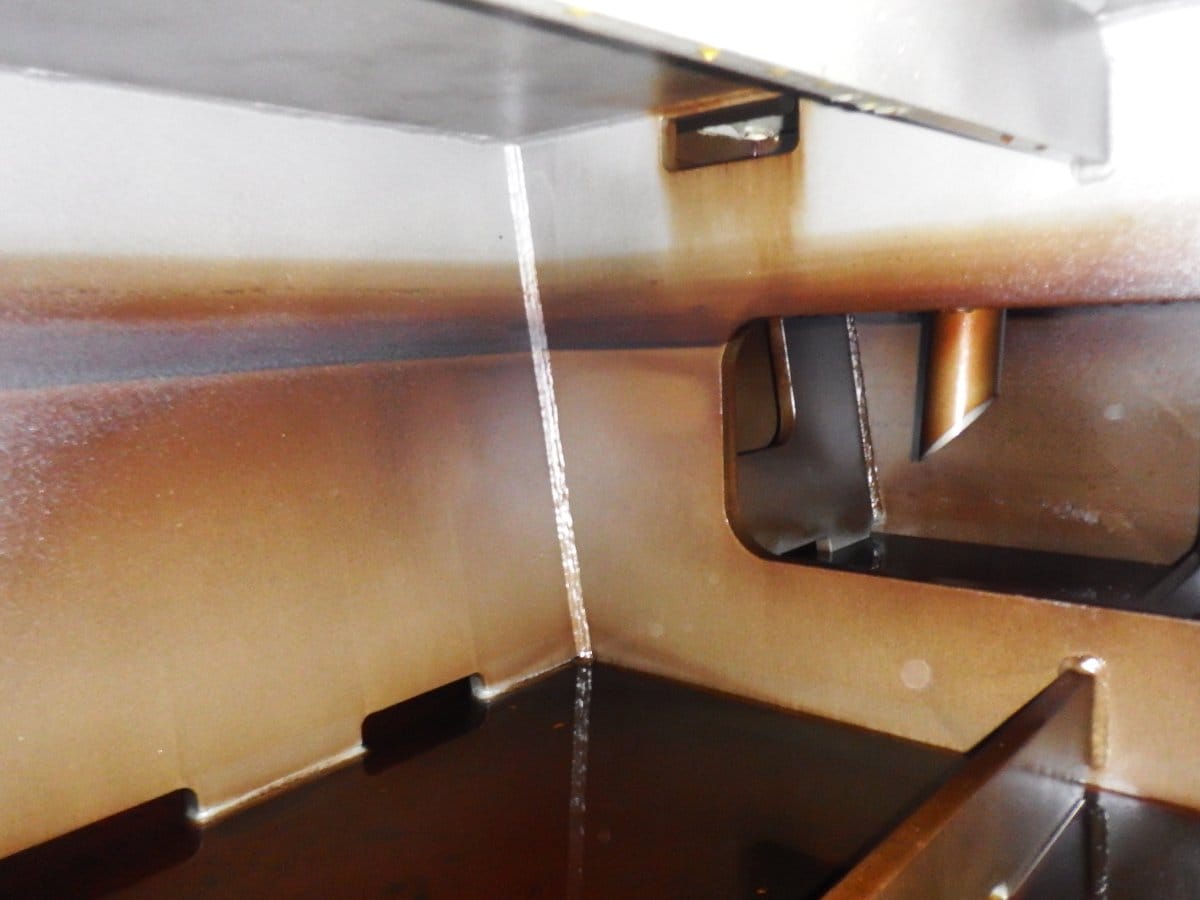
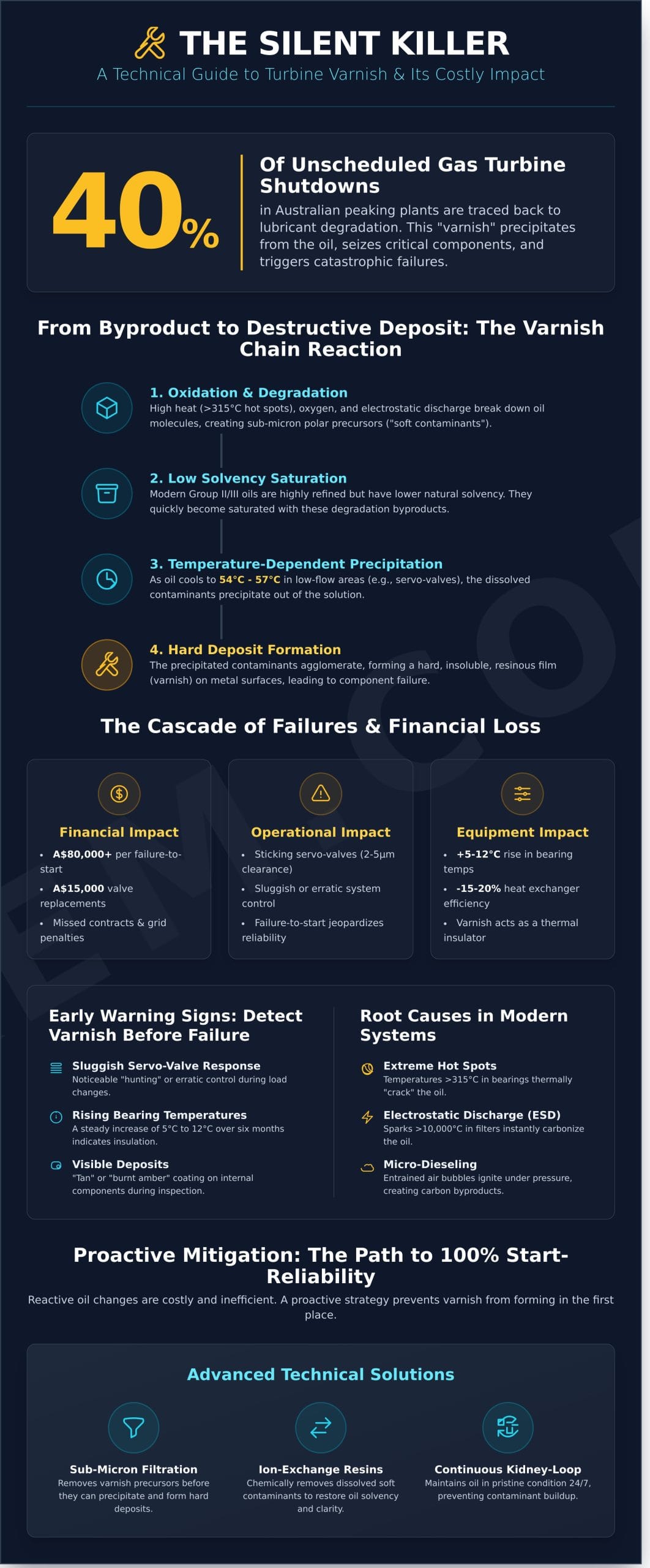
Did you know that nearly 40% of unscheduled gas turbine shutdowns in Australian peaking plants are traced back to lubricant degradation? When temperature fluctuations cause soluble oxidation products to precipitate, the resulting sludge seizes servo-valves and triggers costly trips. You’ve likely seen how these deposits lead to A$15,000 valve replacements and missed contractual windows. Implementing effective varnish mitigation for turbines isn’t just a maintenance task; it’s a critical safeguard for your production revenue and system longevity.
We agree that reactive oil changes are an expensive and inefficient way to manage fluid health. This guide promises to equip you with the technical strategies needed to identify, prevent, and eliminate varnish deposits permanently. You’ll master the scientific approach to maintaining hydrocarbon stability and ensuring 100% start-reliability for your critical assets. We’ll explore the chemical mechanisms of oxidation, evaluate advanced molecular filtration technologies, and provide a structured maintenance roadmap to ensure your turbine oil remains clear and your operations stay compliant with local standards.
Key Takeaways
- Understand why varnish acts as the “silent killer” of power plants by identifying how temperature-dependent solvency triggers the precipitation of insoluble hydrocarbon films.
- Learn to implement a proactive technical strategy for varnish mitigation for turbines using advanced sub-micron and ion-exchange filtration to ensure 100% start-reliability.
- Identify the underlying mechanics of oil degradation, specifically the impact of gas turbine hot spots and electrostatic discharge (ESD) on modern lubricant chemistry.
- Evaluate the cost-benefit of continuous kidney-loop filtration versus reactive cleaning to maintain long-term system integrity and operational longevity.
- Discover how specialized hot oil flushing and biological-friendly restoration methods align with Australian regulatory standards to protect critical infrastructure.
What is Turbine Varnish and Why is it the “Silent Killer” of Power Plants?
Turbine varnish is a thin, insoluble film formed from the degradation of hydrocarbon-based oils. It’s not a typical particulate contaminant like sand or metal shavings; instead, it’s a chemical byproduct that precipitates directly out of the oil. This substance is particularly dangerous because of its temperature-dependent solvency. While degradation products remain dissolved in hot oil, they fall out of solution and form solid deposits when temperatures drop to between 54°C and 57°C. This transition often occurs in low-flow areas or during system cool-downs, making it a persistent threat to operational readiness.
The primary victims of this “silent killer” are high-precision components. Servo-valves, which operate with clearances as tight as 2 to 5 microns, are often the first to fail. Even a microscopic layer of varnish can cause these valves to stick or respond sluggishly. Beyond valves, varnish coats bearings and oil coolers, acting as a thermal insulator that traps heat. For Australian power generators, the business impact is severe. A single “failure-to-start” event at a peaking plant can result in liquidated damages exceeding A$80,000 per incident, while unexpected trips during peak demand periods can cost hundreds of thousands in lost revenue and grid stability penalties.
The Chemistry of Oil Degradation
The formation of varnish begins with oxidation and thermal degradation. When the lubricant is exposed to high local temperatures and oxygen, the molecular structure of the oil breaks down. This process creates polar precursors known as “soft contaminants.” These precursors are sub-micron in size and cannot be captured by standard mechanical filters. Modern Group II and Group III base oils are particularly susceptible to this issue. While these oils are highly refined to resist oxidation, they have lower natural solvency than older Group I oils. This means they can hold fewer degradation products in solution before they begin to plate out as hard, resinous deposits on internal metal surfaces.
Symptoms of Varnish Contamination
Identifying varnish before a catastrophic failure requires a keen eye for subtle operational shifts. Sluggish servo-valve response is a classic early indicator, often manifesting as erratic control or “hunting” during load changes. Monitoring bearing temperatures is equally critical; a steady increase of 5°C to 12°C over a six-month period often signals that varnish is insulating the metal and preventing efficient heat transfer. Operators should also look for a 15% to 20% reduction in heat exchanger efficiency, which typically indicates fouling of the internal cooling surfaces. Visually, the presence of a “tan” or “burnt” amber coating on centrifugal components or valve spools confirms that the oil’s chemistry has reached a tipping point.
Implementing effective varnish mitigation for turbines is no longer an optional maintenance task; it’s a requirement for plant longevity. By addressing the root chemical causes rather than just the symptoms, Australian engineers can prevent the costly “fail-to-start” cycles that plague aging fleets. Successful varnish mitigation for turbines involves a combination of specialized filtration, chemical stability monitoring, and proactive oil conditioning to ensure that soft contaminants never have the chance to become hard, destructive deposits.
The Mechanics of Varnish Formation in Modern Turbine Lubricants
Modern gas turbines in Australia face extreme thermal stress due to high-output requirements and frequent cycling in peaking plants. In these systems, “hot spots” within bearing housings can reach temperatures exceeding 315°C. This localized heat causes the hydrocarbon chains in the lubricant to crack, initiating a chain reaction of oxidation. Unlike older Group I oils, modern Group II and Group III base oils have lower natural solvency. They can’t hold these degradation products in suspension as effectively, which leads to rapid deposit formation on critical surfaces.
High-flow filtration systems contribute to the problem through electrostatic discharge (ESD). When oil flows rapidly through non-conductive filter media, static charges build up and eventually discharge. These internal sparks reach temperatures above 10,000°C, which instantly carbonises the surrounding oil. This degradation is often paired with micro-dieseling. This occurs when entrained air bubbles are compressed in high-pressure zones, such as pump inlets or heavily loaded bearings, causing them to ignite. The resulting carbonaceous by-products are the primary precursors to varnish. Effective varnish mitigation for turbines requires addressing these sub-micron contaminants before they settle on critical components.
Research detailed in Managing Varnish of Turbine Oil demonstrates that these degradation products are polar, leading them to migrate toward metal surfaces. This chemical attraction is the reason why varnish is so difficult to remove once it has baked onto a valve or bearing surface, often requiring specialized chemical cleaning to restore system efficiency.
Solubility vs. Saturation
The saturation point defines the limit of how many degraded molecules a lubricant can hold in a dissolved state. At a standard operating temperature of 60°C, these contaminants usually remain soluble and invisible. However, when a turbine enters standby and the oil cools to an ambient temperature of 22°C, the oil becomes supersaturated. The contaminants precipitate out of the oil, forming a sticky residue. This cycle explains why a turbine might function perfectly during a run but fail to start after a cool-down period. Even if the oil appears clear to the naked eye, the “varnish potential” can be high enough to cause a mechanical failure during the next start-up sequence.
The Role of Additive Depletion
Lubricants rely on antioxidants, such as phenolics and aminics, to mitigate free radicals and prevent oil breakdown. The Rotating Pressure Vessel Oxidation Test (RPVOT) is the industry standard for measuring this remaining life. When a lubricant’s RPVOT value drops below 25% of its original baseline, the oil loses its ability to resist oxidation. Many operators attempt to “sweeten” the oil by adding fresh additives to an aged charge. This often backfires; new additives can act as a flocculant, causing existing polar contaminants to drop out of solution and form heavy deposits. BioKem Oil Services provides comprehensive oil analysis services to help Australian operators determine the true health of their lubricant before these chemical tipping points lead to a costly system trip.
Mitigation vs. Removal: Strategies for Long-Term Turbine Health
Turbine maintenance often falls into a reactive trap. Operators frequently wait for a high-bearing temperature alarm or a sticking valve before addressing oil health. This approach is expensive and ignores the underlying chemistry of lubricant degradation. True varnish mitigation for turbines focuses on preventing the chemical transition from liquid to solid. When oil reaches its saturation point, soft contaminants precipitate onto cool surfaces as a sticky film. Effective mitigation keeps these precursors at levels 30% below their saturation limit, ensuring they stay in solution rather than depositing on critical components.
Standard mechanical filtration relies on the ISO 4406 code. These systems target hard particles at 4, 6, and 14 microns. Varnish precursors typically measure less than 0.1 microns. These sub-micron particles pass through conventional 3-micron filters with ease. A 2023 industry report confirmed that 85% of varnish-related failures occur in systems that technically meet “clean” ISO 4406 targets. Relying solely on mechanical filters is a gamble that ignores the molecular reality of oil oxidation.
Continuous kidney-loop systems represent a strategic investment for Australian power generators. A high-quality unit typically costs between A$18,000 and A$35,000. While the initial capital expenditure is a consideration, it’s a fraction of the A$220,000 cost associated with a single day of unplanned downtime at a peaking plant. These systems offer a sustainable alternative to frequent oil changes. By maintaining fluid chemistry, they reduce hydrocarbon waste and can extend the service life of a 20,000-litre reservoir by an additional 5 to 10 years.
Varnish Removal Technologies
Electrostatic Oil Cleaners (EOC) use a high-voltage electrical field to pull polar contaminants toward collection media. This method is highly effective for removing existing deposits from the fluid. Balanced Charge Purification takes this further by charging particles both positively and negatively, causing them to agglomerate into larger masses for easier capture. During major 2024 scheduled outages, chemical cleaning using eco-friendly solvating flushes can strip existing deposits from internal galleries. This 48-hour process prepares the system for fresh lubricant by removing the “seed” material that accelerates new varnish formation.
Advanced Mitigation Techniques
Modern varnish mitigation for turbines utilizes ion exchange resins to remove degradation products at a molecular level. These resins target the acidic byproducts of oxidation before they can form sludge. Solvating agents increase the oil’s natural ability to hold contaminants in suspension, preventing precipitation even as the fluid ages. Precision thermal management is also critical. By maintaining consistent oil temperatures across the entire circuit, operators prevent “cold spots” where varnish tends to drop out of the solution, particularly in control valves with tolerances as tight as 5 microns.
Implementing a Varnish Mitigation Program (VMP) in 2026
By 2026, the complexity of turbine lubricants has increased due to the prevalence of Group II and Group III base oils. While these oils offer superior thermal stability, they have lower solvency for polar oxidation by-products. This makes a structured VMP essential for operational continuity. Effective varnish mitigation for turbines requires a shift from reactive maintenance to a four-step proactive framework.
- Step 1: Baseline Oil Analysis. Standard tests like viscosity and acid number don’t reveal varnish precursors. You must establish a baseline using Membrane Patch Colorimetry (MPC) and Remaining Useful Life Evaluation Routine (RULER) to track antioxidant depletion.
- Step 2: Specialized Filtration. Install sub-micron or ion-exchange filtration systems. Conventional filters miss particles smaller than 3 microns, which are the primary drivers of valve sticking.
- Step 3: Monthly KPI Tracking. Integrate MPC values into your monthly reporting. This ensures that varnish potential is monitored as a primary health indicator rather than a secondary concern.
- Step 4: Staff Integration. Train onsite personnel in the specific logistics of remote sampling. Contaminated samples lead to false positives, which can cost an Australian site upwards of A$15,000 in unnecessary oil processing.
Implementing this program reduces the risk of “fail-to-start” events by an estimated 40% based on 2024 industrial benchmarks. It moves the facility toward a sustainable lifecycle by extending oil life and reducing the volume of waste hydrocarbons generated during fluid changes.
Managing the complex logistics of a VMP also involves ensuring the facility itself runs smoothly, especially during intensive program rollouts. For sites in Victoria, professional cleaning services like Maid for Geelong can handle the upkeep of offices and common areas, allowing technical staff to focus entirely on their critical tasks.
Advanced Oil Analysis for Varnish Potential
MPC testing remains the gold standard for varnish detection because it directly measures the concentration of insoluble soft contaminants. Relying on standard ISO particle counts is insufficient; varnish precursors are often sub-micron and invisible to laser counters. Utilizing patch test kits allows onsite teams to perform rapid assessments without waiting 10 days for laboratory results from metropolitan hubs. When interpreting MPC ΔE values, a reading above 30 demands immediate intervention. If the ΔE value hits 40, the probability of a turbine trip due to servo-valve stiction increases by nearly 65%.
Australian Site Considerations
Australian power generators often operate peaking units that remain in standby mode for extended periods. In regions like the Pilbara or the Surat Basin, ambient temperature fluctuations are extreme. When oil cools during standby, its solvency drops, causing dissolved varnish to precipitate onto cool metal surfaces. This is a critical issue for remote mining sites in WA and QLD where technical support is hours away. All oil handling must strictly adhere to AS 1940:2017 standards to ensure environmental compliance in sensitive ecosystems. Managing these logistics requires robust onsite storage solutions that prevent moisture ingress, which can accelerate the oxidation process in high-humidity tropical zones.
Successful varnish mitigation for turbines depends on using high-quality data to drive mechanical decisions. If your current oil analysis doesn’t include MPC, you’re missing the early warning signs of system failure. You can take control of your asset reliability today by booking a comprehensive varnish potential audit with Biokem.
BioKem’s Technical Solutions for Turbine Reliability
BioKem delivers specialized engineering services focused on maximizing uptime through effective varnish mitigation for turbines. Our approach integrates advanced hardware with localized technical expertise to address the root causes of lubricant degradation. Central to this strategy is the varnish removal system. This technology extracts polar contaminants that standard mechanical filters often miss; it prevents the accumulation of sticky deposits on critical components like servo valves and bearings. By targeting these sub-micron particles, we ensure that the lubricant maintains its intended lubricating properties under high-stress conditions.
Onsite Technical Interventions
BioKem technicians deploy mobile purification units directly to power generation facilities across Australia. These units operate in a kidney-loop configuration to strip oxidation products from the lubricant without requiring a system shutdown. This “Green” strategy focuses on circularity. By restoring the chemical stability of the fluid, we’ve seen oil service life extended by up to 300% in certain applications. This reduces the environmental footprint of a facility by minimizing waste oil disposal and lowering the demand for virgin base oils. It’s a practical application of science-based maintenance that values long-term ecological health.
The financial impact of these interventions is measurable. In August 2022, a peaking plant in Queensland faced an imminent “failure-to-start” event due to sticking valves. BioKem’s rapid deployment of a varnish mitigation unit stabilized the oil chemistry within 48 hours. This intervention prevented a projected A$100,000 penalty for failing to meet grid supply obligations. Such results demonstrate that proactive oil management isn’t just an operational preference; it’s a financial necessity in the Australian energy market.
Equipment Hire and Long-Term Support
Reliability managers can choose between short-term equipment hire for emergency cleanup or long-term rental for proactive varnish mitigation for turbines. For comprehensive system restoration during major overhauls, we utilize hot oil flushing. This process uses high-velocity turbulent flow to dislodge stubborn deposits from internal pipework that standard filtration cannot reach. As the exclusive Australian distributor for Filters S.p.A. hardware, BioKem ensures that local assets are protected by world-class filtration technology designed for extreme industrial environments.
Every technical intervention is backed by rigorous laboratory analysis. We provide detailed technical reporting that tracks Membrane Patch Colorimetry (MPC) levels and remaining useful life (RULER) testing. This data-driven approach allows for precise oil lifecycle management. For teams looking to upgrade their internal infrastructure, the full BioKem product range offers everything from high-efficiency filter elements to complete skid-mounted purification systems. We don’t just provide hardware; we provide a partnership that anchors global scientific standards in a dependable, regional context. Our commitment to Australian regulatory standards ensures that every solution is compliant, efficient, and tailored to the unique challenges of the local climate and operational demands.
Future-Proofing Your Power Generation Assets
Maintaining peak operational efficiency in Australian power plants requires a proactive stance against hydrocarbon degradation. Industry data shows that sub-micron soft contaminants account for over 70% of unplanned turbine trips; this makes a dedicated strategy for varnish mitigation for turbines essential for meeting 2026 reliability targets. Effective management shifts the focus from reactive oil changes to maintaining long-term fluid chemistry through advanced filtration and solubility enhancement. It’s a technical evolution that safeguards against the “silent killer” of critical machinery.
BioKem serves as the sole Australian distributor for Filters S.p.A., bringing world-class engineering directly to local heavy industry. Our specialist technical teams operate across QLD, NSW, VIC, and WA, ensuring site-specific reliability standards are met with precision. We’ve helped regional facilities reduce maintenance-related downtime by up to 40% through integrated fluid management protocols. By addressing the molecular root causes of varnish today, you’re investing in the long-term ecological and operational health of your facility.
Request a Technical Consultation for Your Turbine Varnish Challenges
Your path to a more resilient and sustainable power infrastructure starts with expert technical oversight.
Frequently Asked Questions
What is the most common cause of varnish in gas turbines?
The primary cause of varnish in gas turbines is thermal degradation resulting from oxidation and adiabatic compression, often called micro-dieseling. When air bubbles are rapidly compressed in high-pressure zones, local temperatures can exceed 1,000°C. This process breaks down hydrocarbon molecules into sub-micron soft contaminants. These polar molecules eventually settle on cooler metal surfaces as a sticky residue, compromising component reliability and heat transfer efficiency across the system.
Can standard oil filters remove varnish deposits?
Standard mechanical oil filters can’t remove varnish because the particles are typically smaller than 0.1 microns. Most industrial filters are rated for 3 to 10 microns, allowing these soft contaminants to pass through easily. Effective varnish mitigation for turbines requires specialized technologies like electro-static oil cleaners or depth filtration systems. These methods target sub-micron particles that standard mechanical media simply aren’t designed to capture during normal operation.
How often should I perform an MPC test on my turbine oil?
You should perform a Membrane Patch Colorimetry (MPC) test every 90 days to maintain a proactive maintenance schedule. While ASTM D7843 suggests annual testing, critical turbine assets in Australia require quarterly monitoring to detect rapid oxidation trends. If your MPC value exceeds 20, the risk of deposit formation increases. By testing every 3 months, you’ll establish a baseline that allows for early intervention before varnish compromises your hydraulic control valves.
Does changing the oil completely solve a varnish problem?
Changing the oil doesn’t solve a varnish problem because up to 15% of the old, contaminated fluid remains trapped in dead legs and internal piping. This residual varnish acts as a catalyst, rapidly depleting the antioxidant additives in the fresh oil. Within 6 months of a simple oil change, MPC levels often return to their previous highs. True varnish mitigation for turbines involves chemical cleaning or side-stream filtration to remove deposits from the entire internal circuit.
What is the difference between Group I and Group II oils regarding varnish?
Group II base oils have higher oxidation stability than Group I oils but possess significantly lower natural solvency. This means that while Group II oils last longer, they can’t hold as many degradation by-products in solution. Once the saturation point is reached, varnish precipitates out onto metal surfaces much faster than in Group I fluids. Most modern turbines transitioned to Group II around 2005, leading to a 40% increase in reported varnish-related failures globally.
How much does unscheduled turbine downtime typically cost?
Unscheduled turbine downtime typically costs Australian power generators between A$50,000 and A$250,000 per day in lost revenue and emergency repairs. For large-scale peaking plants, these costs can escalate if contractual supply obligations aren’t met. Beyond the immediate financial loss, varnish-induced trips cause mechanical stress on components. Investing in preventative maintenance costs less than 5% of a single day’s lost production, making it a vital economic strategy for local operators.
What is the transition temperature where varnish becomes insoluble?
Varnish typically becomes insoluble and begins to precipitate when oil temperatures drop below 40°C. As the fluid cools, its capacity to hold polar degradation products diminishes. This often occurs in dead legs of the piping or when the turbine is shut down for maintenance. These soft contaminants solidify into a hard, amber-like glaze on valves and bearings, which can lead to sticking or stiction when the system attempts to restart.
Can BioKem provide onsite varnish mitigation services in remote areas of Australia?
BioKem provides comprehensive onsite varnish mitigation services across all remote regions of Australia, including the Pilbara and Bowen Basin. Our mobile service teams utilize specialized rigs designed for harsh environments to ensure compliance with Australian Standard AS 4024. We deploy nature-based cleaning agents and advanced depth filtration to restore oil health without requiring a total system flush. Our local expertise ensures that even the most isolated mining or power sites receive technical support.