

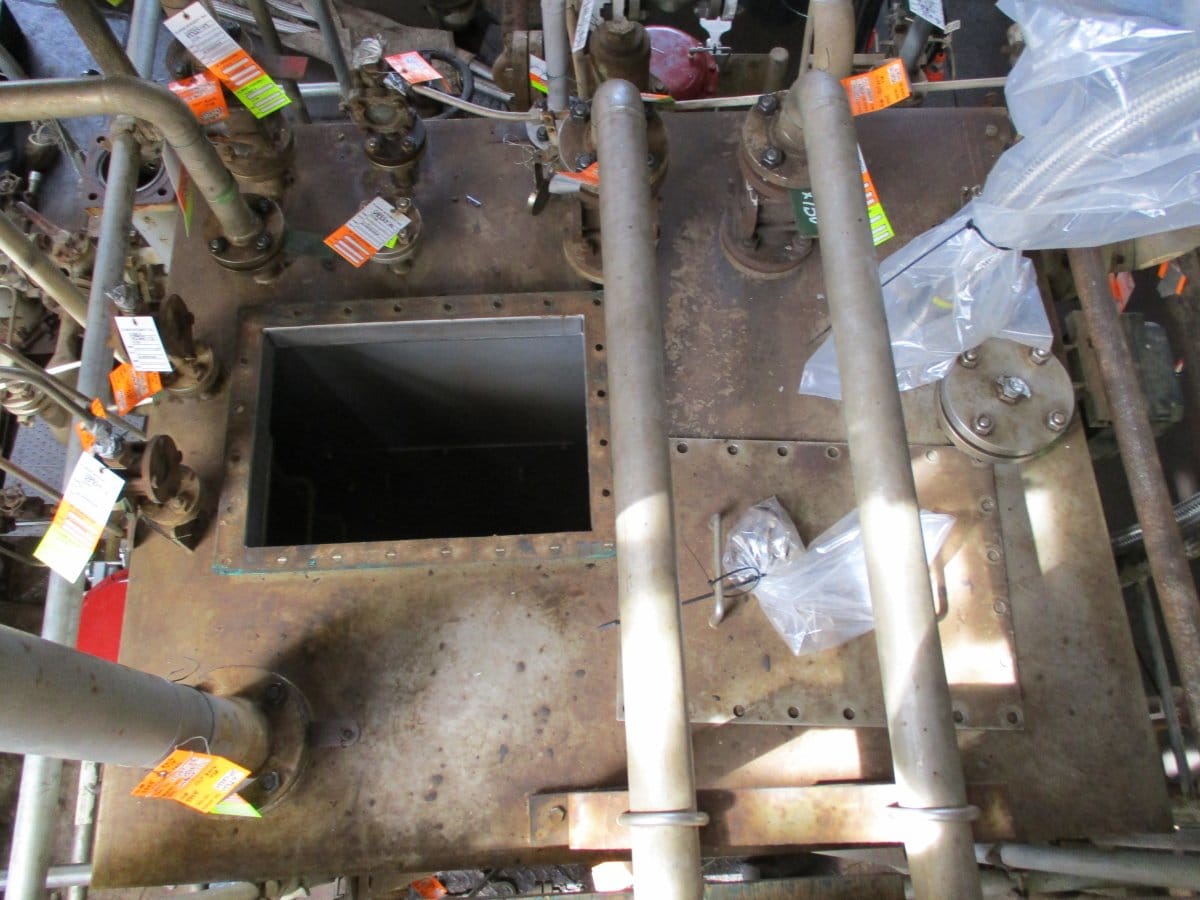
A single day of unplanned downtime at a major Australian processing facility can cost an asset manager upwards of A$180,000 in lost productivity. You’re likely aware that while maintenance is non-negotiable, the traditional approach to industrial tank cleaning often presents a frustrating trade-off between strict AS 2865 confined space compliance and the need for rapid turnaround. Residual hydrocarbons and persistent sludge buildup don’t just occupy volume; they actively threaten the integrity of your new product batches and compromise the structural health of your critical infrastructure.
This technical guide provides the precise framework needed to bridge the gap between rigorous safety and operational efficiency. You’ll discover how to implement nature-based, microbial solutions that achieve ISO-compliant cleanliness levels while significantly reducing the 48-hour window typically required for manual scrubbing. We’ll detail the transition from high-risk chemical washes to sustainable bioremediation techniques that ensure a zero-incident safety record for your team. This overview examines the latest automated cleaning technologies and biological agents that guarantee your system is ready for an immediate return to service according to Australian regulatory standards.
Key Takeaways
- Understand how systematic contaminant removal protects critical downstream assets like turbines and compressors from premature failure.
- Learn to optimize the four key cleaning levers-Time, Action, Chemistry, and Temperature-to select the most efficient industrial tank cleaning method for your facility.
- Navigate Australian WHS laws and AS/NZS standards to ensure your projects remain compliant while managing the industry’s primary cost drivers.
- Identify industry-specific solutions for complex challenges, from managing high-volume diesel particulates in mining to eliminating varnish in power generation reservoirs.
- Discover how integrating onsite technical interventions and fluid recovery can replace wasteful “dump and fill” practices with sustainable oil stewardship.
What is Industrial Tank Cleaning and Why is it Critical for Asset Reliability?
Industrial tank cleaning is the systematic extraction of accumulated sludge, scale, and microbial contaminants from storage vessels. It’s a precise engineering requirement rather than a simple janitorial task. For Australian operators in the mining, power generation, and manufacturing sectors, keeping these vessels free of oxidized hydrocarbons is vital for maintaining downstream equipment. Contaminants left to fester in a storage tank don’t stay stationary. They migrate through the system, causing catastrophic wear on high-speed turbines and centrifugal compressors that require ultra-pure lubrication to function.
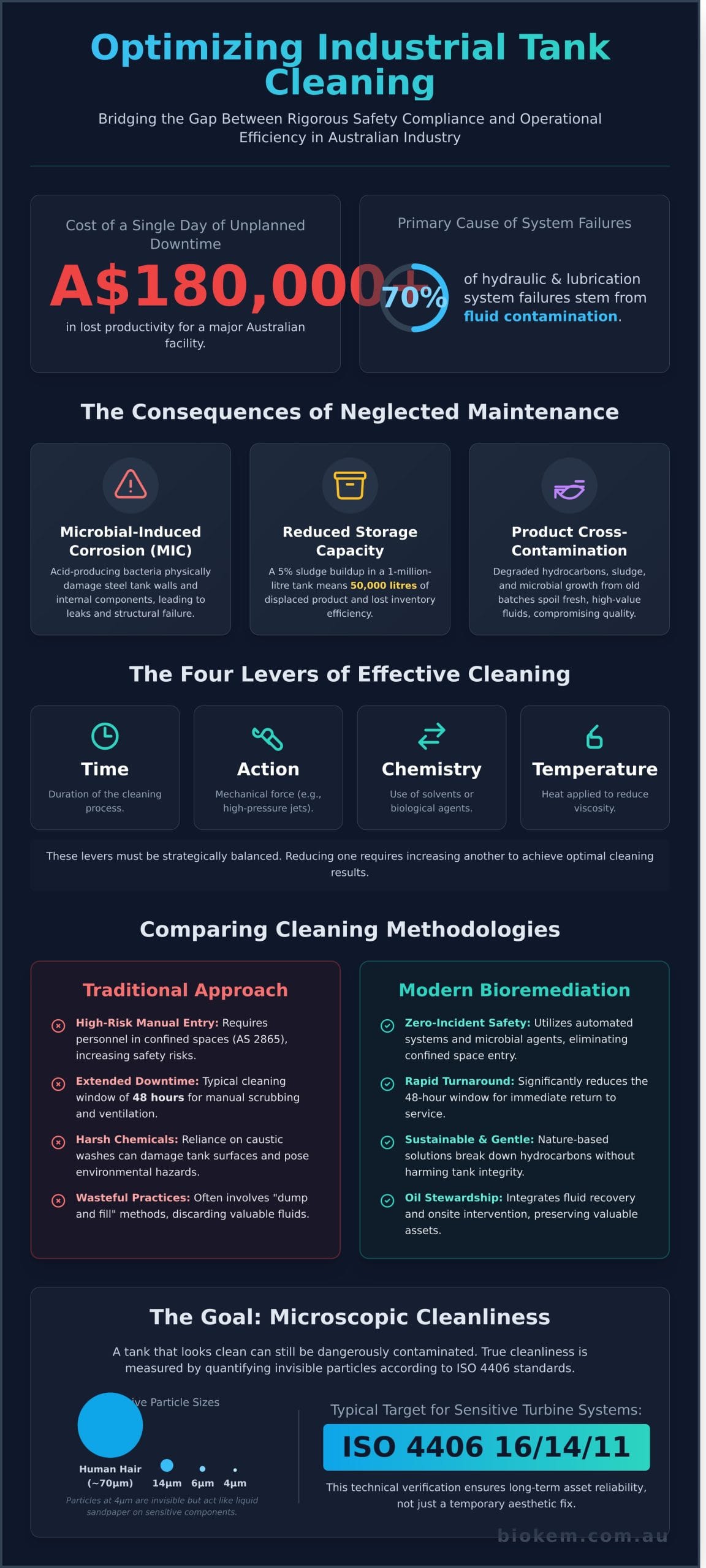
The economic logic for regular intervention is clear. Research indicates that 70% of hydraulic and lubrication system failures stem from fluid contamination. By implementing a rigorous cleaning schedule, facilities often see a 15% extension in the operational life of their primary assets. Modern facilities often employ an automated tank cleaning machine to minimize confined space entry risks while ensuring a consistent, high-pressure removal of stubborn residues. This shift from reactive “break-fix” cleaning to proactive maintenance cycles prevents unscheduled outages that can cost Australian enterprises upwards of A$50,000 per hour in lost productivity.
BioKem Oil Services views this process through a lens of sustainability and technical precision. We prioritize biological and nature-based methods to break down hydrocarbons, reducing the reliance on harsh caustic chemicals. This approach protects the integrity of the tank’s internal surfaces while aligning with modern environmental compliance standards. Effective industrial tank cleaning isn’t just about removing waste; it’s about restoring the equilibrium of the entire mechanical ecosystem.
The Consequences of Neglected Tank Maintenance
Ignoring the buildup at the bottom of a vessel leads to accelerated microbial-induced corrosion (MIC). This biological process allows acid-producing bacteria to eat through steel tank walls and internal heating coils, leading to structural failure. Beyond physical damage, sludge accumulation reduces usable storage capacity. In a 1-million-litre fuel tank, a 5% buildup of “bottoms” equates to 50,000 litres of displaced product, representing a significant hit to inventory efficiency. Cross-contamination also poses a risk, where degraded old fuel or lubricant spoils a fresh delivery of high-value fluids.
Cleanliness Standards: Beyond the Visual Inspection
A tank that looks clean to the naked eye can still be dangerously contaminated. In the world of high-performance machinery, we rely on ISO 4406 codes to quantify fluid hygiene. These codes measure the number of particles at 4, 6, and 14 microns. For context, a human hair is roughly 70 microns wide. Particles at the 4-micron level are invisible but act like liquid sandpaper on sensitive hydraulic valves. To ensure industrial tank cleaning was successful, we utilize independent oil analysis. This technical verification confirms that the internal environment meets the specific cleanliness requirements of the equipment manufacturers, ensuring long-term reliability rather than a temporary aesthetic fix.
- ISO 4406 16/14/11: The typical target for sensitive turbine systems.
- Microbial Testing: Essential for detecting “diesel bug” before it clogs filters.
- Particle Counting: Used to verify the effectiveness of the flushing process post-clean.
Comparing Industrial Tank Cleaning Methodologies: Mechanical vs. Chemical
Successful industrial tank cleaning relies on the strategic balance of four primary levers: Time, Action, Chemistry, and Temperature. This framework dictates how efficiently a technician can strip stubborn residues from internal surfaces. If an operator reduces the chemical concentration, they must compensate by increasing the mechanical action or the cleaning temperature. For Australian facilities managing heavy hydrocarbons or sulphur, maintaining a high temperature is often the most critical factor in reducing viscosity for easier extraction.
Selecting the appropriate methodology requires a deep analysis of the stored substance. Water-based residues often respond well to simple mechanical force, but complex petroleum products require a more nuanced approach. A 2020 technical review regarding the Cleaning Methods of Oil Residues demonstrates that while manual methods are traditional, automated systems provide more consistent results in hazardous environments. The industry is moving rapidly toward “no-entry” robotic cleaning. These systems significantly reduce the risk profile by keeping personnel outside the tank, aligning with Australian WHS standards for confined space safety.
Mechanical Cleaning Techniques
High-pressure water jetting, or hydro-blasting, remains a staple for removing hard scale and oxidation. Technicians often operate at pressures reaching 40,000 psi to strip surfaces back to bare metal. While powerful, this method creates large volumes of contaminated wastewater. To mitigate this, we employ specialized 3D nozzles that rotate on dual axes. These heads provide 360-degree coverage and use 40 percent less water than manual hoses. For heavy sludge that refuses to flow, mechanical scraping combined with high-performance vacuum extraction is used to relocate solids into dewatering units for processing.
Chemical and Biological Remediation
Traditional solvent-based cleaning is effective for dissolving resins and waxes, yet it often introduces secondary pollutants into the waste stream. Biokem champions the use of bioremediation, utilizing eco-friendly microbial cleaners that digest hydrocarbons at a molecular level. These microbes convert toxic oils into water and carbon dioxide, often reducing waste disposal costs by A$500 to A$1,500 per tonne depending on the contaminant. This nature-based approach is safer for the environment and the workforce. Before any physical entry occurs, we use chemical vapor neutralizers to eliminate volatile organic compounds (VOCs). This process can clear a hazardous atmosphere 30 percent faster than traditional mechanical ventilation alone.
The environmental footprint of a cleaning project is now a primary KPI for Australian industrial sites. Moving away from harsh caustics toward biodegradable surfactants allows companies to meet strict EPA regulations while maintaining operational efficiency. If your site is looking to transition away from traditional chemical-heavy processes, implementing nature-based cleaning solutions offers a sustainable path to compliance and performance. Choosing the right methodology is not just about a clean tank; it’s about managing the long-term ecological and financial health of your facility.
Safety and Compliance: Navigating Australian Standards (AS/NZS)
Safety serves as the primary cost driver for industrial tank cleaning projects. It often represents 55% to 65% of the total project quote. This isn’t bureaucratic bloat; it covers the high-tech sensors, specialized insurance, and expert labor required to prevent catastrophic failure. Facility managers hold heavy legal obligations under the Work Health and Safety (WHS) Act 2011. They’re responsible for ensuring every contractor follows rigorous risk assessment protocols. Failure to do so can result in Category 1 penalties. These include potential jail time or fines reaching A$3.8 million for corporations under recent Australian harmonized WHS laws.
Hazardous atmospheres are invisible killers in oil storage environments. Hydrocarbon vapors and Hydrogen Sulfide (H2S) gas can accumulate in stagnant pockets, even after a tank is drained. We use multi-gas “sniffer” detectors to monitor oxygen levels and toxic gas concentrations in real-time. Technicians must wear specialized PPE, often including self-contained breathing apparatus (SCBA) or supplied-air respirators. This equipment ensures that even if a gas pocket is breached during sludge removal, the technician remains isolated from the contaminant. Risk assessments aren’t static documents. They’re live protocols that adapt as the internal environment changes during the cleaning process.
AS/NZS 2865: Confined Space Entry Requirements
Australian Standard 2865 mandates that no person enters a tank without current, nationally recognized certification. Every entry requires a designated “standby person” who remains outside the hatch at all times. This sentry monitors the worker, maintains communication, and manages the rescue plan documentation. We don’t rely on verbal agreements; we use formal permit-to-work systems. These logs record atmospheric readings every 20 minutes to ensure the environment remains well below 5% of the Lower Explosive Limit (LEL). If readings fluctuate, the site is evacuated immediately.
Beyond the immediate entry point, managing overall site safety and personnel flow in complex industrial environments is also a key concern for facility managers. For those looking to enhance their safety protocols with automated monitoring of restricted areas, you can visit Footfall Australia for modern people counting solutions.
Environmental Compliance and Waste Disposal
Managing the waste stream is where biological expertise meets regulatory demand. Industrial tank cleaning generates hazardous sludge that falls under strict state EPA classifications, such as Category A or B waste in Victoria or Trackable Waste in New South Wales. Transporting this material requires licensed EPA vehicles and digital waste tracking certificates to ensure a transparent chain of custody.
We perform a detailed cost-benefit analysis between onsite filtration and offsite disposal. While traditional offsite disposal at a licensed facility might cost between A$450 and A$900 per tonne, onsite bioremediation can be more efficient. By using microbial agents to break down hydrocarbons at the source, we can often reduce the volume of hazardous material by 75% to 80%. This biological approach minimizes the carbon footprint of the project. It also significantly lowers the long-term environmental liability for the facility owner by neutralizing contaminants rather than simply moving them to a landfill.
Industry-Specific Tank Cleaning Challenges
Mining operations in regions like the Pilbara or the Hunter Valley manage diesel storage assets that frequently exceed 500,000 litres. These high-volume environments face constant particulate contamination from airborne dust and iron ore fines. If these contaminants aren’t addressed during industrial tank cleaning, they settle into a dense layer of bottom sludge. This layer reduces usable tank volume and causes premature wear on high-pressure transfer pumps. For oil and gas facilities, the challenge shifts to pyrophoric iron sulfides. These compounds are particularly dangerous because they can spontaneously combust when exposed to oxygen during tank inspections. Managing these risks requires precise chemical passivation to ensure the environment remains safe for entry and maintenance.
Manufacturing plants rely on hydraulic oil tanks to power precision machinery where tolerances are measured in microns. A single batch of contaminated oil leads to valve stiction and unplanned downtime that can cost a facility upwards of A$8,500 per hour in lost productivity. It’s not enough to simply swap the fluid; the internal surfaces must be free of the microscopic silt that accumulates in corners and dead zones of the reservoir. Our approach ensures that these systems meet the strict ISO 4406 cleanliness codes required for modern industrial reliability.
- Mining: Managing particulate ingress and high-turnover fuel stability.
- Power Generation: Eliminating varnish deposits on critical thermal surfaces.
- Oil & Gas: Neutralising pyrophoric hazards and managing heavy crude bottoms.
- Manufacturing: Maintaining sub-micron cleanliness for precision hydraulic circuits.
Turbine and Hydraulic Reservoir Cleaning
Varnish mitigation is a critical requirement for power generation and large-scale manufacturing. This sticky, resinous byproduct of oil oxidation coats internal baffles and cooling coils, acting as an insulator that reduces cooling efficiency by 15% to 25%. We don’t just drain the oil; we use specialized mechanical agitation to strip these layers from the metal. Linking this process to a 24-hour high-velocity hot oil flush ensures the entire circuit is decontaminated. This provides a total system reset, preventing the new oil charge from being compromised by residual chemical precursors left in the pipework.
Fuel and Diesel Tank Maintenance
Microbial growth, often called “diesel bug,” thrives at the fuel-water interface in long-term storage tanks across Australia. These organisms can render a 100,000-litre batch of fuel unusable in less than 30 days if left unchecked. Since Australian Tier 4 heavy engines utilize high-pressure common rail systems, even microscopic biological debris causes catastrophic injector failure. Effective industrial tank cleaning must be followed by the installation of high-efficiency coalescing filters. These units remove 99.9% of free and emulsified water, ensuring the fuel meets the stringent requirements of modern engine manufacturers and prevents A$40,000 repair bills for fuel system overhauls.
Protect your infrastructure and maintain fluid integrity with our specialized solutions to optimise your fuel and oil storage today.
The BioKem Approach: Integrating Tank Cleaning with Oil Stewardship
Traditional industrial tank cleaning often defaults to a “dump and fill” mentality. This approach is inherently wasteful and ignores the latent value of the existing lubricant. BioKem shifts this paradigm toward a philosophy of oil stewardship. We view fluid as a high-value asset rather than a disposable consumable. Our onsite technical interventions focus on fluid recovery, which can reduce total lubricant spend by 40% annually for large-scale industrial operations.
We don’t just remove the sludge; we restore the environment the oil lives in. Our technicians use vacuum dehydration to extract dissolved water and gases that traditional filtration misses. This process, combined with mechanical tank remediation, ensures the system is chemically stable. To maintain these results, we leverage Filters S.p.A. technology. These high-performance filtration systems provide post-clean protection that prevents rapid re-contamination. This ensures particulate counts remain below critical thresholds for extended periods, often doubling the time between required service intervals.
By moving beyond simple cleaning, we address the root causes of system degradation. This proactive methodology prevents the formation of varnish and oxidative by-products. It’s a strategic move that protects the longevity of pumps, valves, and actuators. When we leave a site, the system isn’t just clean; it’s optimized for peak mechanical performance.
Technical Intervention vs. General Cleaning
General cleaning services often focus on visible debris. BioKem technicians focus on the chemistry of the entire system. We use professional oil analysis to prove the ROI of every industrial tank cleaning project. For instance, reducing a system’s ISO 4406 cleanliness code from 21/19/16 to 15/13/10 can double the life of sensitive hydraulic components. We develop customized cleaning plans for critical lubrication assets, ensuring that every intervention accounts for the specific viscosity and additive package of the oil in use.
Our approach minimizes the environmental footprint of heavy industry. Disposal costs for waste oil in Australia currently range from A$0.25 to A$0.65 per litre, depending on the location and contamination level. By recovering 95% or more of the existing fluid through our technical interventions, we eliminate these costs and the associated carbon footprint of transporting new oil to remote sites. This biological and technical synergy represents the future of sustainable industrial maintenance.
Equipment Hire and National Support
Maintaining system health requires consistent effort. We offer access to specialized filtration and cleaning units for hire across Australia. This allows sites to manage their own fluid health between major scheduled interventions. Our national coverage extends from our primary base in Capalaba, Queensland, to the most remote mining operations in Western Australia and the Northern Territory. We provide the same level of technical rigor whether we’re on a metropolitan manufacturing floor or a dusty mine site. You can contact BioKem for a technical tank cleaning assessment to determine the best strategy for your specific assets.
We understand the logistical challenges of Australian industry. Our equipment is built to withstand harsh environments, ensuring reliability in temperatures exceeding 45 degrees Celsius. Whether you’re managing a single turbine or a fleet of excavators, our national support network ensures you have the tools and expertise to maintain fluid excellence. We aren’t just a service provider; we’re a partner in your operational efficiency.
Optimising Asset Longevity Through Technical Precision
Maintaining high-value infrastructure requires strict adherence to AS/NZS 2865:2009 standards and a proactive approach to contamination control. Effective industrial tank cleaning isn’t just about removing sludge; it’s a critical component of oil stewardship that prevents unplanned downtime. By choosing specialized methodologies like hot oil flushing and varnish mitigation, asset managers can extend the service life of critical components by up to 40%. BioKem operates as the authorized Australian distributor for Filters S.p.A., ensuring your systems meet global filtration benchmarks while remaining compliant with local environmental regulations. Our national service network covers all Australian states, delivering technical expertise that balances operational efficiency with ecological responsibility. We don’t just clean tanks; we restore system health through nature-based alternatives and rigorous engineering protocols. It’s a sustainable way to secure your site’s productivity for the long term.
Enquire about BioKem’s Technical Tank Cleaning Services to discuss your site-specific requirements with our national engineering team today.
Frequently Asked Questions
How often should industrial storage tanks be cleaned?
Industrial storage tanks typically require professional cleaning every 3 to 5 years to maintain structural integrity and product purity. Australian Standard AS 1940:2017 outlines specific maintenance intervals for flammable and combustible liquids. If a tank stores heavy fuel oil, sludge accumulation often necessitates a 24 month cleaning cycle. Conversely, tanks for refined distillates can operate for 7 years before sediment levels impact fuel quality or tank capacity.
What is the safest way to clean a tank containing hazardous vapors?
The safest method involves full degassing and vapor suppression using specialized bio-catalytic agents before any personnel approach the unit. BioKem utilizes eco-friendly degassing chemistry that neutralizes volatile organic compounds at a molecular level. This process reduces Lower Explosive Limit levels to 0% within 4 to 6 hours. It eliminates the risk of flash fires and ensures the environment’s safe for subsequent inspection or mechanical work.
Can industrial tank cleaning be performed without entering the tank?
Yes, modern industrial tank cleaning can be performed using automated no-entry systems such as 360-degree rotating jet heads and robotic cannons. These systems allow technicians to remove 95% of sludge from the exterior, which significantly reduces the risks associated with confined space entry. By utilizing high-pressure nozzles and closed-loop circulation, we maintain safety while achieving a thorough clean that meets ISO 14001 environmental management standards.
What is the average cost of professional industrial tank cleaning in Australia?
Professional cleaning costs in Australia generally range from A$5,000 for small 10,000-liter units to over A$35,000 for large-scale industrial reservoirs. Factors influencing the final quote include the volume of hazardous waste, the degree of hydrocarbon contamination, and site accessibility. For a standard 50,000-liter diesel tank, companies should budget approximately A$8,500 to A$12,000. This price typically covers labor, specialized equipment, and initial site risk assessments.
How do I know if my tank requires chemical cleaning or just mechanical jetting?
Chemical cleaning’s necessary when hydrocarbons have bonded to the tank walls or when microbial growth is present. Mechanical jetting effectively removes loose sediment and scale but won’t eliminate microscopic biological contaminants. If your last laboratory fuel test showed a microbial count exceeding 100 CFU/L, chemical bioremediation is required. BioKem’s technical team uses borescope inspections to determine the specific contamination profile before recommending a treatment protocol.
What are the risks of using third-party labor for confined space cleaning?
Using untrained third-party labor increases the risk of atmospheric hazards and falls, which account for 90% of confined space fatalities. Non-specialized workers often lack the A$20 million public liability insurance and specific AS 2865-2009 certifications required for high-risk entries. If an incident occurs, the site owner faces legal liabilities and potential fines exceeding A$1.5 million under Australian Work Health and Safety laws. Professional crews bring validated safety systems.
Does BioKem provide waste disposal services after tank cleaning?
BioKem manages the entire waste lifecycle, including the transport and disposal of hazardous sludge at EPA-licensed facilities. We provide a waste tracking certificate for every ton of material removed, ensuring your facility remains 100% compliant with state environmental regulations. Our process prioritizes hydrocarbon recovery, often reclaiming 80% of the oil from the sludge. This reduces the total volume of waste destined for landfill and lowers your overall environmental footprint.
How long does a typical 50,000-liter industrial tank cleaning take?
A standard industrial tank cleaning project for a 50,000-liter vessel typically takes 1 to 3 business days to complete. The first day involves setup, degassing, and initial waste extraction. The second day focuses on high-pressure cleaning and final scrubbing of the internal surfaces. If the tank requires internal repairs or specialized chemical liners, the timeline may extend by an additional 48 hours to allow for proper curing and inspection.