

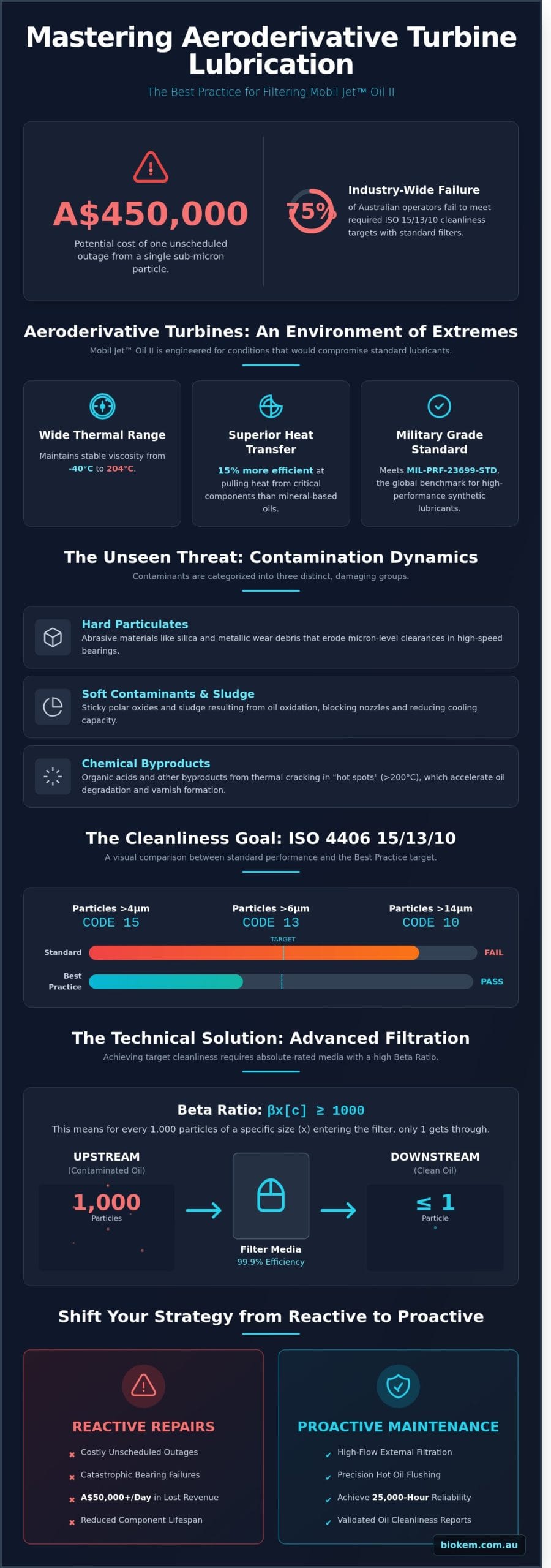
A single sub-micron particle can be the catalyst for a A$450,000 unscheduled outage if it compromises a high-speed bearing in your aeroderivative unit. You know that maintaining fluid integrity is non-negotiable for operational stability. However, 75% of Australian operators find that standard filters fail to reach the ISO 4406 15/13/10 targets required for peak performance. Implementing the Best Practice for filtering aeroderivative gas turbine synthetic oil circuits – Mobil Jet™ Oil II is the only way to prevent the varnish buildup that plagues these high-heat environments. It’s a technical challenge that requires more than just a basic swap of filter elements.
We’ll show you how to master the technical requirements for maintaining lubricant cleanliness to ensure your turbine hits its 25,000-hour reliability milestones. You’ll gain a clear framework for proactive lubrication management that delivers validated oil cleanliness reports and extends component life. This approach shifts your focus from costly reactive repairs to a sophisticated, sustainable maintenance model built for the unique demands of the Australian energy sector. We’ll break down the chemistry of synthetic degradation and the mechanical solutions that keep your oil within specification for years, not months.
Key Takeaways
- Understand the unique thermal stress profiles of aeroderivative engines and why maintaining MIL-PRF-23699-STD compliance is critical for long-term component integrity.
- Master the Best Practice for filtering aeroderivative gas turbine synthetic oil circuits – Mobil Jet™ Oil II by deploying absolute-rated media with a Beta ratio of βx[c] ≥ 1000.
- Identify the mechanisms of “hot spot” degradation and learn how to effectively categorize hard particulates and soft chemical byproducts that compromise turbine reliability.
- Learn how to transition from reactive repairs to a proactive maintenance strategy in Australia using high-flow external filtration rigs and precision hot oil flushing.
The Performance Demands of Aeroderivative Gas Turbines and Mobil Jet™ Oil II
Aeroderivative gas turbines represent the peak of power density in modern industrial applications. These units transition aviation technology into land-based power generation and marine propulsion, operating under extreme thermal profiles that would compromise standard lubricants. Mobil Jet™ Oil II has become the global benchmark for these systems by meeting the MIL-PRF-23699-STD specification. This synthetic lubricant maintains a stable viscosity across a demanding temperature range from -40°C to 204°C. Adhering to the Best Practice for filtering aeroderivative gas turbine synthetic oil circuits – Mobil Jet™ Oil II is essential to maintaining the integrity of these high-value assets.
To better understand how this specific lubricant performs under pressure, watch this comparative analysis:
Thermal Stress and Synthetic Ester Stability
The high specific heat of Mobil Jet™ Oil II allows it to pull heat away from engine components with 15% more efficiency than traditional mineral-based alternatives. This synthetic ester base remains chemically stable even when bulk oil temperatures exceed 200°C. When temperatures surpass this threshold, unprotected oils begin to undergo oxidative breakdown. This process leads to the formation of hard carbon deposits and sticky sludge. These contaminants block oil feed nozzles and reduce the cooling capacity of the circuit. Biokem’s approach to hot oil flushing and filtering ensures these degradation products don’t accumulate in critical pathways. We focus on maintaining the chemical purity of the oil to extend the life of the synthetic ester and prevent the onset of varnish.
Why Aeroderivatives are Sensitive to Fluid Cleanliness
Unlike heavy industrial frames, aeroderivative bearings are engineered with clearances measured in microns. High-speed rotational stability depends on a pristine fluid film; sub-micron particulates act as abrasives that erode these clearances over time. Even a small increase in ISO cleanliness codes can lead to catastrophic bearing failure. In the Australian power sector, an unscheduled outage can cost operators upwards of A$50,000 per day in lost revenue and emergency repair fees. Using a particle pal range to monitor fluid health is a core component of the Best Practice for filtering aeroderivative gas turbine synthetic oil circuits – Mobil Jet™ Oil II. Maintaining ISO 15/12/10 cleanliness levels protects against the financial risks associated with premature component wear. Our local expertise helps Australian facilities meet strict environmental and operational standards through precision filtration and nature-based solutions.
Understanding Contamination Dynamics in High-Temperature Synthetic Circuits
Maintaining oil health in aeroderivative units like the LM6000 or LM2500 requires a technical focus on fluid chemistry. Mobil Jet™ Oil II is a hindered polyol ester engineered for thermal stability, yet high-velocity circuits introduce air and moisture that accelerate oxidation. Contaminants in these systems are categorised into three distinct groups: hard particulates like silica or metallic wear debris, soft contaminants such as polar oxides, and chemical byproducts including organic acids. When oil passes through “hot spots” where temperatures spike above 200°C, the ester base can undergo thermal cracking. This process creates carbonaceous deposits and microscopic sludge that standard mechanical filters often fail to trap.
Implementing a Best Practice for filtering aeroderivative gas turbine synthetic oil circuits – Mobil Jet™ Oil II is critical because these sub-micron precursors are the primary drivers of component failure. While federal regulations for oil filtration mandate specific safety bypasses and mesh sizes for engine integrity, industrial power generation demands even tighter controls to prevent long-term asset degradation. Moisture and air entrainment further compound these issues. In high-velocity circuits, entrained air leads to micro-dieseling, a phenomenon where air bubbles collapse under pressure, generating localised heat that chars the surrounding oil molecules and creates “black oil” conditions.
The Role of Fine Particulates in Bearing Wear
Particles in the 2 to 5 micron range are particularly destructive because they match the dynamic film thickness of high-speed bearings. These tiny contaminants act as abrasive sandpaper, bridging the oil film and causing surface fatigue. It’s vital to distinguish between “nominal” filtration, which might only capture 60% of particles at its rated size, and “absolute” filtration, which provides a Beta ratio of 75 or higher. A reduction in the ISO 4406 particle count by two codes can increase component fatigue life by 50%.
Varnish Formation and Chemical Degradation
Varnish isn’t a solid at first; it starts as a liquid-phase oxidation byproduct that stays dissolved in hot Mobil Jet™ Oil II. As the lubricant cools in stagnant zones or passes through high-pressure drops, these polar molecules precipitate out, forming a sticky residue on metal surfaces. This transition from liquid to vapour and then to solid phase is what leads to sticking servo valves and blocked cooling passages. Implementing effective varnish mitigation strategies is essential for removing these sub-micron contaminants before they polymerise into hard lacquer. For operators in Australia facing high ambient temperatures, proactive hot oil flushing and filtering ensures these circuits remain clear of performance-robbing deposits.
Best Practice Filtration Architecture for Mobil Jet™ Oil II
Maintaining peak performance in aeroderivative turbines requires more than just high-quality lubricant. It demands a rigorous filtration architecture designed specifically for the chemical and thermal profiles of synthetic esters. Implementing the Best Practice for filtering aeroderivative gas turbine synthetic oil circuits – Mobil Jet™ Oil II involves a multi-layered approach to contaminant management that prioritises absolute capture and thermal stability.
The foundation of this architecture rests on four critical technical requirements:
- High-Beta ratio filter elements: We specify βx[c] ≥ 1000 for all critical circuit points. This ensures an efficiency of 99.9% for the target particle size, preventing the microscopic “sandblasting” effect that erodes high-speed bearing surfaces.
- Temperature-compatible media: Mobil Jet™ Oil II often operates in environments where bulk oil temperatures reach 200°C. Standard media will fail; only specialised materials can maintain structural integrity at these extremes.
- Strategic placement: Engineers must install specialist oil filters at the scavenge return lines and the pressure supply side to protect sensitive components from both ingested and generated contaminants.
- Continuous monitoring: Differential pressure (ΔP) sensors across filter housings provide the first warning of element loading. In Australian industrial settings, waiting for a scheduled maintenance interval to check filters often results in bypassed oil and accelerated wear.
High-Beta Ratio Filters and Material Compatibility
The chemical composition of Mobil Jet™ Oil II is aggressive toward standard cellulose filter media. Cellulose fibres can swell or migrate into the oil stream when exposed to synthetic esters at 200°C. We utilise glass fibre or stainless steel wire mesh media to ensure long-term stability. These materials don’t react with the lubricant’s additive package. It’s equally vital to verify that all seals and gaskets are constructed from high-specification fluorocarbons or Viton. Utilising Filters S.p.A. products provides the necessary assurance that every component in the housing can withstand the unique demands of aeroderivative turbine operation without degrading.
Target ISO Cleanliness Codes for Reliable Operation
Operational reliability depends on achieving and maintaining a strict ISO 4406 cleanliness target, typically 15/13/10 for aeroderivative turbines. Achieving this level requires a shift in how operators view “clean” oil. New oil delivered in drums often tests at 18/16/13, which is far too dirty for direct injection into a turbine. We recommend using the particle pal ranges for real-time verification of oil cleanliness during fluid transfers and system operation. This proactive monitoring identifies contamination spikes before they trigger a costly unplanned shutdown. Adopting this Best Practice for filtering aeroderivative gas turbine synthetic oil circuits – Mobil Jet™ Oil II ensures that your lubricant remains a functional asset rather than a source of wear.
Proactive Maintenance: Hot Oil Flushing and Purification
Implementing the Best Practice for filtering aeroderivative gas turbine synthetic oil circuits – Mobil Jet™ Oil II requires a structured approach to decontamination. These high-performance systems operate under extreme thermal stress, making proactive maintenance essential for preventing premature component failure. A systematic flush removes sub-micron particulates and chemical contaminants that standard internal filters often miss.
- Step 1: Perform a baseline oil analysis to determine current contamination levels. This data provides the necessary benchmark for measuring the success of the cleaning process.
- Step 2: Isolate the turbine and connect high-flow external filtration rigs. This step ensures that debris isn’t pushed deeper into sensitive bearing compartments.
- Step 3: Execute a hot oil flush at turbulent flow rates. We target a Reynolds number exceeding 4,000 to ensure the fluid velocity is sufficient to dislodge adhered particles from the pipe walls.
- Step 4: Use paddle flushing screens to verify the removal of debris. These screens provide visual evidence of the circuit’s internal condition.
- Step 5: Validate the system with a final ISO 4406 cleanliness report. For aeroderivative units, achieving a code of 15/13/10 or better is the industry standard for long-term reliability.
When to Perform a Hot Oil Flush
Timing is critical for maintaining circuit integrity. Post-commissioning flushes are mandatory in Australia to remove “built-in” debris such as silica, welding slag, or preservation compounds from new installations. Following a major overhaul, a flush ensures the circuit is pristine before a high-speed restart, preventing immediate damage to new bearings. Condition-based intervention is also necessary when trending analysis shows a 20% or greater spike in wear metals like iron or silver. Adhering to the Best Practice for filtering aeroderivative gas turbine synthetic oil circuits – Mobil Jet™ Oil II ensures these assets remain operational during Australia’s peak energy demand periods.
Advanced Purification: Vacuum Dehydration
Mobil Jet™ Oil II is a synthetic polyol ester, making it naturally hygroscopic. It readily absorbs moisture from the atmosphere, especially in humid Australian coastal environments. Excess water triggers hydrolysis, a chemical reaction that breaks down the ester base and leads to a rapid increase in the Acid Number (AN). Vacuum dehydration effectively removes dissolved, emulsified, and free water without compromising the oil’s additive package. By utilizing heat transfer systems to maintain optimal purification temperatures between 50°C and 60°C, we can lower water content to below 100 ppm. This process prevents the formation of corrosive by-products and extends the service life of the lubricant.
Protect your critical turbine assets by booking a professional hot oil flushing and purification service today.
Executing a Best Practice Lubrication Program in Australia
Australian power generation and offshore operators are moving away from the traditional “break-fix” mentality. This reactive approach often leads to catastrophic component failure and millions in lost revenue. Transitioning to a proactive maintenance strategy is the most effective way to protect high-value assets. By focusing on the root causes of wear, specifically particulate and moisture contamination, facilities can increase turbine availability by up to 25%.
Implementing the Best Practice for filtering aeroderivative gas turbine synthetic oil circuits – Mobil Jet™ Oil II requires more than just standard filters. It demands technical specialists who understand the unique chemistry of Type II esters. Partnering with experts for onsite interventions ensures that lubrication remains within OEM specifications. This technical oversight is vital for insurance validity. Many Australian industrial insurers now mandate documented ISO 4406 cleanliness codes before renewing policies for critical energy infrastructure. Beyond compliance, these practices extend the functional life of synthetic oil by 200%, drastically reducing the total cost of ownership (TCO).
Specialized Equipment Hire for Turbine Maintenance
Asset managers frequently face the challenge of managing oil quality during peak demand or scheduled outages. Utilizing industrial oil filtration equipment hire provides a flexible solution without the capital expenditure of permanent hardware. High-flow filtration rigs can be deployed to remote sites in Western Australia or the Northern Territory to handle emergency decontamination. Onsite purification is often 60% cheaper than full oil replacement when considering the logistics of disposing of used synthetic fluids. It allows the turbine to stay in service while the rig removes sub-micron varnish precursors that standard onboard systems cannot catch.
Onsite Analysis and Laboratory Validation
Reliable data is the foundation of any lubrication program. Technicians use patch test kits to get immediate visual confirmation of oil health in the field. These kits identify metallic wear debris and carbonaceous matter that indicate internal component stress. While onsite tests provide speed, independent laboratory reports provide the legal and technical validation required for warranty claims. We recommend that Australian operators establish a 12-month rolling lubrication health check. This structured schedule ensures the Best Practice for filtering aeroderivative gas turbine synthetic oil circuits – Mobil Jet™ Oil II is maintained year-round. Consistent monitoring prevents the sudden varnish accumulation that causes 40% of unplanned turbine trips in peak-load facilities.
- Reduces oil disposal costs and environmental impact.
- Maintains ISO cleanliness standards for insurance compliance.
- Eliminates the risk of acid build-up in ester-based lubricants.
- Provides a documented audit trail for asset integrity audits.
Securing Peak Reliability for Your Aeroderivative Assets
Optimising the longevity of high-performance turbines requires more than just standard maintenance; it demands a rigorous approach to fluid cleanliness. Implementing the Best Practice for filtering aeroderivative gas turbine synthetic oil circuits – Mobil Jet™ Oil II ensures that thermal degradation and sub-micron varnish don’t compromise your critical assets. As the authorised Australian distributor for Filters S.p.A., BioKem provides specialised hot oil flushing and purification services that strictly adhere to ISO 4406 cleanliness standards. These proactive measures reduce the risk of costly component failure across Australia’s demanding energy and industrial sectors. By focusing on precise contamination control, operators maintain peak efficiency while fulfilling environmental responsibilities through significantly extended oil life. It’s time to transition from reactive repairs to a disciplined, data-driven lubrication strategy that protects your mechanical integrity. Our team brings local technical expertise to solve complex filtration challenges with quiet confidence and proven results.
Consult with BioKem’s Technical Experts for Aeroderivative Oil Management to protect your investment and ensure your operations remain resilient.
Frequently Asked Questions
Why is Mobil Jet™ Oil II preferred for aeroderivative gas turbines?
Mobil Jet™ Oil II is preferred because it maintains exceptional thermal and oxidation stability at extreme operating temperatures up to 204°C. This synthetic ester lubricant reduces deposit formation in high-heat zones like bearing chambers. Since its introduction in 1963, it’s logged over 5 billion hours of flight time. For Australian operators, its ability to handle rapid load cycles in peaking power plants makes it a reliable choice for maintaining engine efficiency.
What is the recommended ISO 4406 cleanliness code for aeroderivative engines?
The target ISO 4406 cleanliness code for most aeroderivative engines is 15/13/10. Maintaining this level ensures that particles larger than 4, 6, and 14 microns don’t exceed 320, 80, and 10 particles per millilitre respectively. Following the best practice for filtering aeroderivative gas turbine synthetic oil circuits – Mobil Jet™ Oil II helps operators achieve these targets. This prevents premature wear on precision-engineered bearings and prevents servo valve stiction.
Can I use standard hydraulic filters for synthetic turbine oil circuits?
You can’t use standard hydraulic filters because the synthetic esters in Mobil Jet™ Oil II are chemically aggressive toward common seal materials like Buna-N or Nitrile. Standard filters often fail when exposed to these lubricants at temperatures exceeding 100°C. You must specify filters with Fluorocarbon (Viton) seals and glass fibre media. Using incompatible materials leads to seal swelling and bypass leakage, which compromises the entire lubrication system’s integrity.
How often should I perform hot oil flushing on a turbine circuit?
You should perform hot oil flushing during initial commissioning or after major mechanical failures that introduce metallic debris. Industry standards suggest flushing until 100% of the circuit reaches the target ISO cleanliness code at flow rates 2 to 3 times the normal operating velocity. For Australian power generators, scheduling this every 48,000 operating hours during a major overhaul ensures the removal of varnish and carbonaceous deposits that standard filtration misses.
What are the signs that my Mobil Jet™ Oil II is degrading?
The primary signs of degradation are a sharp increase in the Total Acid Number (TAN) and a darkening of the oil’s colour. If your TAN exceeds 2.0 mg KOH/g, the oil’s acidity can cause lead corrosion in bearings. You’ll also notice a viscosity increase of more than 10% from the baseline. Regular laboratory analysis every 500 to 1,000 hours is vital for detecting these chemical changes before they cause hardware damage.
How does vacuum dehydration help maintain synthetic ester lubricants?
Vacuum dehydration removes dissolved water and gases to prevent the hydrolysis of synthetic esters. Because Mobil Jet™ Oil II is hygroscopic, it absorbs moisture from the air, which can lead to acid formation and oil breakdown. Maintaining water levels below 100 ppm via vacuum dehydration preserves the lubricant’s chemical structure. This process is a critical part of the best practice for filtering aeroderivative gas turbine synthetic oil circuits – Mobil Jet™ Oil II.
What is the difference between a nominal and absolute filter rating?
An absolute filter rating indicates a 99.9% efficiency at a specific micron size, whereas a nominal rating suggests only 50% to 95% efficiency. For aeroderivative turbines, you need absolute-rated filters with a Beta ratio of 1000 or higher. A 3-micron absolute filter captures 999 out of 1,000 particles at that size. Nominal filters allow too many damaging particles to pass through, which shortens the lifespan of high-speed components.
Is pre-filtering new Mobil Jet™ Oil II necessary?
Pre-filtering new oil is essential because fresh Mobil Jet™ Oil II typically arrives with an ISO cleanliness code of 18/16/13, which is too dirty for immediate use. Pumping oil directly from the drum into the reservoir introduces thousands of contaminants. You should use a portable filtration cart to bring the oil down to ISO 15/13/10 before it enters the turbine. This simple step reduces the initial wear on your high-value assets.