

If you believe the sealed drum of lubricant arriving at your site is ready for immediate use in your rotational asset, you’re likely risking a A$100,000 turbine/compressor failure. It’s a common misconception that "new" equals "clean" in the Australian industrial sector. The technical reality is that oil packaged and supplied by a refinery most often does not meet the cleanliness specification set by the OEM for the equipment it is used on. According to industry data from the Noria Corporation, up to 80 percent of mechanical wear is directly attributable to particle contamination, much of which is introduced during the refining and packaging process before the fluid even reaches your facility.
You understand the importance of maintaining asset integrity to avoid the sting of a rejected warranty claim or unplanned downtime during a critical production cycle. This guide shows you why refinery-supplied oil falls short of modern tolerances and how you can achieve the specific ISO 4406 cleanliness levels your OEM demands. We’ll outline the exact filtration steps and transfer protocols required to extend the service life of your turbines and pumps while meeting local regulatory expectations for operational efficiency and environmental responsibility.
Key Takeaways
-
Understand the critical distinction between chemical purity and particulate cleanliness. It’s crucial to grasp this difference, as new oil delivered from refineries often fails to meet the stringent cleanliness specifications set by equipment OEMs.
-
Learn to accurately decode ISO 4406 particulate counts. This skill is vital for ensuring your industrial lubricants align with Target Cleanliness Levels, especially considering that oil supplied by a refinery often falls significantly short of OEM requirements.
-
Identify the specific contamination "touch points" that occur during lubricant transport and storage. These points are key to understanding why new oil, even when freshly packaged, frequently fails to achieve the cleanliness specifications mandated by the OEM.
-
Discover proactive strategies, such as implementing "Filter-In" policies and utilizing kidney-loop filtration. These methods are essential for rectifying the inherent cleanliness deficiencies often present in newly supplied refinery lubricants.
-
Explore how professional onsite technical services and comprehensive chemical analysis from BioKem Oil Services can effectively bridge this critical cleanliness gap, ensuring your lubricants consistently achieve and maintain OEM specifications.
Table of Contents
The New Oil Myth: Why Refinery Supply Often Fails OEM Specifications
Maintenance teams across Australia often equate a sealed drum with a clean fluid. This assumption is a dangerous oversight for modern industrial operations. The fundamental truth is that oil packaged and supplied by a refinery most often does not meet the cleanliness specification set by the OEM for the equipment it is used on. While the fluid is chemically pure according to its formulation, the mechanical cleanliness is frequently several ISO codes higher than what a high-performance hydraulic system requires.
Refineries operate as high-volume chemical manufacturing plants. Their primary quality control metrics focus on viscosity index, additive packages, and oxidation stability. Microscopic particulate counts aren’t the priority during the blending process. As the fluid moves through kilometres of pipework, storage tanks, and high-speed packaging lines, it picks up environmental debris. It’s common for a new batch of oil to arrive with a level of contamination that would trigger an alarm in a functioning system.
Refinery Standards vs. Equipment Requirements
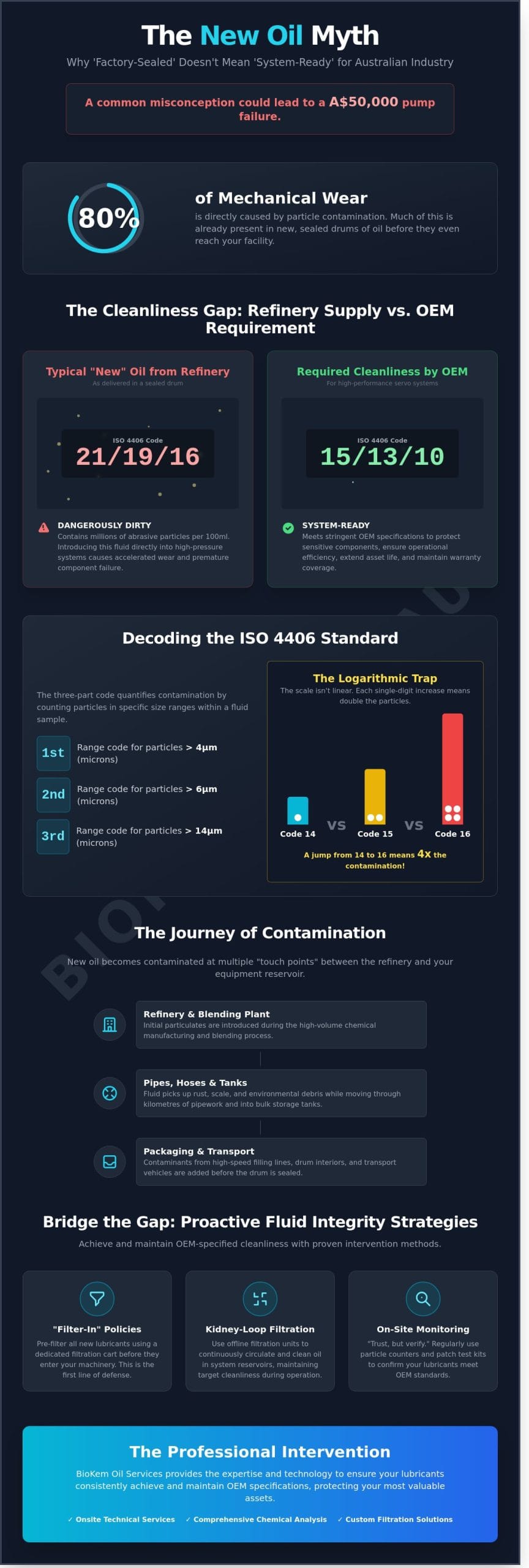
Refineries define "clean" based on chemical composition and the absence of visible sediment. This doesn’t account for the microscopic particles that cause the most damage. A typical 205L drum of new hydraulic oil often shows an ISO 4406 cleanliness level of 21/19/16. This represents millions of particles larger than 4 microns per 100ml of fluid. In contrast, high-performance servo systems demand ratings as low as 15/13/10. The gap between refinery output and OEM requirements isn’t a small margin; it’s a significant technical discrepancy that leads to equipment failure.
The Cost of Assuming New Oil is Ready for Service
Modern industrial machinery in Australia is built with tighter tolerances than ever before. High-pressure systems operating at 3,000 psi or higher are extremely sensitive to silt-sized particles that act as sandpaper on internal surfaces. If you introduce refinery-fresh oil directly into a system without pre-filtration, you risk immediate damage to sensitive components like servo valves and piston pumps. Introducing contaminated new oil into a system causes abrasive particles to bridge clearances between moving parts, which accelerates the ‘wear-in’ phase of new machinery and creates a cycle of premature component degradation.
Because oil packaged and supplied by a refinery most often does not meet the cleanliness specification set by the OEM for the equipment it is used on, assuming "new" means "ready" is a direct risk to your asset’s lifespan. Relying on the supplier’s seal isn’t a strategy; it’s a gamble. Without verifying the fluid’s condition using on-site particle monitoring or patch test kits, you’re compromising your entire proactive maintenance framework from the very first hour of operation.
Decoding OEM Cleanliness Standards and ISO 4406
Understanding fluid cleanliness requires a firm grasp of the ISO 4406:2021 classification system. This international standard uses a three-part code to represent the number of particles larger than 4μm, 6μm, and 14μm detected in a one-millilitre sample of fluid. For instance, a common target for high-pressure industrial turbines is 16/14/11. These numbers aren’t linear; they’re logarithmic. Every one-point increase in a code represents a doubling of the particle count. If your system moves from a code of 14 to 15 in the 6μm range, you’ve doubled the amount of wear-inducing debris circulating through your machinery.
It’s a common misconception that oil is ready for use straight from the drum. In reality, oil packaged and supplied by a refinery most often does not meet the cleanliness specification set by the OEM for the equipment it is used on. Most new oil arrives at Australian industrial sites with a cleanliness level of approximately 20/18/15. This is significantly dirtier than what modern high-precision components require. OEMs set specific Target Cleanliness Levels (TCL) because they know that even microscopic contamination leads to premature failure and costly downtime. Adhering to these targets is both a technical necessity and a prerequisite for maintaining warranty protection.
Why Clearances Matter in Modern Machinery
The relationship between lubricant film thickness and particle size determines the lifespan of your components. In many high-performance systems, the oil film separating moving parts is often thinner than 1μm. When silt-sized particles in the 4μm to 6μm range enter these gaps, they cause three-body abrasion. In high-velocity oil streams, these particles act as an abrasive medium, effectively sandblasting internal surfaces and valve seats. Critical components like servo-valves and piston pumps have the tightest tolerances, making them the first to fail when contamination levels rise above the OEM’s specified threshold.
Consulting Your Operator’s Manual
You’ll find the required fluid specifications in the technical data section of your operator’s manual or the manufacturer’s lubrication guide. This document dictates the specific ISO cleanliness code required for optimal performance and longevity. Using oil that falls outside these parameters creates a significant legal risk, as it provides a loophole for manufacturers to deny warranty claims if a component fails prematurely.
Australian operators should regularly use professional oil analysis to benchmark their incoming oil against these OEM requirements. If your current supply doesn’t meet the mark, implementing a secondary filtration step before the oil enters your reservoir is essential. For a quick on-site assessment of your fluid’s condition, using a patch test kit can provide immediate visual confirmation of the particulates present in your system.
The Journey of Contamination: From Refinery to Reservoir
Most maintenance teams assume that oil arriving in a sealed drum or tanker is ready for immediate use. This assumption is a primary driver of premature component failure. Oil packaged and supplied by a refinery most often does not meet the cleanliness specification set by the OEM for the equipment it is used on. The fluid undergoes a complex journey with dozens of touch points where contaminants enter the stream. During transport, constant vibration causes internal abrasion within the tanker walls, releasing metallic fines into the fluid. As these storage tanks settle, they "breathe" through standard vents, drawing in ambient moisture and airborne particulates from the surrounding environment.
Cross-contamination remains a critical risk in bulk logistics. Multi-use delivery tankers often cycle through different lubricant grades. If a tanker previously held a high-zinc engine oil and now carries a zinc-free hydraulic fluid, residual volume and contaminated hoses can compromise the entire batch. On-site storage practices further exacerbate the issue. Statistics show that roughly 65% of industrial drums in regional Australia are stored outdoors. Thermal cycling from the sun causes these drums to expand and contract, creating a vacuum that sucks moisture and silica through the bungs, even when they appear sealed.
The Role of Human Error and Infrastructure
Reliability programs frequently fail during the final transfer stage. Dirty transfer pumps and unwashed funnels are silent killers of equipment longevity. It’s a common mistake to believe that "topping up" with new oil improves the system. In reality, adding unfiltered new oil can actually degrade the cleanliness of the existing system by introducing a fresh slug of contaminants. It’s vital to verify fluid quality before it touches your machines. Using patch test kits at the point of delivery provides an immediate, visual baseline of ISO cleanliness, ensuring you don’t pump a liability into your reservoir.
Environmental Factors in Australian Industry
Australian mining and regional operations face unique environmental challenges. Sub-10 micron silica particles, common in areas like the Pilbara, act as a grinding paste in high-pressure hydraulic components. Ambient temperatures frequently exceeding 40°C accelerate oxidation, which triggers varnish formation and causes essential additives to drop out of the solution. Moisture ingress is equally destructive. Beyond reducing lubricity, water in hydrocarbons facilitates microbial growth. This biological activity creates biomass that clogs filters and generates organic acids that corrode internal metal surfaces, leading to costly unplanned downtime.
Strategies for Achieving and Maintaining Fluid Integrity
Lubricant management starts long before a machine begins its cycle. It’s a documented reality that oil packaged and supplied by a refinery most often does not meet the cleanliness specification set by the OEM for the equipment it is used on. To bridge this gap, Australian industrial sites must adopt a rigorous "Filter-In" policy. Whether the fluid arrives in IBC totes or steel drums from Container Authority, this protocol ensures that every litre of new lubricant passes through a high-efficiency filter cart before it enters bulk storage or the machine reservoir. By treating new oil as a contaminated raw material rather than a finished product, you prevent the introduction of refinery-level particulates into sensitive systems.
Ongoing maintenance requires more than just initial filtration. Kidney-loop systems provide continuous polishing by circulating oil through a secondary filtration circuit, which keeps ISO 4406 cleanliness codes stable even during peak operation. For new installations or systems that have undergone major repairs, hot oil flushing is essential. This process uses high-velocity fluid to create turbulent flow, dislodging internal construction debris, weld slag, and silica that standard filtration cannot reach. Complementing this with upgraded desiccant breathers and high-quality seals prevents secondary contamination from the harsh Australian environment, where airborne dust and high humidity are constant threats.
Onsite Purification Techniques
Effective fluid management involves addressing both solid and liquid contaminants. Vacuum dehydration is a critical technique for removing dissolved water and gases that compromise oil film strength and promote oxidation. For particulate control, we utilise high-efficiency Filters S.p.A. products to achieve precise micron ratings. In high-temperature applications, varnish mitigation units are necessary to remove the soft contaminants that lead to valve stiction and reduced heat exchanger efficiency.
Establishing a Sampling Protocol
Effective fluid integrity is the foundation of mechanical reliability and environmental responsibility. Consult with Biokem’s technical team to audit your current oil handling procedures and implement a world-class filtration standard.
Professional Intervention: The BioKem Solution
Closing the gap between refinery-grade delivery and the stringent requirements of modern machinery requires specialized expertise. Oil packaged and supplied by a refinery most often does not meet the cleanliness specification set by the OEM for the equipment it is used on. BioKem Oil Services provides the technical bridge needed to ensure your lubricants achieve the necessary ISO 4406 cleanliness codes before they enter your critical systems. We focus on proactive hydrocarbon management, ensuring every litre of fluid supports equipment longevity rather than accelerating wear.
Onsite Technical Services for Heavy Industry
BioKem Oil Services mobilizes specialized technicians to sites across Australia to execute high-velocity oil flushing and purification. These programs are tailored for turbines, compressors, and complex hydraulics where particle contamination leads to catastrophic failure. Our teams ensure all operations comply with Australian environmental regulations and safety standards, such as AS 1940 for the storage and handling of flammable and combustible liquids. By utilizing chemical analysis and onsite particle counting, we verify the oil reaches the exact OEM target before the system restarts. This process eliminates the risk of "built-in" contamination from new oil batches.
Equipment Hire and Hardware Solutions
For operations requiring one-off system cleans or temporary fixes, industrial oil filtration equipment hire offers a cost-effective alternative to capital expenditure. Selecting the right unit depends on flow rates and fluid viscosity, factors our technical team assesses for every project. We don’t just drop off machinery. We provide comprehensive training and support to ensure your onsite teams use the equipment safely and effectively. This approach empowers your workforce while maintaining the highest standards of fluid hygiene and system reliability. It’s a practical way to manage hydrocarbons without the long-term burden of asset ownership.
Efficient asset management often extends to navigating regional regulatory requirements for transport. For those coordinating vehicle logistics between Singapore and Malaysia, you can discover Radiant VEP Solutions for expert help with the Vehicle Entry Permit application process.
Securing Asset Longevity through Fluid Integrity
Contact BioKem for a Professional Oil Cleanliness Audit and take the first step toward total fluid reliability.
Frequently Asked Questions
Why doesn’t the refinery just supply cleaner oil?
Refineries prioritise chemical composition and viscosity over particulate cleanliness during the bulk manufacturing process. Most refineries produce oil to an ISO 4406 code of approximately 22/21/18, which is far above the 16/14/11 often required for high-pressure hydraulics. Refining facilities and transport tankers aren’t designed as sterile environments. Oil packaged and supplied by a refinery most often does not meet the cleanliness specification set by the OEM for the equipment it is used on.
Is it really necessary to filter oil straight out of a new 205L drum?
You must filter oil from a new 205L drum because "new" oil is rarely "clean" oil. New drums frequently contain metal shavings from the manufacturing process and moisture from condensation during storage. Testing shows that drum-delivered oil can contain up to 32 times more particulate matter than what a sensitive hydraulic system requires. Pre-filtering ensures you aren’t introducing harmful abrasive particles into your machinery from the very first fill.
What is the most common contaminant found in new refinery oil?
Hard particulate matter, specifically silica and metallic debris, is the most prevalent contaminant in new refinery oil. These particles typically range from 2 to 15 microns in size, which is invisible to the naked eye. In Australia, airborne dust during transport and storage often enters breather caps. This particulate load leads to "three-body abrasion," where particles get trapped between moving surfaces and accelerate component wear by 50% or more.
How do I know if my machinery is at risk from ‘new’ oil contamination?
Your machinery is at risk if the ISO 4406 cleanliness rating of your delivered oil is higher than the specification in your OEM manual. Most modern Australian mining and industrial equipment requires an ISO code of 18/16/13 or better. If you’re using oil packaged and supplied by a refinery most often does not meet the cleanliness specification set by the OEM for the equipment it is used on, your valves and pumps are vulnerable to premature failure.
Can I use standard filters to reach OEM ISO 4406 targets?
Standard onboard filters aren’t designed to handle the high initial contamination levels found in new oil. These filters usually have a lower dirt-holding capacity and are meant to maintain cleanliness, not achieve it from a dirty baseline. To reach strict ISO 4406 targets like 15/13/10, you need dedicated kidney-loop filtration or high-efficiency off-line processing. Using standard filters for this task leads to frequent bypass events and increased operational costs.
What happens if I ignore the OEM cleanliness specifications?
Ignoring OEM cleanliness specifications leads to the immediate voiding of equipment warranties and a 70% reduction in component life. Contaminated oil causes sticking valves, internal leakage, and increased operating temperatures. According to industry studies, 80% of hydraulic system failures are directly attributable to fluid contamination. In an Australian mining context, this translates to thousands of dollars in unplanned downtime and avoidable repair expenses.
Is onsite oil purification more cost-effective than frequent oil changes?
Onsite oil purification is significantly more cost-effective because it extends the service life of the lubricant by up to four times. Instead of discarding oil that’s chemically sound but physically dirty, purification removes the particulates and moisture. This reduces your total oil procurement costs and aligns with Australian environmental regulations by decreasing waste. It’s a sustainable approach that lowers the total cost of ownership for heavy machinery.
How can BioKem help if my system has already been contaminated by new oil?
BioKem provides advanced high-velocity hot oil flushing and technical fluid analysis to restore your systems to OEM standards. Our team uses specialised filtration technology to remove built-up silt and varnish that standard oil changes leave behind. We focus on nature-based solutions and local Australian expertise to ensure your equipment operates efficiently. By implementing a managed fluid cleanliness program, we help you maintain compliance and long-term ecological health.