


A brand-new data centre generator is often at its most vulnerable the very first time it’s switched on. You’ve likely invested millions in a Tier III or IV facility, yet the pressure to meet a strict go-live deadline can lead to overlooking the microscopic welding slag and construction debris hiding within your pipework. This oversight highlights the importance of conducting lube oil commssioning flushes on data centre generators to prevent a 5-micron particle from triggering catastrophic engine failure during your first major grid outage. We know the stress of navigating complex ISO 4406 cleanliness requirements while trying to maintain your project timeline.
This article explains why high-velocity hot oil flushing is the non-negotiable final step to guarantee 100% reliability for your mission-critical power systems. You’ll learn how this process ensures compliance with manufacturer warranty terms and provides the validated system cleanliness required for zero-hour operational success. We’ll walk through the technical benchmarks and Australian standards that define a truly clean system, giving you the confidence to hand over a reliable, high-performance asset.
Key Takeaways
- Construction-phase contaminants like weld slag and metal shavings pose a latent threat to mission-critical systems that visual inspections alone cannot detect.
- Understanding the importance of conducting lube oil commssioning flushes on data centre generators is essential to achieving the turbulent flow required to remove microscopic particulates.
- Learn why achieving a Reynolds Number greater than 4000 is the technical benchmark for dislodging persistent debris that standard filtration methods fail to capture.
- Discover how to safeguard sensitive engine components during the cleaning process by utilizing bypass blocks and establishing rigorous baseline oil analysis.
- Explore BioKem’s “Purification First” methodology, which ensures Australian regulatory compliance and system reliability while reducing environmental waste through advanced oil recovery.
The Critical Role of Commissioning Flushes in Data Centre Reliability
A lube oil commissioning flush is a vital pre-operational cleaning process that removes internal contaminants from a newly installed or upgraded lubrication system. While many engineers assume a new generator is clean, “as-built” systems are inherently contaminated during the construction and assembly phase. Internal pipework often harbours welding slag, rust, dust, and moisture from the workshop or the shipping process. Understanding the importance of conducting lube oil commssioning flushes on data centre generators is the first step toward achieving the “Zero Hour” reliability mandate. This mandate ensures the generator performs perfectly from its very first second of operation.
To better understand the mechanics of this process, watch this helpful video:
Effective contamination control principles dictate that a system must be cleaned to a level beyond its operational requirements before the first start-up. This ensures that the initial circulation of oil doesn’t carry abrasive particles directly into sensitive engine components. Without this step, the very first time the engine turns over, it could be circulating destructive debris through its most critical surfaces.
The High Stakes of Data Centre Standby Power
In the Australian data centre sector, where Service Level Agreements (SLAs) guarantee 99.999% uptime, the stakes are incredibly high. A single bearing failure during a power outage can lead to massive financial penalties and reputational damage. Financial costs for downtime often exceed A$12,000 per minute for Tier III and IV facilities. The lubrication system acts as the lifeblood of the backup generator, yet standard engine filters are designed for operational maintenance rather than construction debris. These primary filters will quickly clog or bypass when faced with the coarse grit found in un-flushed systems. Professional hot oil flushing and filtering is the only reliable method to ensure the system is ready for duty.
Warranty Compliance and Asset Longevity
Original Equipment Manufacturers (OEMs) set rigorous ISO 4406 targets for initial oil cleanliness. If these targets aren’t met, you risk voiding multi-million dollar warranties before the generator even begins its service life. The importance of conducting lube oil commssioning flushes on data centre generators is clear when you consider the long-term impact of latent debris. Microscopic particles trapped in the system cause abrasive wear on engine liners and bearings, significantly shortening asset longevity. Even if the unit doesn’t fail immediately, this internal erosion can reduce the asset’s lifespan by 25% or more. Investing in a proper flush at the start prevents an A$500,000 engine overhaul five years down the line.
Identifying Latent Contaminants in New Generator Lubrication Circuits
Latent contamination is debris trapped in dead-legs and pipe walls during assembly. For critical infrastructure like data centres, these hidden particulates represent a silent threat to operational uptime. Relying on a visual inspection of new oil is a dangerous oversight. Even oil that appears “clear and bright” to the naked eye can contain millions of microscopic particles that fall outside the ISO 4406 cleanliness standards required for high-speed standby engines. This reality underscores the importance of conducting lube oil commssioning flushes on data centre generators before the first load test occurs.
During the construction phase, pipework is exposed to the elements and various mechanical processes. Atmospheric moisture reacts with unprotected internal surfaces, creating localized oxidation. Manufacturers often apply rust inhibitors to mitigate this, yet these chemical films can become problematic when they interact with the final service lubricant. A professional hot oil flushing service ensures these barriers are removed before they can compromise the oil chemistry.
Physical Debris: Mill Scale and Weld Slag
Mechanical assembly introduces aggressive particulates like weld slag, metal shavings, and mill scale. Weld beads that remain inside the circuit act as abrasive sandpaper on precision bearing surfaces once the system is pressurized. Mill scale is particularly deceptive; it remains bonded to the pipe wall until the first high-temperature run, where thermal expansion causes it to flake off in large volumes. These particles often exceed 40 microns in size. Since standard engine filters are typically rated for 10 microns, these larger solids can cause immediate scoring or blockages in narrow oil galleries. Implementing High velocity oil flushing is the only reliable method to achieve the turbulent flow necessary to dislodge this heavy debris.
Chemical Contaminants and Preservatives
New lubrication circuits aren’t just physically dirty; they’re chemically complex. Anti-corrosion coatings and assembly lubes often contain zinc or phosphorus levels that clash with the generator’s specific oil additive package. When new oil reacts with these residual manufacturing chemicals, it accelerates the oxidation process. This reaction leads to the premature formation of varnish, a sticky residue that coats heat exchangers and causes solenoid valves to stick. In the Australian climate, where site storage temperatures can fluctuate by 20°C in a single day, the risk of condensation and subsequent chemical degradation increases. Addressing these risks during the commissioning phase protects the long-term integrity of the fluid and the asset. Understanding the importance of conducting lube oil commssioning flushes on data centre generators allows operators to bypass these early-life failures entirely.
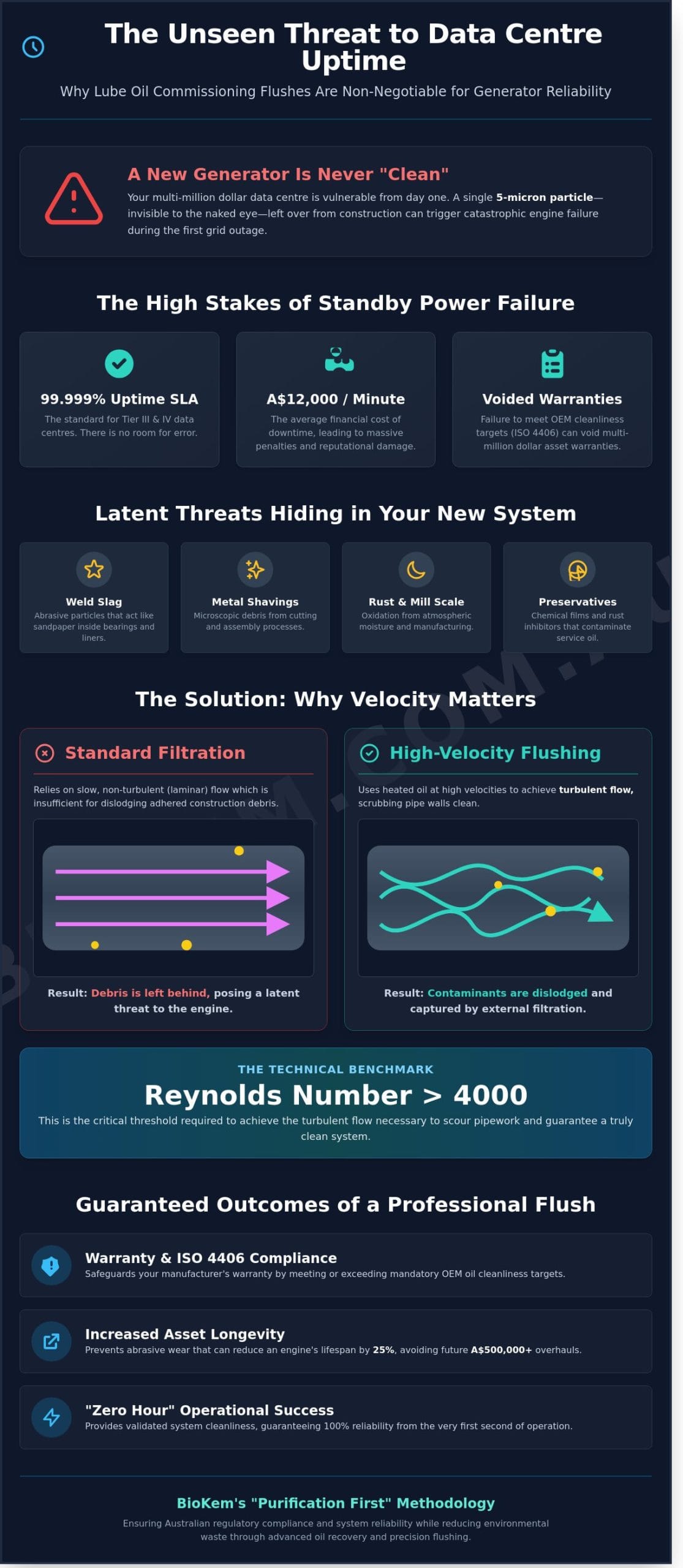
Hot Oil Flushing vs. Standard Filtration: Why Velocity Matters
Standard filtration focuses on cleaning the oil itself by passing it through a static filter media to remove suspended contaminants. While this maintains oil chemistry, it does nothing to address the debris clinging to the internal surfaces of the pipework. The importance of conducting lube oil commssioning flushes on data centre generators lies in the mechanical removal of “built-in” contaminants like welding slag, rust, and silica that settle during construction. Achieving this requires more than just a clean fluid; it requires high-velocity flow to physically dislodge stubborn particulates.
The effectiveness of a flush is determined by the Reynolds Number (Re), a dimensionless value used in fluid mechanics to predict flow patterns. To achieve a successful clean, engineers aim for a Reynolds Number greater than 4,000. At this level, the fluid transitions from a smooth, orderly state into a chaotic, high-energy state. This energy is what provides the mechanical force necessary to sweep the internal diameter of the piping clean. Biokem utilizes specialized equipment to ensure these targets are met, adhering to strict Australian industrial standards for system cleanliness.
For more detailed technical insights, refer to this Hot Oil Flushing: A Guide to Industrial System Cleaning.
Laminar vs. Turbulent Flow
Standard onboard pumps in data centre generators typically produce laminar flow. In this state, the oil moves in parallel layers with the highest velocity at the centre of the pipe and almost zero movement at the pipe wall. This allows heavy particles to remain undisturbed on the bottom of the conduit. Without sufficient velocity, the oil simply flows over the debris without picking it up.
Turbulent flow creates a “scrubbing” action. The chaotic movement of the fluid molecules strikes the pipe walls from multiple angles, lifting particles into the main stream. To reach these velocities, Biokem employs external high-flow pump skids during the commissioning phase. These units provide flow rates often 2 to 3 times higher than the generator’s operating pump, ensuring that every internal surface is subjected to the necessary kinetic energy to release trapped contaminants.
The Temperature Advantage
Temperature is a critical variable in the flushing equation. By heating the oil to a range of 60 to 70°C, two major physical advantages are gained. First, thermal expansion causes the metal pipework to expand slightly, which helps crack and release mill scale or brittle debris trapped in joints and crevices. Second, heat significantly reduces the oil’s viscosity. Thinner oil moves more easily at high speeds, making it much simpler to reach the required Reynolds Number for turbulent flow.
Maintaining these high temperatures also ensures that particles remain in suspension until they reach the high-efficiency filter elements in the flushing rig. Safety is paramount when handling oil at these temperatures within a sensitive data centre environment. Biokem technicians follow rigorous safety protocols, including the use of high-temperature rated hoses, secondary containment systems, and real-time pressure monitoring to prevent leaks. Understanding the importance of conducting lube oil commssioning flushes on data centre generators ensures that these thermal and mechanical forces are harnessed correctly to protect your A$500,000+ power assets from premature failure.
Best Practices for Executing a Data Centre Generator Lube Flush
Precision execution is the hallmark of a successful commissioning project. Before any fluid enters the system, we establish a technical baseline through a comprehensive system walkthrough and initial oil analysis. This phase identifies potential “dead legs” in the piping where debris typically settles during construction. Protecting the engine’s internal surfaces is the highest priority. We utilise custom bypass blocks to redirect the flushing fluid away from sensitive bearings and journals. This prevents the very particles we’re trying to extract from causing abrasive wear during the high-velocity cleaning process. Recognising the importance of conducting lube oil commssioning flushes on data centre generators ensures that critical engine components are protected from the moment of first start.
Step-by-Step Flushing Protocol
The protocol begins by isolating the generator’s internal lubrication circuit and connecting a high-flow external filtration skid. Efficiency relies on achieving a high Reynolds number to create turbulent flow. We cycle the oil through varying temperature and flow stages to maximize the kinetic energy of the fluid, ensuring that particles bonded to pipe walls are dislodged. Technicians install paddle flushing screens at strategic points to capture and inspect larger debris. This visual inspection provides tangible proof of the system’s internal state and helps us adjust the flow path in real-time. It’s a scientific approach that doesn’t leave cleanliness to chance.
Verification and ISO 4406 Targets
Verification must be result-based rather than time-based. Relying on a clock often leads to incomplete cleaning or wasted energy. We target specific ISO 4406 cleanliness codes, typically 16/14/11, which represent a significant reduction in particulate compared to standard “new” oil delivered in drums. Real-time particle counters monitor the fluid continuously to track the decay of contamination. For immediate onsite confirmation, Patch Test Kits allow for a physical record of the fluid’s purity. The importance of conducting lube oil commssioning flushes on data centre generators is finally validated when we issue the “Cleanliness Certificate.” This document is essential for the commissioning file, providing the necessary evidence for warranty compliance and insurance requirements in the Australian market.
Adhering to these rigorous standards ensures your backup power systems are ready for the extreme demands of a data centre environment. If you’re preparing for a new installation, book a professional hot oil flush for your facility to ensure long-term reliability.
BioKem’s Approach: Precision Flushing for Mission-Critical Infrastructure
BioKem provides specialized onsite technical expertise to ensure your facility remains operational from day one. We understand the high stakes of uptime in the digital economy. The importance of conducting lube oil commssioning flushes on data centre generators can’t be overstated when a single hour of downtime can cost Australian enterprises upwards of A$400,000 in lost revenue and service penalties. Our team deploys rapidly across Australia, bringing technical precision to every project to mitigate these risks before they manifest.
We operate with a “Purification First” philosophy. This strategy prioritizes oil recovery and decontamination over simple replacement. It’s a method that significantly reduces environmental waste and lowers the total cost of ownership by extending the life of the initial oil fill. By positioning BioKem as your national partner, you gain access to a consistent standard of excellence for data centre projects in every state, ensuring that local regulatory requirements and technical specifications are met without compromise.
Advanced Filtration Technology
Our technical advantage lies in the hardware we deploy. We utilize high-dirt-holding capacity elements from Filters S.p.A. to accelerate the flushing timeline. These specialized elements capture a higher volume of particulate matter in a single pass than standard industrial filters, which shortens the duration of the commissioning phase. Our custom-built flushing skids are engineered specifically for the tight footprints of modern Australian data centre plant rooms. These compact units allow our technicians to work efficiently without obstructing other trades. To ensure the long-term health of the system, we integrate varnish mitigation during the process. This prevents the buildup of soft contaminants that often lead to catastrophic valve sticking during emergency generator starts.
Environmental Responsibility and Compliance
BioKem’s biological and technical solutions align directly with corporate sustainability goals. By purifying oil onsite to meet or exceed ISO 4406 cleanliness codes, we reduce the carbon footprint associated with the transport, refining, and disposal of thousands of litres of lubricant. This approach supports your ESG reporting and demonstrates a commitment to circular economy principles. We ensure 100% compliance with Australian industrial and environmental standards, including the rigorous requirements of AS 1940:2017 for the storage and handling of flammable and combustible liquids. The importance of conducting lube oil commssioning flushes on data centre generators is anchored in this balance of technical reliability and ecological stewardship, providing a clean start for the life of your critical power assets.
Securing Data Centre Reliability Through Precision Engineering
Ensuring 99.999% uptime for Australian data centres begins well before the first power outage occurs. The importance of conducting lube oil commssioning flushes on data centre generators is clear when you consider that 75% of early-life bearing failures stem from particulate contamination introduced during the construction phase. Standard filtration often misses microscopic debris lodged in complex pipework. To eliminate these threats, technicians must achieve a Reynolds number exceeding 4,000 to ensure turbulent flow. This mechanical action dislodges welding slag and silica that static oil changes won’t reach.
BioKem provides the technical precision required to meet strict ISO 4406 cleanliness codes across all national sites. As the sole Australian distributor for Filters S.p.A., we offer national onsite technical deployment for mission-critical infrastructure. Don’t risk your Tier III or IV certification on unverified lubrication circuits. Consult with BioKem for your Data Centre Commissioning Project to guarantee your backup systems are ready for immediate load. Protecting your hardware today ensures a resilient digital future for Australia.
Frequently Asked Questions
How long does a typical lube oil commissioning flush take for a data centre generator?
A typical lube oil commissioning flush for a data centre generator takes between 24 and 72 hours per unit. This timeframe depends on the system’s piping complexity and the initial contamination levels detected during the first circulation. We maintain turbulent flow with Reynolds numbers exceeding 4,000 to ensure that all particulate matter is effectively dislodged from the internal surfaces.
Can I just use the engines built-in filters instead of an external flush?
You can’t rely on built-in engine filters because they’re designed for operational maintenance rather than the removal of heavy construction debris. Standard filters lack the capacity to capture weld slag, sand, and metal shavings often left behind during the installation phase. Understanding the importance of conducting lube oil commissioning flushes on data centre generators ensures these contaminants are removed before they reach sensitive bearings.
What ISO 4406 cleanliness level is required for new generator commissioning?
New generator commissioning requires a target cleanliness level of ISO 16/14/11 to meet manufacturer warranty specifications. This standard ensures that the oil contains fewer than 640 particles sized 4 microns or larger per millilitre. Achieving this level of purity is vital for Australian data centres where 99.999% reliability is the expected operational baseline.
Is it necessary to flush the system if the generator arrived pre-filled with oil?
It’s necessary to flush the system because vibration during transport from the factory can dislodge internal scale and casting sand into the oil. Even if the oil was clean at the point of manufacture, moisture ingress during shipping often occurs. A professional flush validates the entire lubrication circuit’s integrity and replaces the storage oil with high-performance lubricant suited for long-term standby service.
What is the difference between a chemical flush and a hot oil flush?
A chemical flush uses solvent-based surfactants to dissolve deposits, while a hot oil flush relies on high-velocity fluid and heat to mechanically strip contaminants away. We prefer hot oil flushing at temperatures between 60°C and 75°C because it’s more environmentally responsible and doesn’t leave aggressive residues. This physical cleaning method is safer for the seals and gaskets found in modern high-speed diesel engines.
How often should a generator lube system be flushed after the initial commissioning?
A generator lube system should only require flushing again after a major engine overhaul or if oil analysis detects a significant contamination event. For most standby units in Australia, this occurs every 12,000 to 15,000 operating hours. Regular fluid sampling every 6 months is the best way to monitor if the system needs an unscheduled intervention due to oxidation or coolant leaks.
Does hot oil flushing remove water and moisture from the system?
Hot oil flushing removes moisture effectively when the flushing rig includes an integrated vacuum dehydration unit. This process reduces dissolved water levels to below 100 parts per million, which prevents the microbial growth that often plagues stored diesel lubricants. Removing moisture is a critical step in the importance of conducting lube oil commissioning flushes on data centre generators to prevent internal corrosion during idle periods.
What happens if we find large metal particles in the flushing screens?
If you find metal particles larger than 250 microns in the flushing screens, you must halt the process and perform a borescope inspection. This discovery often indicates a manufacturing defect or a failure during the assembly of the oil galleries. Documenting these findings allows for warranty claims before the engine is started, potentially saving A$200,000 or more in catastrophic repair costs.